Wednesday, June 27, 2012

Sea Watch

Sunday June 24th
Tropical Storm Debbie

 Herring Gull in transition to Second-cycle molt in comparison to a Laughing Gull
Photo is courtesy of Bob Pelkey


Reports have been coming in
from the Atlantic side of Florida off pelagic species being observed on-shore due to prevailing winds. Well, even though we see far fewer pelagic species, the potential for finding pelagic species on-shore on the Gulf of Mexico side of Florida are increased due the presence of Tropical Storm Debbie sitting off-shore. We have experienced lots of rain, heavy winds, flooding and beach erosion due to T. S. Debbie and a few scattered reports of pelagic have been coming in. Primarily north of us. Reported were jaegers, a brown noddy and several sooty terns.

So on Sunday I headed out in the rain for Bunche Beach. Arriving about 9:30 the rains had subsided for now, but the winds and waves were still quite high. Not much beach was visible and only a few shore birds were present including a Willet, a Black-bellied Plover, a couple of Ruddy Turnstones, a pair of Least Terns, a very wet Red-shouldered Hawk and a Laughing Gull. Then waves of Magnificent Frigatebirds appeared from the north and very slowly floating on the winds along the shore, heading southerly. Had several soaring, almost hovering on the winds just three feet above my head. Alas my camera is broken so I missed on some great photo opportunities. I had counted thirty-three plus Frigatebirds and after an hour and a half I left to met up with Bob Pelkey on Sanible Island.

Before Going to Sanible I stopped at Bowditch Point Park on Ft Myers Beach, were I found a trio of Red Knots, Black Skimmers, Wilson's Plovers, Semipalmated Plover, Black-bellied Plover, Ruddy Turnstone, Willets, Pelicans, Least Terns, Laughing Gulls, Sandwich Terns, Royal Terns, Sanderlings and a Gray Kingbird laying low from the winds.

We made stops at Sanible Lighthouse and Bowman's Beach were all we could really see were heavy surfs and few birds. At Blind Pass the best birds were a Sandwich Tern, a trio of Chimney Swifts and a family of Red-bellied Woodpeckers. We dipped on any real pelagics. One interesting observation were some para-sailing adventurers at Blind Pass, who, I my mind, were risking serious harm in such powerful surf and winds, Several times we noticed the para-sailors totally lifted off the surf by five to ten feet, very close to a rock jetty.

On the Sanibel Causeway we encountered more Frigatebirds, more laughing Gulls and an out-of-place Herring Gull.


Tuesday June 26th

Sea Watch Part 2


I had not planned on doing any birding today, but late on this Tuesday afternoon I had dropped my daughter off in Bonita Springs, but did bird nearby Ft Myers Beach. Radio news reports had described severe damage on Ft Myers Beach due to T. S. Debbie including Little Estero Island were the Least Tern colony was nesting. So as an after thought I did drive over and found that much of the nesting colony site at the south end of the beach was flooded. No doubt the storm conditions would have been detrimental to any eggs or young of the least terns, snowy plovers or wilson's plovers still nesting here. Did see many more Magnificent Frigatebirds including a female who was harassing the gulls and terns laying-low on the sands. Other birds seen included Least Terns, Royal Terns, Laughing Gulls, Black Skimmers, an American Oystercatcher, Wilson's Plovers and Ruddy Turnstones.


Next I rechecked Bowditch Point Park at the other end of the Ft Myers Beach. Even with the winds still blowing hard there was a seaside wedding taking place on the beach. Other sightings here were a lone Snowy Plover, several Wilson's Plovers, several Laughing Gulls, Black Skimmers, Royal Terns, Least Terns, Sandwich Terns, a lone Common Tern, a lone Forster's Tern, and a very out-of-place Ring-billed Gull.


On these two days I didn't find any pelagic species, but did have some good birds just the same.


Friday, June 22, 2012

Birding in June

Birding in June in Southwest Florida
Wilson's Plovers Chicks

The summer months are not the best time to bird in southwest Florida. The migrants have passed on through, the winter visitors are gone  and several shore bird species disappear, as they return to the Far North for breeding. So with the reduced number of species and the heat of summer, birding can be a bit frustrating for next couple of months.


Snowy Plover
But interesting birds are still around.  Last week I headed over to Little Estero Lagoon on Ft Myers Beach to visit the Least Tern nesting area. We have hundreds of nesting least terns on hand and I also located almost a dozen Snowy Plovers with several chicks and far more nesting Wilson's Plovers.  One surprise was a dozen resting Red Knots, plus Royal and Sandwich Terns, and a soaring Magnificent Frigatebird. Also had a few non-migrating Black-bellied Plovers, Sanderlings and Semipalmated Plovers.  The wires along Estero Boulevard also hosted four Gray Kingbirds.

Least Tern
On recent visits to Bunche Beach in June I had a late and LIFER White-rumped Sandpiper, a Whimbrel, Royal Terns, Sandwich Terns, Least Terns, a pair of Gull-billed Terns, American Oystercatchers, some late Dunlins, Semipalmated Sandpipers, and several Short-billed Dowitchers. Plus Ospreys, Bald Eagle, Willets, a Lesser Yellowlegs, Roseate Spoonbills, Brown Pelicans, both Night-herons, Reddish Egrets, Black Skimmers, Purple Martins, Mottled Ducks, White-eyed Vireos, and Prairie Warblers. Out on  Cayo Costa Island,  Charlie Ewell also had the Gull-billed Terns and a Black Tern.

Snowy Plover Chick
A visit to Babcock-Webb in Charlotte County, I easily located nesting Red-cockaded Woodpeckers, a couple of, still singing, Bachman's Sparrows and several Brown-headed Nuthatchs.  Plus Anhingas, Common Nighthawks, Eastern Meadowlarks, Loggerhead Shrikes, Northern Mockingbirds, Eastern Bluebirds, Eastern Towhees and Pine Warblers. Also a bobcat.
White-tailed deer at OK Slough

At Hicky's Creek Park I added Red-headed Woodpecker and Chimney Swifts. In Cape Coral we had Florida Scrub Jays, Burrowing Owls, Monk Parakeets and Eurasian Collarded-doves. At Okaloacoochee Slough  we added Northern Bobwhite, Wild Turkey, Swallow-tailed Kites, Red-bellied Woodpeckers, Red-shoulder Hawk, Great Crested Flycatcher, American Crow and more nighthawks. Barred Owls are regular visitors at my work place and White-winged Doves and Brown Thrashers are seen around my home. Snail Kites and Limpkins are still easily found at Harn's Marsh.
Snail Kite with Sandhill Crane family in the background
Gray Kingbird on Ft Myers Beach
 

Sunday, May 27, 2012

Not Bad for Plan B

May 26 and 27th

Saturday - Cancelled Pelagic Trip

Cuban Golden Yellow Warbler by Bob Pelkey at Card Sound Toll.
The pelagic trip sponsored by Michael Brothers and the Marine Science Center in Ponce Inlet was a long awaited activity for this holiday weekend. I was looking forward to seeing several new birds. Such as black-capped petrol and arctic tern. But Tropical Storm Beryl changed our plans. As Bob Pelkey, Lee County's Master Birder - Vince McGrath,  Dr Jose Padilla Lopez and I were traveling across the state to attend the trip we received the, actually expected, news that the trip had to be cancelled. So what do we do know. We formulated Plan B.  Lets head to the Keys.

So we changed course and headed south. At a quick stop along Rt 70 in Okeechobee County we picked up Black-bellied Whistling Duck, Limpkin, Barn Swallow, Osprey, White-eyed Vireo, American Crow and American Coot.  Other sightings included Crested Caracara, Red-shouldered Hawk, Sandhill Cranes, Swallow-tailed Kites, Cattle Egrets, Eastern Meadowlark and White-winged Doves.

 After many miles we tryed the 800 Building on Old Griffin Road for the smooth-billed ani. There have been a few reports of sighting here recently, but these guys seem to be becoming much harder to find. After dipping on the ani we checked out the Cave Swallow colony in Cutler Ridge. Found a couple of dozen cave swallows zipping around the bridge they called home.
Bob Pelkey and Jose Padilla-Lopez

Vince McGrath directing the show

After Lunch in Florida City, were we picked up Common Myna, we headed to the Keys by way of Card Sound Road.  At the toll booth we parked to search for the Cuban Golden Yellow Warbler, an East Indian subspecies of yellow Warbler, only found in the the U.S. in the mangroves of the Florida Keys. After spending time in the locating and photography of a pair of Black-whiskered Vireos, we did succeed with Cuban Golden Yellow Warbler. We also saw our first of the day Magnificent Frigetbird, our first of the day White-crowned Pigeon and singing Prairie Warblers.

On Key Largo the sightings of Gray Kingbirds, White-crowned Pigeons, Eurasian Collered Doves and Mourning Dove were numerous.  We stopped at Dangy State Park, were we easily found more Black-whiskered Vireos, White-eyed Vireos and a pair of Mangrove Cuckoos.

By six o'clock we had made it to the government building in Marathon we encountered dozens of White-crowned Pigeons. The target of the nesting Roseate Terns were harder to locate. After some time a pair was seen, including one who was very active in harassing one of the many Least Terns that were also nesting on the roof top.

The last target of the day were the Antillean Nighthawks, that are found at the Marathon Airport.  We found a pair cavorting with each other at the western end of the run way. Also on hand was a lone Killdeer and several Cattle Egrets. Because we had made a last minute decision to come to the Keys on a holiday weekend, there wasn't a room to be had. So we retreated to Homestead for accommodations to prepare for day two.

Sunday, May 27th - Miami Area

White-wing Parrot hanging around at U of M

Our first stop of the day was the quite and beautiful campus of the University of Miami. Many exotics are to be found here and we did have some sucess. We began with a pair of White-winged Parrots and was able to add a noisy pair of Common Hill Mynas, followed by a pair of Spot-breasted Orioles and a Chestnut-fronted Macaw. Awesome. I have dipped on all of these species in the past.

Another White-winged Parrot

A Chestnut-fronted Macaw at the U of M campus
Other species seen here included Chimney Swifts, Green Heron, Downy Woodpecker, Fish Crows, Blue Jays and House Sparrows.

Looks like someone left the door open - Cockatiel

Muscovy Ducks
Muscovy Ducklings
Egyptian Goose

At the Kendell Baptist Hospital campus we added the ever present Mitre Parrots and a suprise Cockatiel. At the pond we found Muscovy Ducks, a family of Egyptian Geese, a Swan Goose, White Ibis and Boat-tailed Grackles. It was sad to see a Fish Crow fly-in with the body of a duckling which it began to consume.

Following a great lunch at a Cuban resturant, we headed for home. Did stop along Turner River Road in Big Cypress National Preserve with the idea of maybe sighting white-tailed kite. No today but we did add a Least Bittern, Great Blue Heron, Red-shouldered Hawk, a Pileated Woodpecker, Northern Bobwhite, an Eastern Bluebird, Great Crested Flycatcher, an Anhinga, Eastern Towhee, Common Nighthawk and Red-winged Blackbirds.

To quote Vince "Not bad for plan B"

Links -
Bob Pelkey's Blog Report
Trip List (75)-

Black-bellied Whistling-Duck, Swan Goose (Domestic type), Egyptian Goose, Muscovy Duck (Domestic type), Wood Duck, Northern Bobwhite, Wood Stork, Magnificent Frigatebird, Double-crested Cormorant, Anhinga, Brown Pelican, Least Bittern, Great Blue Heron, Great Egret, Snowy Egret, Little Blue Heron,  Tricolored Heron, Cattle Egret, Green Heron, White Ibis, Glossy Ibis, Black Vulture, Turkey Vulture, Osprey, Swallow-tailed Kite,   Red-shouldered Hawk, Crested Caracara, American Coot, Limpkin, Sandhill Crane, Killdeer, Willet, Laughing Gull, Least Tern, Roseate Tern, Rock Pigeon, White-crowned Pigeon, Eurasian Collared-Dove, White-winged Dove, Mourning Dove, Cockatiel, Mitred Parakeet, Chestnut-fronted Macaw, White-winged Parakeet,  Mangrove Cuckoo, Common Nighthawk, Antillean Nighthawk, Chimney Swift, Red-bellied Woodpecker, Downy Woodpecker, Pileated Woodpecker, Great Crested Flycatcher, Gray Kingbird,  White-eyed Vireo, Black-whiskered Vireo, Blue Jay, American Crow, Fish Crow, Loggerhead Shrike, Purple Martin, Barn Swallow, Cave Swallow, Eastern Bluebird, Northern Mockingbird, Common Hill Myna, Common Myna, European Starling, Cuban Golden Yellow Warbler, Prairie Warbler, Red-winged Blackbird, Eastern Meadowlark, Common Grackle, Boat-tailed Grackle, Spot-breasted Oriole, House Sparrow

Thursday, May 24, 2012

Mangrove Cuckoo at Ding Darling

Thursday, May 24th


Mangrove Cuckoo seen about May 22nd by Dr Jose Padilla-Lopez at Ding Darling

Went back to Ding Darling with Vince McGrath (Lee County Master Birder) to take another stab at finding the elusive mangrove cuckoo. Even with the help of John and Rachael, of the Ecostudies Institute, we could not  come up with one today.  Rachael is heading a research project at Ding Darling on the Mangrove Cuckoo living there. She has banded three or four including attaching radios for relocation of these birds. Other birds seen and heard included Black-whiskered Vireo, White-eyed Vireo, Prairie Warbler, Magnificent Frigetbird, Great Creasted Flycatchers, Red-bellied Woodpeckers, Roseate Spoonbills and Yellow-crowned Nightherons

Links:
http://www.ecoinst.org/index.html (Ecosudies Institute website)
http://www.ecoinst.org/ecostudies_pages/publications.html (Published Report on Declining Mangrove Land Species)

Wednesday, May 23, 2012

American Oystercatchers - Sanibel Island

Wednesday, May 23rd

American Oystercatcher at Sanibel Causeway

 Headed over to Ding Darling Wildlife Refuge on Sanibel Island in hopes of locating a mangrove cuckoo. The high tides really reduced the shore birds and waders. Did find a single Willet, a pair of Mottles Ducks, fifteen Roseate Spoonbills and a few waders. Did luck out with locating a calling Black-whiskered Vireo and a White-eyed Vireo at the crossover dike. A couple of years age I had success at this spot with spotting a couple of mangrove cuckoos. But today I did not hear or see any here or at other likely spots.

Roseate Spoonbills at Ding Darling

Great Blue Heron

View of Estero Bay
 On the way back home I stopped on the Sanibel Causeway beaches and got some good photos of a pair of American Oystercatchers posing on the rocks. Other birds seen included Ruddy Turnstones, Willets, Laughing Gulls, a lone Least Tern, a few Brown Pelicans

Yellow Rat Snake sunning itself on Wildlife Drive

Wednesday, May 9, 2012

Eastern Screech Owl at Six-Mile Cypress Preserve

Tuesday,  May 8th

My daughter, Katie and I headed over to Six-mile Cypress Preserve to see if any late migrants were about. We first stopped at the pond at Metro Parkway to see if any white pelicans were on-hand. Just the day before Bob Pelkey along with several fellow photographers rescued a hurt pelican here. It was taken to C.R.O.W. on Sanibel for treatment of its broken wing. We didn't see any pelicans today, but did find a couple of Black-necked Stilts, Least Sandpipers, Killdeers among the usual waders.
Eastern Screech Owl

At Six-mile it was very quite. We were rewarded with sighting the resident Eastern Screech Owl sticking its head out of the nest box in the parking lot. The other good sightings was refinding the Great White Heron at Gator Pond, that I had reported on in a earlier posting. A feww other birds seen included Tufted Titmice, Northern Cardinals and Roseate Spoonbills.

Birds at Bunche Beach

Sunday May 6th


Made a quick stop at Bunche Beach this morning and arrived at a high tide.  Not too birdy, but some that were there were in fine breeding plumage.
Sanderling

Reddish Egret

Reddish Egret

Willet

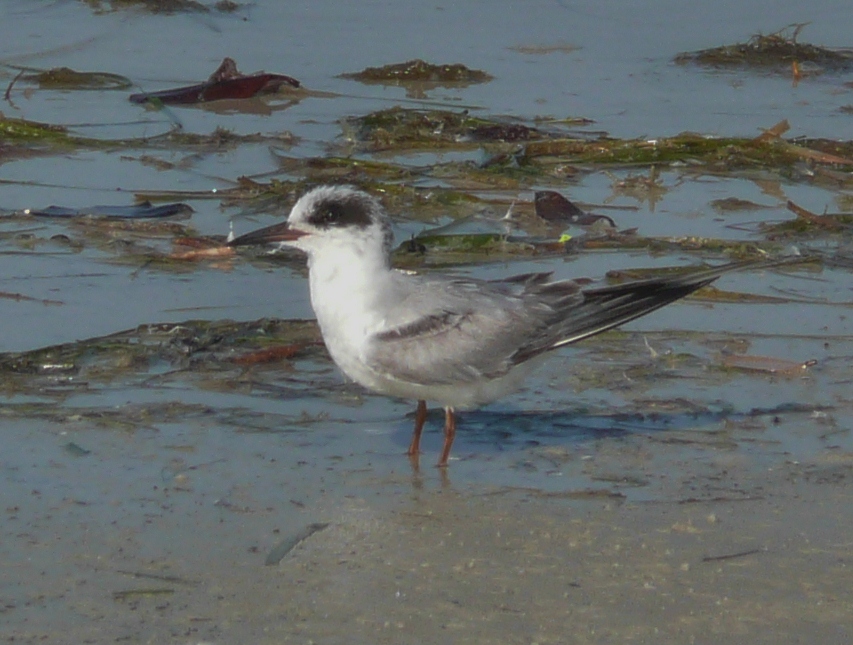
A young Common Tern.  My first of the year

Short-billed Dowitcher

The Common Tern, a Forster's Tern and a Semipalmated Plover