Monday, August 3, 2015

Migration

Monday, August 3rd

A FOS Yellow-throated Warbler
seen at Bunche Beach Preserve


Neotropical bird migration is slowly rolling into Southwest Florida. 

Today I feel lucky with seeing my first-of-season Hooded Warbler at Six-mile Cypress Slough Preserve. Master Birder Vince McGrath spotted the hoody for our group.

Last week I had seen my FOS Black-and-White Warblers at Six-mile and other birders have seen prothonotary warblers, American red-starts and red-eyed vireos as well. All of these early migrants do nest in northern Florida and easily arrive here first.

A couple of Short-tailed Hawks have also returned to the Six-Mile Slough Preserve from central Florida.


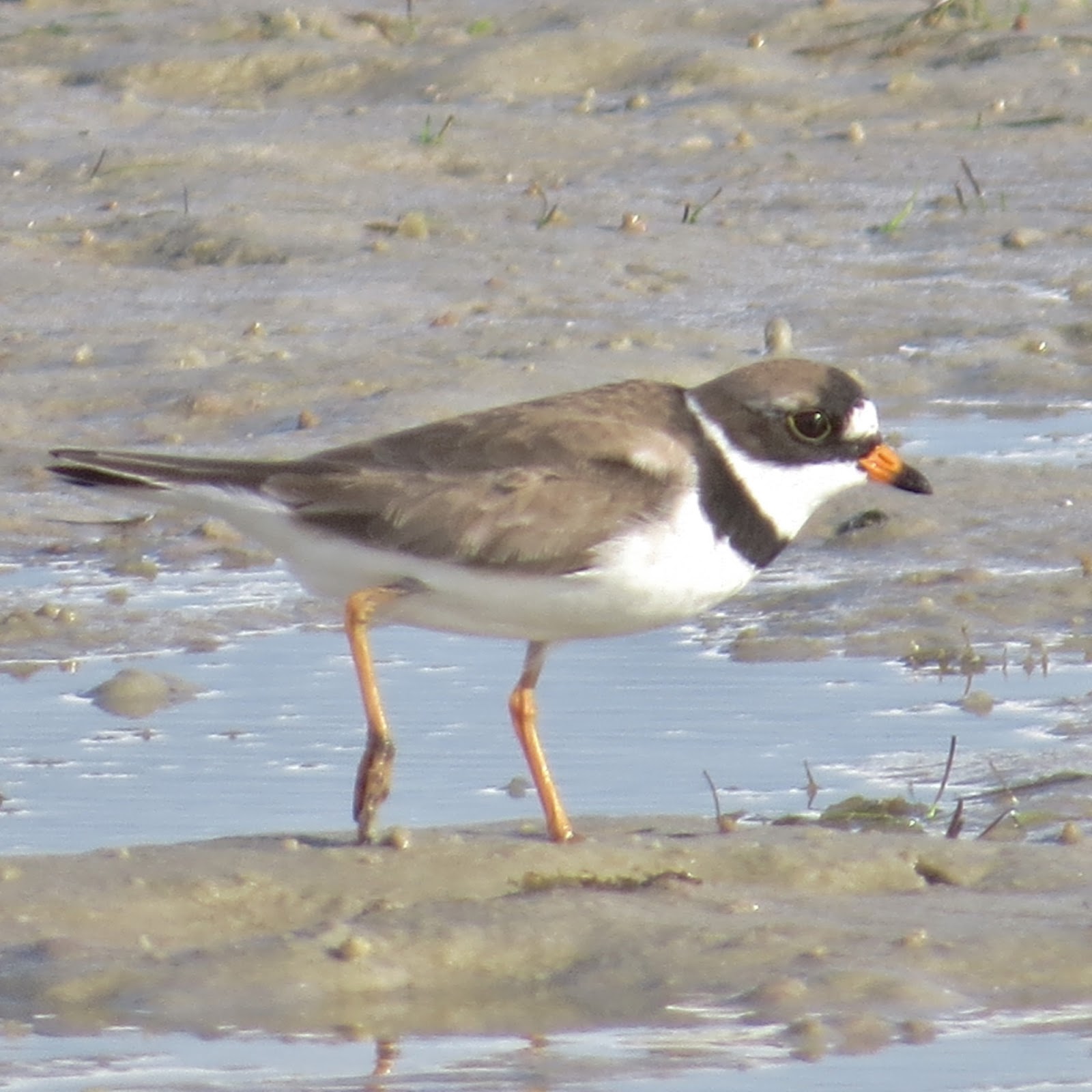
Shorebirds have already been migrating for a few weeks now and I elected visit to Bunche Beach Preserve yesterday. I arrived on a low tide and found hundreds of shorebirds working the mud-flats and shallows for a meal. There were hundreds of Short-billed Dowitchers present fresh from the Arctic. Marbled Godwits, Sanderlings, Least Sandpipers, Semipalmated Plovers and a FOS sighting of a Piping Plover had also arrived. A couple of Barn Swallows flew in. Prairie Warbler and a FOS Yellow-throated Warbler were also seen here. Other birds seen included a flock of twenty Rosette Spoonbills, lots of waders, a couple of Spotted Sandpipers, a Least Yellowlegs, Willets, Ruddy Turnstones, Black Skimmers, Least Terns, Bald Eagle and Osprey.
Semipalmated Plover sporting his breeding colors


Earlier in the day I had my FOS Belted Kingfisher sitting on the a power line. Soon we'll be hosting many more species

FOS Piping Plover

Reddish Egret. A White-morphed Reddish Egret was also seen at Bunche 

White Ibis

Osprey breed at Bunche Beach

Least Sandpiper at rest

Wilson's Plover are a year-round residents

Hundreds of Short-billed Dowitchers have arrived

Wilson's Plover

A few Red Knots were present

This Fiddler Crab thought it was well hidden

Tuesday, July 21, 2015

Loxahatchee National Wildlife Refuge

Tuesday, July 21st


Today Bob Pelkey and I traveled from Ft Myers across the state to Palm Beach County to visit Loxahatchee NWR. We were twitching today to find a lifer.

 I had dipped on finding a Smooth-billed Ani several times, but we knew about the highly reported pair of these birds being seen by many birders on the Marsh Trail at Loxahatchee.

And today they were cooperative.

We arrived just before nine a.m. and did not have to wait very long. There unique call easily identified their approach and were kind enough to pose for a few pictures. Lifers!!

In our time here we also added a King Rail, Common Gallinules, Limpkin, Snail Kite, Black-necked Stilts and a few waders.
Smooth-billed Ani on the Marsh Trail


Before leaving the refuge we checked out some muddy cells at the entrance where we saw a lot more Black-necked Stilts, Least Sandpipers, a couple Solitary Sandpipers, more Greater and Lesser Yellowlegs and many more waders.
Black-necked Stilt

Earlier we had a slight delay when we spotted a flooded field on Sam Senter Road. We had many Black-necked Stilts, Greater and Lesser Yellowlegs, a couple of Least Sandpipers, Rosette Spoonbills, a Least Tern, some Mottled Ducks and all of the expected waders.

As we were heading back toward home, we stopped to investigate some rice fields. Lots of Black-bellied Whistling Ducks, a trio of Fulvous Whistling-Ducks, more Yellowlegs, Black-neck Stilts and waders were seen. 


Limpkin on the Marsh Trail
Great Blue Heron on the Marsh Trail
 In a few weeks we'll return to the Everglades Ag Fields to spot the many anticipated migrating terns, gulls, shorebirds and grass peeps that should be arriving.. Maybe I can find some buff-breasted sandpipers, which is another bird i've dipped on in the past.

Black-bellied Whistling-Ducks in the rice fields

Fulvious Whistling-duck laying low in the rice
Tricolored Heron

Little Blue Heron on the Marsh Trail
Swamp Lily seen along the Marsh Trail

Thursday, July 16, 2015

Flamingo and a Great White Heron

Thursday, July 16th


It is getting harder to find lifers in my 'backyard', but today I was finally able to spot a Lifer in a  rare to our-corner-of-Florida, American Flamingo. The bird has been reported for a the past few days, with Keith Laakkonen confirming the flamingo in the Estero Bay Aquatic Preserve.

American Flamingo seen at Estero Bay Aquatic Preserve
Photo courtesy of Keith Laakkonen

This site can be reached by kayak or by use of a spotting scope from New Pass at Lover's Key State Park, which is south of Ft Myers Beach.

My best pic

Even though the flamingo is an iconic symbol for the State of Florida they are infrequent visitors here, and escapees are always a possible status of some of these sightings.

Great White Egret seen at New Pass
My first interesting bird seen when I arrived on site this morning was a Great White Heron. A white morph of the Great Blue Heron. These Great White Herons are normally seen further south toward the Everglades and the Florida Keys.


White Ibis at New Pass

Tuesday, June 30, 2015

June Challenge

Tuesday, June 30th

June is the absolute slowest time of the year for birding in South Florida. A couple of years ago The June Challenge was created to stimulate interest in getting out to bird during the doldrums, by for offering a friendly contest to see which county could amass the most sightings. I'm not officially participating, but I'm still trying to find at least a hundred species within Lee County.


1 Black-bellied Whistling-Duck


2 Fulvous Whistling-Duck


3 Muscovy Duck


4 Wood Duck


5 Eurasian Wigeon


6 Mottled Duck


Mallard x Mottled Duck cross. 


7 Northern Bobwhite


8 Double-crested Cormorant


9 Anhinga


10 American White Pelican


11 Brown Pelican


12 Least Bittern


13 Great Blue Heron


14 Great Egret


15 Snowy Egret


16 Little Blue Heron


17 Tricolored Heron


18 Reddish Egret


19 Cattle Egret


20 Green Heron


21 Black-crowned Night-Heron


22 Yellow-crowned Night-Heron


23 White Ibis


24 Glossy Ibis


25 Roseate Spoonbill


26 Black Vulture


27 Turkey Vulture


28 Osprey


29 Swallow-tailed Kite


30 Snail Kite


31 Bald Eagle


32 Red-shouldered Hawk


33 Red-tailed Hawk


34 Common Gallinule


35 American Coot


36 Limpkin


37 Sandhill Crane


38 Black-necked Stilt


39 American Oystercatcher


40 Black-bellied Plover


41 Wilson's Plover


42 Semipalmated Plover


43 Killdeer


44 Willet


45 Marbled Godwit


46 Ruddy Turnstone


47 Sanderling


48 Semipalmated Sandpiper


49 Short-billed Dowitcher


50 Laughing Gull


51 Ring-billed Gull


52 Least Tern


53 Royal Tern


54 Sandwich Tern


55 Black Skimmer


56 Rock Pigeon


57 Eurasian Collared-Dove


58 Common Ground-Dove


59 White-winged Dove


60 Mourning Dove


61 Burrowing Owl
A Juvenile Burrowing Owl


62 Barred Owl


63 Common Nighthawk


64 Chimney Swift


65 Red-headed Woodpecker


66 Red-bellied Woodpecker


67 Downy Woodpecker


68 Northern Flicker


69 Pileated Woodpecker


70 Monk Parakeet


71 Nanday Parakeet


72 Great Crested Flycatcher


73 Gray Kingbird


74 Loggerhead Shrike


75 White-eyed Vireo


76 Blue Jay


77 Florida Scrub-Jay


78 Fish Crow


79 Northern Rough-winged Swallow


80 Tufted Titmouse


81 Carolina Wren


82 Blue-gray Gnatcatcher


83 Eastern Bluebird


84 Brown Thrasher


85 Northern Mockingbird


86 European Starling


87 Northern Parula


88 Pine Warbler


89 Prairie Warbler


90 Northern Cardinal


91 Red-winged Blackbird


92 Eastern Meadowlark


93 Common Grackle


94 Boat-tailed Grackle


95 House Sparrow


96 Cooper's Hawk

97 Purple Gallinule


Well I didn't find one hundred species. Came close though. Some species missed that I expected to find included Crested Caracara, Wild Turkey, Wood Stork and Eastern Towhee.