Showing posts with label Marsh Wren. Show all posts

Sunday, November 22, 2015

A Visit to the Celery Fields and Big Cypress

Tuesday, November 17

Today, with Bob Pelkey behind the wheel, we had planned a stop at the Celery Fields in Sarasota. Then the reports came out about the Mountain Bluebird being seen at the Oasis Visitor Center at Big Cypress Preserve. So a stop was planned for there as well.

Mountain Bluebird

We arrived in early afternoon and easily spotted the Mountain Bluebird. It was sitting on its spot on a fence near the parking lot. Very unusual to have this western bird in the Everglades. The bird is reported to be a juvenile female and is a lifer for me. Hasn't been reported here since about the 20th.


Some other species seen at the visitor center.

American Alligator

Tricolored Heron

Great Blue Heron

Snowy Egret

Great Egret

American Crow

The Celery Fields - Sarasota


Bob and I arrived at dawn and spent the morning mostly around the south cell. Soras could be heard calling and Marsh Wrens heard babbling. Least Bittern was hiding in the flag weed and Purple Gallinule were active as well. Rosette Spoonbills, Glossy Ibis and Wood Storks were flying over head. Limpkins were calling and Black-bellied Whistling Ducks were just hanging around. Calling Nanday Parakeets and a flock of Brown-headed Cowbirds too.
Loggerhead Shrike


Savannah Sparrow

Swamp Sparrow

Limpkin

Marsh Wren

From here traveled about a mile up Palmer Road to Palmer Lake were we added Northern Shovelers, Lesser Yellowlegs, Glossy Ibis, Laughing Gulls, Forster's Terns Long-billed Dowitchers and a Crested Caracara

Tuesday, December 21, 2010

Marsh Wren

-A Visit to Babcock-Webb Wildlife Mangaement Area
Tuesday December 21st


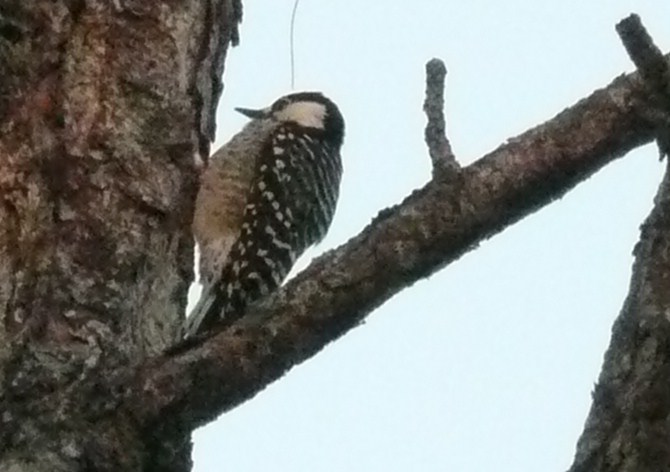
Red-cockaded Woodpecker
 I try to visit Babcock-Webb on a monthly basis and during hunting season check the calendar to avoid visiting on a scheduled hunting day.  Right now it is small game season, but not on Tuesdays. So Tuesday morning I am on site at Babcock to witness several of the endangered, Red-Cockaded Woodpeckers exiting their nest holes just after sunrise. The temperatures at dawn are at 45degrees, the sky is clear and the moon in full. Seems that I slept through today's lunar eclipse on this Winter Solstice day.  I am standing in the middle of Oilwell Grade road, within the red-cockaded colony sight, which has marked nest trees on both sides of the lane. There are a number of these marked colony sights at babcock, but this is the closest to the main entrance. On schedule the birds emerge and start there day.  There are three and each starts there squeaky calling as the peek their heads out of the nest hole. Getting a weather report and exchanging remarks with their neighbors.  Then whoosh, they are out, checking nearby trees for a quick meal and will forage for a while, then off they go.
Eastern Meadowlark singing atop a pine tree
Moving on from the woodpecker colony I was able the sight an American Kestrel sitting in the same tree that it was noticed in last month. Could hear Sandhill Cranes several time and Eastern Towhees as well.  Odd that I never did spot any today.  Heard several House Wrens and was able to see a couple of them. Found a few mixed feeding flocks of Yellow-rumped Warblers, Palm Warblers, Pine Warblers, Red-bellied Woodpeckers, Downy Woodpeckers, Eastern Bluebirds and three Brown-headed Nuthatches. Spooked a Great Horned Owl near Crooked Lake and saw about four Northern Harriers. Other raptors experienced here was hearing the call of a Red-shouldered Hawk an a kettle of five immature Bald Eagles soaring near Webb Lake.
Eastern Meadowlark were seen and heard through-out the property. Sparrows were seen mostly in wet fields, as were Common Yellowthroats. Primarily Savannah Sparrows and found a single Swamp Sparrow  in the brush along the Seaboard Grade road. In that brushy spot, had a couple of the common yellowthroats and a surprise of a Marsh Wren. Marsh and sedge wrens are nemesis birds for me. This was only second sighting of a marsh wren, the first in Florida and I have yet to identify a sedge wren.
Northern Mockingbird
Was also pleased to find a Grasshopper Sparrow along Tram Grade road.  I initially tried to identify it as a bachman's sparrow, but that white strip atop the crown on this bird marked it as a grasshopper sparrow.  Besides missing on the bachman's sparrow today were red-tailed hawk and northern bobwhite.
Grasshopper Sparrow

Grasshopper Sparrow
The refuge camping area was overflowing with tents, campers and swamp buggies. Lots of sportsman on sight for the various hunting activities here. The white-board at the check-in sight listed the game that had been taken so far this season. I recall seeing that seventy-six deer had been harvested along with four hundred plus hogs, over sixteen-hundred snipe and about six hundred quail. Also listed were small numbers of other animals harvested including raccoons, squirrels and coyotes etc.
Palm Warbler


Eastern Phoebe
My List -(55)
Pied-billed Grebe, Double-crested Cormorant, Anhinga, Great Blue Heron, Great Egret, Snowy Egre, Little Blue Heron,Tricolored Heron, Cattle Egret, Green Heron, White Ibis, Black Vulture, Turkey Vulture,Bald Eagle, Northern Harrier, Red-shouldered Hawk, American Kestre, Common Moorhen, Sandhill Crane, Killdeer, Wilson's Snipe, Rock Pigeon, Mourning Dove, Common Ground-Dove, Great Horned Owl, Belted Kingfisher, Red-bellied Woodpecker, Downy Woodpecker, Red-cockaded Woodpecker, Northern Flicker, Pileated Woodpecker, Eastern Phoebe, Loggerhead Shrike, Blue Jay, Tree Swallow, Brown-headed Nuthatch, House Wren, Marsh Wre, Blue-gray Gnatcatcher, Eastern Bluebird, Gray Catbird, Northern Mockingbird, Yellow-rumped Warbler, Pine Warbler, Palm Warbler, Common Yellowthroat, Eastern Towhee, Savannah Sparrow, Grasshopper Sparrow, Swamp Sparrow, Northern Cardinal, Red-winged Blackbird, Eastern Meadowlark, Common Grackle, Boat-tailed Grackle

Thursday, October 14, 2010

Trumpeter Swans - Turnbull NWR

Trumpeter Swans - Turnbull NWR
Cheney, Washington
Friday, October 8th

Left Florida for a vacation in America's Great Northwest, flying into Spokane, Washington late last Thursday.  Spokane was chosen because it was closest airport to the actual reason for flying some 3000 miles. It was to participate in my daughter Melissa' s wedding in nearby Moscow, Idaho on Saturday. Melissa and her fiancee Robbie elected to come back to Moscow for there wedding as they loved the area.  Robbie was a former student at the University of Idaho in Moscow, were the ceremony was held. But this trip offered me a great birding opportunity. One were I could find any number of lifers that would never be seen in Florida. So I planned birding trips in the area for Friday, Sunday and Monday. Eastern Washington and the Idaho panhandle offered several habitats for birding.  Most of the area is rolling hills covered in wheat fields. The area is known as the Palouse. My targeted birding locations included Turnbull NWR in Cheney, Wa; Mann Lake in Lewiston, Id; and Mt Spokane State park in Washington.
  At this point I would like to acknowledge the help and support of four great local birders. They were extremely helpful in where to look and what was realistic in seeking local specialities. The second weekend of October is not the best time as so many seasonal species have already left for warmer climates.
Robert Mortensen, of Idaho, whom I got to know through his blog BIRDING IS FUN.
Terry Gray, President of the Palouse Audubon Society of Moscow, Idaho
Charles Swift, also of Moscow, Idaho and the University of Idaho and
Jon Isacoff of the Spokane Audubon Society and a professor at Gonzaga University

Pines Lake
As we flew in late Thursday night to stay in Spokane, my first birds of Washington waited till dawn Friday. Of course they were your usual urban birds - House Sparrow, European Starling and American Crows.  But I soon hit my first lifer of the day with a pair of Black-Billed Magpies flying over the parking lot. After picking up my rental car and heading south to Turnbull National Wildlife Refuge found a couple of the very common Red-Tailed Hawks, more magpies and a Great Blue Heron.

A portion of the Headquarters Trail - Cheever Lake lies below the trail and meadows rises above
 Turnbull National Wildlife Refuge
Arrived at Turnbull Refuge about 9:45am. The refuge is a unique geological sight called a Channeled Scablands. The brochure describes the varying habitats to include wetlands, rock, ponderosa pine and aspen forests, grasslands and steppe. The weather for the day was chilly and overcast with a potential for some rain.

All seven of 'Solo's'  Trumpeter Swan family
 The refuge is home to a noted male Trumpter Swan named Solo who was head of a family of seven swans living here at Turnbull. I got the privilege getting a scoped viewing of the entire family from a refuge volunteer at the Pines Loop Trail head. Was fortunate to get a couple more viewings. One were the whole flock noisily flew overhead in a v-formation and later as they rested on a lake.
Found these American Red Squirrels to be very noisy
Hiked portions of the Pines Loop and Headquarters Trails. The wetlands offered a single Canada Goose, many Mallards and Coots.  A few American Wigeons, a lone male Wood Duck and a couple of Ruddy Ducks. Saw about three each of Double-crested Cormorants and Pied-billed Grebes. A great many Red-winged Blackbirds worked the cattails and several Marsh Wrens could be heard and was finally lucky to observe a couple of wrens as my second LIFER of the day.  Chipping Sparrows were busy in nearby grasses. Other birds found along the trails included  LIFERS of several Western Bluebirds and Red-breasted Nuthatchs, plus  Black-capped Chickadees, Ruby-crowned Kinglets,  Yellow-rumped Warblers, American Goldfinch, White-crowned Sparrows,  and Northern flickers.  Higher up in more grassy or steppe terrain I was able to find a pair of American Kestral and LIFERS in a Western Meadowlark and a Northern Shrike. Was able to added a LIFER of a Common Raven that flew overhead as I was returning to my car at the conclusion of the walk.

Wrapped up my visit here with the 5.5 mile auto tour trail. Was able to add Northern Pintail, Lesser Scaup, Ring-Necked Duck and a lone Great Blue Heron.  Found a pair Greater Yellowlegs working a muddy shoreline and a Hairy Woodpecker in the company of a flock of LIFER Pygmy Nuthatches.  Spent about three and half hours here and I could see that a springtime or September would yield a far greater variety of birdlife. I did miss on a few species on my list, but it was a good day especially the impressive swans.


Greater Yellowlegs

 While passing through Cheney on the way back to Spokane, noted a flock of Wild Turkeys in a backyard. Understand that wild turkeys are becoming very numerous in the area.
Wild Turkey outside of Cheney, Washington

The rest of the flock

My Day List - (37, 8 lifers ) Canada Goose, Trumpeter Swan, Wood Duck, American Wigeon, Mallard, Northern Pintail, Ring-necked Duck, Lesser Scaup, Pied-billed Grebe, Double-crested Cormorant, Great Blue Heron, Wild Turkey, Red-tailed Hawk, American Kestrel, American Coot, Greater Yellowlegs, Hairy Woodpecker, Northern Flicker, Rock Pigeon, Northern Shrike, Black-billed Magpie, American Crow, Common Raven, European Starling, Black-capped Chickadee, Red-breasted Nuthatch, Pygmy Nuthatch, Marsh Wren, Ruby-crowned Kinglet, Western Bluebird, Yellow-rumped Warbler, Chipping Sparrow, White-crowned Sparrow, Red-winged Blackbird, Western Meadowlark, American Goldfinch, House Sparrow