Thursday, September 18, 2014

Illinois Trip - Day Three

Saturday August 30th

Rollins Savannah Forest Preserve - Gray's Lake


Its been a few years since I've visited Rollins Savannah and its my first visit at this time of the year. Today the prairie is aflame with the colors of the many wildflowers blooming across the preserve.  This place is certainly a success story from its convergence from Illinois farmland back to a the prairie that once encompassed most of the state.
American Goldfinch

I arrived very early and quickly found that the American Goldfinches were everywhere, attracted to the seeds being produced by abundance of flowers. The grassland birds that breed here seem to have already departed for the south. Didn't see any bobolinks and just one Eastern Meadowlark. Also missed, again on the henslow's sparrows, I did see few Song and Swamp Sparrows. I did get to see a Northern Harrier as it patrolled the grass.

The wetlands areas had very few waterfowl species today.  Just a Mallard and a hand-full of Blue-winged Teal. Had hoped for a sighting of mute swans, but recent reports state that the swans are not as numerous as I had experienced in the past. They may have already migrated to the southern end of the state or the DNR has been quietly reducing their numbers as they are considered to be an exotic, disruptive species. 

Did have a nice surprise when I sighted a Marsh Wren in the company of a Virginia Rail. A very nice surprise.
Green Heron

Other species seen or heard today included Great Blue Herons, Great Egrets, a Green Heron, a Killdeer, a few , Cedar Waxwings, Starlings, a Tennessee Warbler and Red-winged Blackbirds.

Tuesday, September 9, 2014

Road Trip - Day Two

Friday, August 29th

Chicago - Montrose Point Bird Sanctuary


We made our only trip into the city as I had promised my daughter a visit to the Chicago Field Museum for the mummies and fossils. But first we had to make a birding stop in Lincoln Park at the Montrose Point Bird Sanctuary and the 'Magic Hedge' located right on Lake Michigan. The birding here can be very special, especially in migration.


We arrived about 8:30 am an hit on a Lifer with sighting a Yellow-bellied Flycatcher.  I was keen to visit here as there were opportunities to find birds that do not pass through Florida very often, such as the yellow-bellied flycatcher, as well as a Philadelphia Vireo and a Nashville Warbler we found here. American Goldfinches, House Finches and House Sparrows were no doubt the most common birds on the day followed by the many Chimney Swifts swooping overhead. Other species found today included a female Baltimore Oriole, several Black-capped Chickadees and Cedar Waxwings.  Down by the beach we did not see any special shorebirds, such as baird's sandpiper or hudsonian godwit, but did see  Sanderlings, Killdeer, and Semipalmated Plovers. The grassy area were ablaze in color with all of the blooming wild flowers. Wish we had more time to discover more interesting birds but it was time to head to the museum.
Ruby-throated Hummingbird

Chicago Skyline
 The grassy area were ablaze in color with all of the blooming wild flowers. Wish we had more time to discover more interesting birds but it was time to head to the museum.
Lots of butterflies

Magic Hedge


Chicago Field Museum


The Field Museum was just a short drive from Montrose Harbor and we were here for the fossils and Mummies. In the Egyptian Hall we were lucky to catch-up with a gentleman leading an extremely interesting  guided tour about ancient Egypt. He, for example, was explaining the meaning of symbols on a 3000 year old copy of The Book of The Dead.  Which he explained was not really a religious document, but a guide book on how to enter the afterlife.


At one end of the Main Hall stands the most complete remains of "Sue" a T. Rex unearthed recently in South Dakota. Sue's skull was far too heavy to successfully mount with the rest of her bones. It sits on display on upper level while a lighter facsimile adores the skeleton. More on the Story of Evolution is located on the upper level above Sue.

Another carnivorous dinosaur on display
Lots of fossils
The Tsavo Lions. They killed and ate over 100 men
A display on the main Hall allowed visitors to handle species from the archives including this extinct Passenger Pigeon

This specimen is of the extinct Carolina Parakeet Both these extinct birds were native to Florida. As is the presumed extinct Ivory-billed Woodpecker

Road Trip - Day One

Thursday, August 28th


Over the Labor Day weekend my daughter and I flew up the Chicago Area to attend a couple of family functions.  We actually flew into the Milwaukee airport as it was closest to my sister's home in Antioch, Illinois.


Nicholson Wildlife Refuge - Caledonia, Wisconsin
Nicholson's is a small preserve ideally located along our route from the airport. As a birder I had to add a stop somewhere on this beautiful afternoon.  The weather is about ten degrees cooler than at home in Florida which my daughter and I were both enjoying.

Sandhill Cranes

The park features a mix of ecosystems including wetlands, uplands and grass. I walked about a mile in and was first entertained by a few noisy Black-capped Chickadees. Other species encountered several that would soon be relocating to my part of the world including Cedar Waxwings, Gray Catbirds, American Robins, Tree and Barn Swallows. Several Sandhill Cranes were busy on some farmland bordering the property. In the wetlands we had our best sighting in a trio of Ruddy Ducks, plus a Green Heron, Great Blue Heron, Mallard, Pied-billed Grebes and a fly-over of Canada Geese.  Other sightings included American Crow, Red-tailed Hawk and even Rock Pigeons.
Maintained trail at Nicholson's

Crab Apples

Canada Geese

After an hour it was time to head on to Antioch and family.

Tuesday, August 19, 2014

Whimbrels on Ft Myers Beach

Tuesday, August 19th


Pair of Whimbrels seen at Carlos Pointe, Ft Myers Beach
This morning I headed to the south end of Ft Myers Beach to a location known as Carlos Pointe. The site is part of a protected stretch of beach reserved for breeding Least Terns, Wilson's Plovers, Snowy Plovers and Black Skimmers.  Currently the skimmers are active nesting here with several young birds present.  However I came here looking for Whimbrels or avocets. We don't see many of these birds here, but they have been reported recently.  Luckily for me a trio of Whimbrels were present, keeping company with several Marbled Godwits.


Whimbrel

Whimbrel

Marbled Godwit

Black Skimmer

Juvenile Black Skimmer

Monday, August 18, 2014

Shore Birds of the EAA

Tuesday, August 12th


Black-necked Stilt
The other day I drove out to the Everglades Ag. Fields in western Palm Beach County to check-out the sod farms and flooded cane fields for migrating swallows, terns and shorebirds. It was kind of a disappointing trip.  Only found a couple of flooded fields, were most of the bird activity was beyond the scope of my bins,  I really need to acquire a spotting scope someday. 

I could find all of the expected waders including wood storks and roseate spoonbills and a few shorebirds including Spotted sandpipers, greater and lesser yellowlegs, killdeers, a great many black-necked stilts,  a possible solitary sandpiper and a dozen Long-billed Dowitchers. Dipped on any whistling ducks or early upland sandpipers.

Greater Yellowlegs
As for terns, I did see a sampling of expected species including - Black, Gull-billed, Least, Forster's and Caspian Terns. Along the Miami Canal, a great many Swallows were congregating. Mostly Barns Swallows with a few Cliff and Bank Swallows mixed in. 


Long-billed Dowitcher
Hopefully I can return in a couple of weeks, when the possibility of locating some of the most sought after migrants - Upland Sandpipers, Buff-breasted Sandpiper and Wilson's Phalarope should improve. 

Sunday, August 10, 2014

Red Knots

Thursday, August 1st

Red Knots
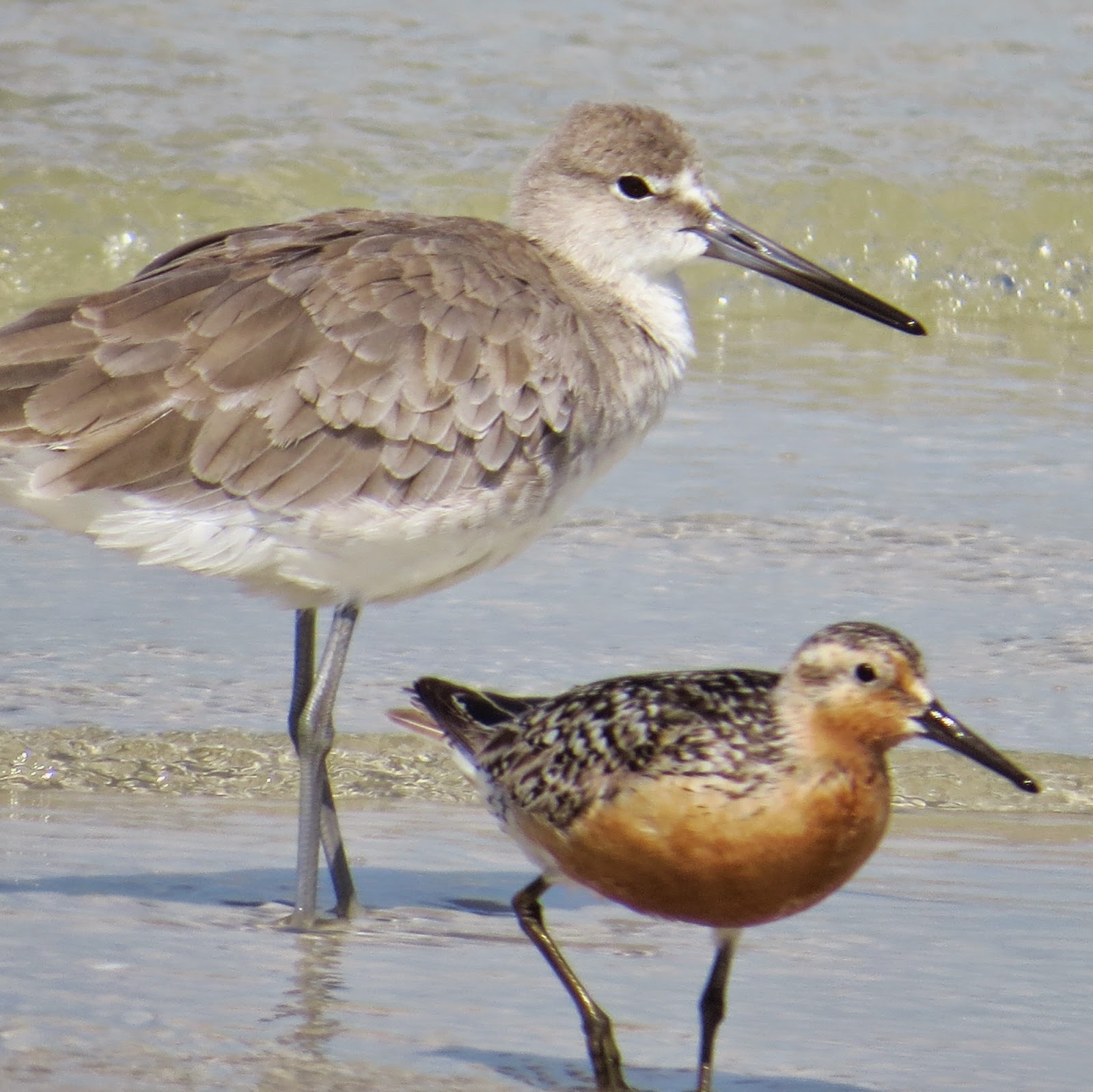
Today I had a small window of opportunity to do some birding. I chose to follow-up on a posting by Dave McQuade about American Avocets on Ft Myers Beach.  As I have dipped on the species so far this year it was logical to see if the avocets had stuck around. Well, I didn't really expect to have had them stick around and I was right.  That is as far as their not being on site from 9 am to 10 am.  Did find a few good birds though such as a quartet of feeding Red Knots.                                                                                                      

Red Knots

Willet and Red Knot

Black Skimmer

Sanderling

Ruddy Turnstone

Monday, August 4, 2014

Kites


Tuesday, July 29th  
Mississippi Kite seen at Power Line Road, July 2013
Photo courtesy of Bob Pelkey
Bob Pelkey, of swfloridabirder.blogspot.com, invited me to join him on a trip up to Payne's Prairie State Park's LaChua Trail.  Its a four hour drive and Bob likes to arrive early, so we left Ft Myers very early at about 3:30 am.

Snail Kite
Our goal was to find Mississippi Kites and for me getting that tick would nail down all four kite species that are found in Florida for this year.  I was lucky to have see a White-tailed Kite in Everglades National Park back in early January.  Snail Kites are easily found locally, year round.  And the Swallow-tailed Kite is a popular sight here from late February till the end of July. So this just leaves finding a Mississippi Kite which should be found around Gainesville and the Payne's Prairie Park this time of year.
This was a repeat visit for us as we had successfully found the kites here last year.  So today we arrived as the park opened at 8 am, and started the day by birding the parking lot. Here White-eyed Vireos and Carolina Wrens dominate. Pushing-on we began hearing numerous Eastern Towhees and spotted four Indigo Buntings darting into the brush.  A male Blue Grosbeak was singing atop a shrub near the La Chua Sink boardwalk and was briefly joined by a female Orchard Oriole.

Horse Barn at Payne's Prairie

Blue Grosbeak
Water levels were highest I have ever seen here. Right up to both sides of the Trail.  The flooded fields were rich with Pink Lotus, Water Lilies, Purple Hyacinths and Arrowroot.  Along the trail Green Herons were very common and we were able to add a lone Least Bittern, a Purple Gallinule, several Common Gallinules, a couple of Black-crowned Night-herons, dozens of Black-bellied Whistling Ducks, a lone Mottled Duck and a young King Rail.

But what about the Kites. They, like the vultures, usually don't take to air till around 9:30 as the air warms up.. So right on cue a pair of Mississippi Kites made their appearance near the Sink as they hunted for dragonflies. With the high humidity and rising temperatures it was time to move on. But was a successfully visit.

On the trip home we elected to make one more stop, at Power Line, which actually divides Pasco County from Hernando County.  It was also a place were Swallow-tailed Kites and few Mississippi Kite would congregate before migration. This year the Mississippi Kites haven't been seen here very often and today we didn't locate any and only saw on Swallow-tailed Kite. Other sighting did includes a pair of Southeastern American Kestrels, a Red-headed Woodpecker and a beautiful Red-tail Hawk.


So from here we headed back to Ft Myers.
Today's Species - 51
Black-bellied Whistling-Duck, Muscovy Duck, Mottled Duck, Northern Bobwhite, Pied-billed Grebe, Anhinga, Least Bittern, Great Blue Heron, Great Egret, Snowy Egret, Little Blue Heron, Tricolored Heron, Cattle Egret, Green Heron, Black-crowned Night-Heron, White Ibis, Glossy Ibis, Black Vulture, Turkey Vulture, Osprey, Swallow-tailed Kite, Mississippi Kite, Red-shouldered Hawk, Red-tailed Hawk, Laughing Gull, King/Aztec Rail, Purple Gallinule, Common Gallinule, Sandhill Crane, Rock Pigeon, Mourning Dove, Chimney Swift, Red-headed Woodpecker, Red-bellied Woodpecker, Pileated Woodpecker, American Kestrel, Great Crested Flycatcher, White-eyed Vireo, Blue Jay, American Crow, Fish Crow, Barn Swallow, Carolina Wren, Eastern Towhee, Northern Cardinal, Blue Grosbeak, Indigo Bunting, Red-winged Blackbird, Eastern Meadowlark, Boat-tailed Grackle and Orchard Oriole.


Swallow-tailed Kite