Friday, February 5, 2016

On To Tallahassee

Tuesday, February 2nd

Day Two
St Marks Lighthouse


On day two of our birding trip to North Florida, Bob Pelkey and left Gainesville, skipping our missed venues from yesterday, and headed to Tallahassee.


Whooping Crane?

Savannah Sparrow
Our first stop were the cow ponds along Biltmore Avenue to see the whooping crane that has been roosting here.  Seems a local birder, Marcelle Praetorios, advised that the whooper hadn't returned to the pond last night and wasn't present today.  we also missed the canada geese as they had left the pond a short time prior to our arrival.

Carolina Chickadee

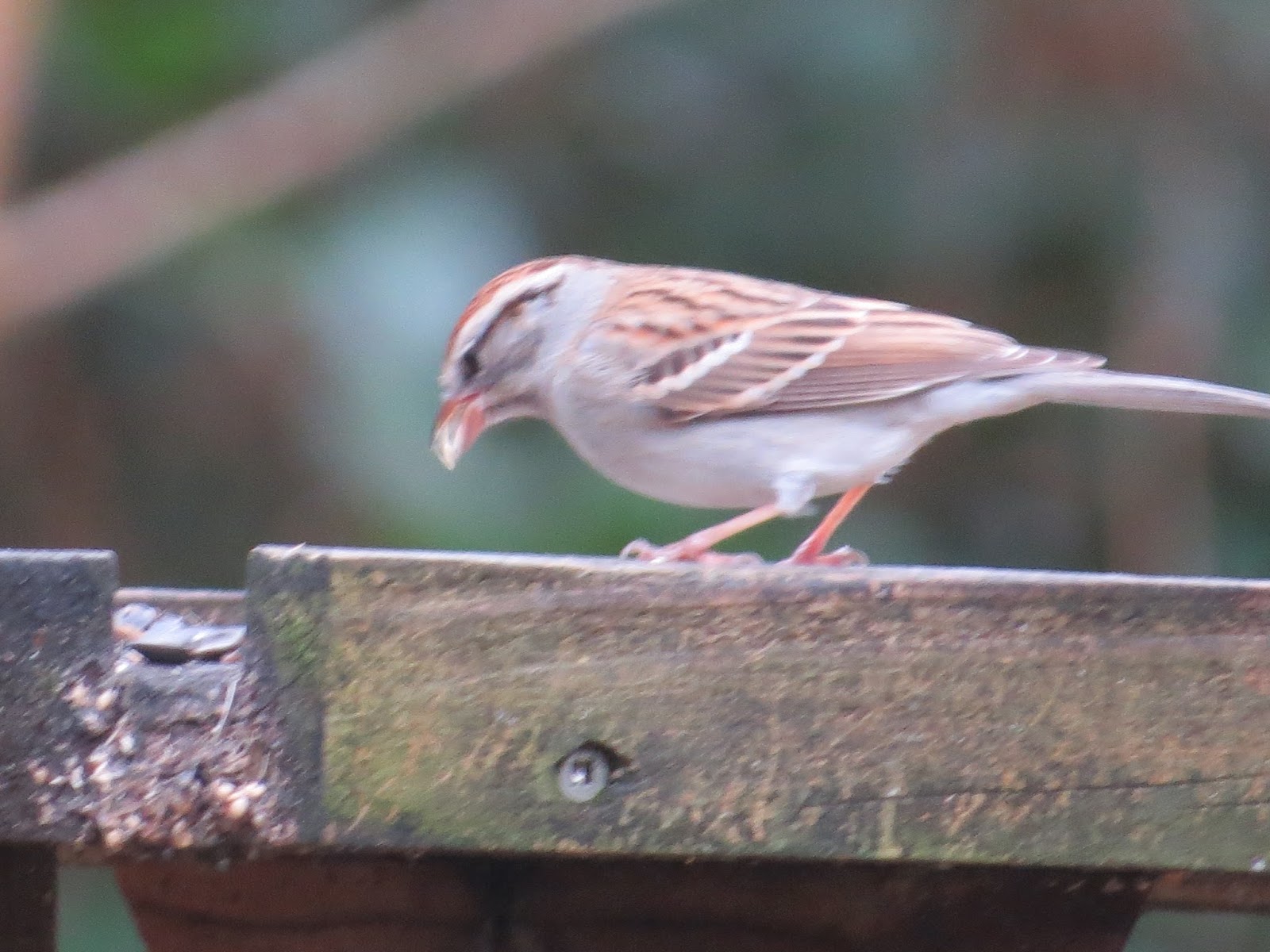
A Young Chipping Sparrow

We did see four Buffleheads, a flock of American Pipits, Savannah Sparrows, Song Sparrows, a flock of Cedar Waxwings, Killdeer, Least Sandpipers, White Ibis, Tree Swallow, Palm and Yellow-rumped Warblers and Eastern Meadowlarks.


Hummingbirds

We next visited with a nice lady in Tallahassee who has a fabulous bird sanctuary in her backyard. There, we also met a nice couple from Canada who were also there to enjoy the hummingbirds too. Bob I both had Lifers with the pair of Black-chinned and a Calliope Hummingbirds. The feeders also attracted a Ruby-throated and Rufus Hummingbirds, Baltimore Orioles, American Goldfinches, Pine Siskins, Downy Woodpecker, White-breasted Nuthatch, Eastern Bluebirds, Chipping Sparrows, Cardinals, and even an Orange-crowned Warbler taking a drink from a hummingbird feeder.
Baltimore Oriole

Pine Siskin

Calliope Hummingbird

House Finch

Chipping Sparrow

St Marks National Wildlife Refuge

Black-crowned Night-heron
Our final stop for the day was at St Marks NWR. We spent the final three of day light here looking to photograph birds. First off, there were few waterfowl. The ponds near the lighthouse were virtually empty of ducks. Looks like migration is underway.


Vermilion Flycatcher

See spotted four Wood Ducks up at the visitors center, and a few Buffleheads, a few Blue-winged Teal, Ring-necked Ducks, a nice raft of Redheads and Lesser Scaups later. One target we did succeed in was a Vermilion Flycatcher at Stoney Bayou. Also seen were American White Pelicans,  a lot of American Coots, Common Gallinule a rare bird candidate in a Purple Gallinule at Headquarters Pond, a family of Black-crowned Night-herons, a calling Clapper Rail, a Marsh Wren, a Sedge Wren, heard a Great Horned Owl and Eastern Towhees. Shorebirds included Sanderlings, Short-billed Dowitcher, Dunlin, Willets, Greater and Lesser Yellowlegs.

American White Pelicans in fishing formation

Eastern Phoebe


Bufflehead

Redhead

Bufflehead

White-tailed Deer

Operation Migration

When we arrived at St Marks, we met a couple of folks from Operation Migration setting up one of there ultralight aircraft for a special event this weekend.  This is in anticipation of the arrival of the latest class of young Whooping Cranes being trained to migrate from Wisconsin to there winter home here at St Marks.


Due to the bad weather that has been plaguing the South this winter, whoopers have been held up in Georgia. From there, when weather conditions improve they will make their final push to reach St Marks. You can follow there progress at Operation Migration


Thursday, February 4, 2016

Looking For Birds in Gainesville

Monday, February 1st

It's vacation time and I've planned a five birding trip around North Florida looking for seasonal specialties. On Day One, Bob Pelkey and I, started out from Ft Myers to bird our way up to Gainesville.
A scene from Bayport Park

Double-Crested Cormorant at Bayport Park
But not all plans work out as scheduled. First off, a bad weather front was expecting to move in by Wednesday, spoiling our itinerary. But as were passing by Tampa, there was flat tire. Luckily the the delay was only a couple of hours. 


Horned Grebe with it catch


Red-Breasted Merganser at Bayport
Ruddy Turnstone

Our next stop was a visit to Bayport Park near Hernando Beach to look for a brewers blackbird that has wintered here the past few years. Missed the blackbird but found Horned Grebes, Common Loon,  and Forster's, Laughing and Ring-billed Gulls.


Then we stopped briefly at Tuscawilla Prairie Preserve at Micanopy in Alachua County. The target was a brown creeper. This are a very uncommon bird in Florida and would have been a nice to find one.  But not today.  We did add a Hermit Thrush, White-eyed Vireo and Yellow-rumped Warbler.

A View at Tuscawilla Preserve in Micanopy

By now time is getting tight. We'll have to pass on stops in Gainesville at the La Chua Trail and Magnolia Parke. We have an option to check them out on Tuesday morning before leaving town, but that approaching  weather front had to be eliminated that option. 

Blue-Winged Teal at Sweetwater

We did stop at Sweetwater Wetlands Preserve in south Gainesville. A new venue for us and outstanding property for birding. We only spent a couple of hours, but could have spent twice the time. We found Black-Bellied Whistling Ducks, Blue-winged Teal, Northern Shovelers, Limpkins, Coots, Common Gallinules, Glossy and White Ibis, lots of other waders, Osprey, Soras, Wilson's Snipe
Limpkin at Sweetwater
Black-Bellied Whistling Duck

A Northern Shoveler

Sora

A Wilson's Snipe

A Gainesville Gator

Lastly we had to be at Dauer Hall on the U of Florida campus before sundown to witness the wintering Vaux's Swift as they came into roost in the chimney of this building. We arrived by 5 pm and had almost a hour's wait till we spotted the first swift at 5:57 as it circled the building. No more were seen till the flock arrived about 6:10 and enter the chimney in a sudden burst. Due to the diminished light and the birds rapid movement we could not capture any photos.

Vaux's Swift are a far western bird and it is highly irregular. though not unheard of, for these birds to winter in Florida instead of Mexico. The swifts were Lifer's for both of us
Dauer Hall, University of Florida

Monday, January 25, 2016

American Flamingo

Monday, January 25th

We're having a little excitement around here as a celebrity visitor is has been showcasing its beauty at a local beach. Folks have been traveling from near and far for the opportunity to meet this unusual guest to Lee County. 
American Flamingo at Bunche Beach

Many people think of this visitor as a Florida icon, but American Flamingos are not often easily seen in the Sunshine State. A very small number have been seasonal in hard to reach sites in Everglades National Park, as well as recent sightings in restricted areas of Palm Beach County. But last week this bird appeared at Bunche Beach Preserve, providing exquisite views for the many birders flocking to the site. An Awesome bird.

My speculation on the provenience of the Flamingo could possibly be associate with the El Nino effect in the Pacific Ocean. As the bird lacks any leg bandings, it can be assumed the it is not an escapee, but a wild bird. Unusual wind patterns and strong thunderstorms coming across the Gulf of Mexico could have pushed the bird from its wintering grounds in Mexico to our coast. Hope it sticks around for awhile.

Monday, January 18, 2016

Black Scoters

Monday, January 18, 2015


Today I spent the morning birding on Ft Myers Beach. I was hoping to locate some Black Scoters as well as a reported Surf Scoter being seen along the beach.


First stop was at Bowditch Point Park, located at the north end of the island. Not much was happening here, but a few gulls and cormorants. Did see a Lesser Black-backed Gull.

Lesser Black-backed Gull

Ring-billed Gull

This Gopher Tortoise resides near the parking lot at Bowditch Point Park


Next was a very productive stop at Carlos Point at the south end of the island. Yesterday's violent storm had washed the beach with a large quantity of sea life including sea urchins, sea stars, horseshoe crabs,jellyfish, sponges, sand dollars and a lot of shells.  All of this was a banquet for the shorebirds, including Willets, American Oystercatchers, Ruddy Turnstones, Sanderlings, Black-bellied Plovers, Snowy Plovers and more. Also found a Great Black-backed Gull and a small number of Ringed-billed and Laughing Gulls, plus some Royal Terns.  A flock of Black Skimmers passed by of shore and inshore I did see a trio of Black Scoters. I didn't spot the surf scoter and also dipped on common loon, horned grebe, and frigatebirds.
Great Black-backed Gull

American Oystercatcher

This Oystercatcher is sporting three leg bands while dining on sea urchin
This bird, designated as DG(XX), was banded as a chick in June, 2010 in Cape Hatteras, N. C.
 Each year it has been wintering at Little Estero Lagoon, Ft Myers Beach, but returns each spring to the Outer Banks of North Carolina.
 In 2015 it successfully fledged a chick, with oystercatcher DG(AL) at Cape Lookout National Seashore. Data provided by the American Oystercatcher Band Database 
Snowy Plover with lunch
Ruddy Turnstone

Snowy Egret

Male Black Scoter


Sea Urchin and Welk

Sea Stars

Sponge

A Fighting Conch shell

Friday, January 15, 2016

Return to Winkler Pint - Estero Preserve State Park

Monday January 11th

Returned to Winkler Point trails at Estero Preserve State Park in search of birds to boost my 2016 bird list. The location is very challenging, but today, due to low temperatures the walk was insect free. But recent rains have almost completed flooded the location.
Trail Marker at Winkler Point

So I trudged through the standing water  to the large pond at the south end of the preserve. There I was able to identify a pair of Buffleheads, another pair of Ruddy Ducks and hundreds of Lesser Scaups. At the smaller pond I spotted a few dozen skiddish American Wigeons, but didn't see any mottled ducks, pintails or blue-winged tea.
American Wigeon

 Later I added a Merlin, Red-breasted Mergansers, Greater and Lesser Yellowlegs, Black-bellied Plovers, American Avocets, American White and Brown Pelicans.  


Also spotted a Short-tailed Hawk and a Salt Marsh Sparrow and a Nelson's Sparrow. Dipped on any wrens, rails or bitterns.

Short-tailed Hawk

Greater Yellowlegs

Saw many of these Common Buckeyes today

Birding in Cape Coral

Friday January 15th
Mangled lighting

Today we experienced severe weather including continuing tornado warnings. Just last Saturday residents of Cape Coral experienced a touch down of an EF-2 Tornado. More than two hundred homes were damaged and the baseball fields on Pelican Boulevard were damaged as well.
Some of the damage at the Baseball Fields
Monk Parakeet at Pelican Boulevard Ball Fields 

The ballfield was also home to a colony of nesting Monk Parakeets and several Burrowing Owls. On Monday I ventured into the area to conduct a birding survey of the Cape. 

The stop at a ballfield revealed damage to trees, fencing and the lighting structures. As for the birds I only spotted a single parakeet and no owls. 

Next headed to the Festival Park area (still undeveloped) at the interestion of Kismet and Chiquita. Finally spotted a Burrowing Owl, Eastern Meadowlarks, Loggerhead Shrikes, Kestrel, and several Florida Scrub Jays.
The Monk Parakeet making adjustments to a surviving nest

More Birds of Cape Coral

Burrowing Owl at Festival Park

Eastern Meadowlark

Florida Scrub Jay

Python Challenge 2016


Thursday January 15th


Tomorrow kicks off the Python Challenge of 2016.  These exotic invaders have the real potential to be a devastating threat to South Florida ecosystems as the large snakes, being top predators, are already wiping out prey species.  Rabbits, raccoons and other small mammals are disappearing within the snakes range and they are a threat to many of the endangers species such as spoonbills and wood storks

Hundreds of hunters will be searching for these serpents in and around the Everglades in hopes of winning cash prizes. PETA types are concerned about any cruelty to the snakes, The hunt will last until Valentines Day and it wil be interesting to see how of these invaders are remove

Links to Python Challenge Sites