Showing posts with label Hermit Thrush. Show all posts

Monday, December 14, 2020

Cinnamon Teal

 Monday December 14th

Made another two day road trip, last week, with stops at Silver Springs State Park, Sweetwater Wetlands in Gainesville, Daytona Beach and Merritt Island National Wildlife Refuge.

Rhesus Monkey habitat at Silver Springs State Park


Stopped first at Silver Springs State Park east of Ocala. Silver Springs is famed as the home territory for troops of feral Rhesus monkeys who's presence are due to monkeys having escaped into the forests almost hundred years ago. Eventually they will be removed as obnoxious exotics, but for now they have been culled to reduce their numbers. Until recently a small number of feral squirrel monkeys had existed in areas near to the Gordon River in Naples, Florida. But licensed trappers were allowed to cull these monkeys.  They are probably extirpated at this point.

Sandhill Trail

It started as a cold day while I hiked the Sandhill Trail, which featured a sandhill Long-leaf Pine ecosystem.  Carolina Chickadees, Tufted Titmice, Blue-gray Gnatcatchers, American Robins and Downy Woodpeckers were active. Some of the flora in this habitat included the Long-leaf Pines, Sand Pines, American Turkey, Live, Sand Post Oaks and Myrtle Oaks, Saw Palmetto, Black Cherry American Olive, Leafy Elephant's Foot and Coastalplain Golden aster.
Sand Pine


River Trail

 Before leaving leaving Silver Springs walked the  River Trail.  A different, more riparian ecosystem then the sandhill area. Some of the flora here included Bald Cypress, Live and Water Oaks, American Sweetgum, Pignut Hickory, Southern Magnolia, Red Maple, Dahoon and American Holly, Sugar Hackberry, Silverling, American Beautyberry, Sparkleberry and Walter's Viburnum
 At the trail head was immediately met by an active Hermit Thrust. Not a lot of other birds seen or hears, aside Yellow-rumped and Palm Warblers , a few waders and Blue-Gray Gnatcatchers. 

Sparkleberry

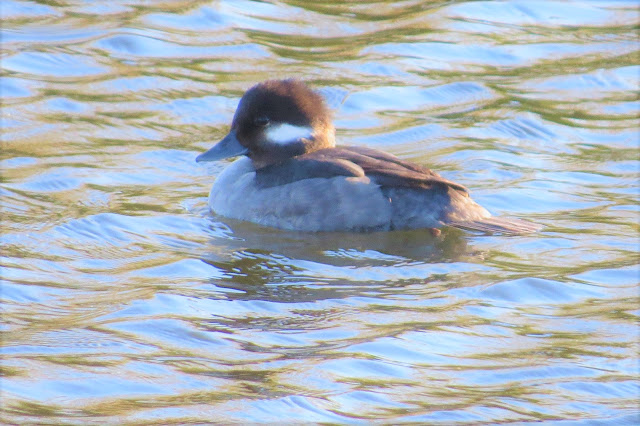
A single Bufflehead was present today

Gainesville is less than an hour north from Ocala and had several venues in mind to bird, but wanted to start at Sweetwater Wetlands. Have had some very nice visits here in the past and rusty blackbirds had
been roosting here up till a week ago. Birding was a bit disappointing. Water level were too high for shore birds and snipes and for some reason I didn't notice any sparrows either. The venue can be very  good for waterfowl. For some reason black-bellied whistling ducks weren't present during my visit. But we had a great many Common Gallinule and American CootsPlus some Blue-winged and Green-winged Teal, Leaser Scaup, Ruddy Ducks and Ring-necked Ducks.  Did hear a Sora calling. 

Limpkin seen at Sweetwater Wetlands

Day Two

Daytona Beach wasn't really my target venue.  Had planned to make a stop at Ormand Beach to see if gannets were present and Sabastian Inlet or Ponce Inlet to look for purple sandpipers. But I really needed an extra day on this trip to handle all these possible stops. Perhaps a five to seven day trip next month could be accommodating.

Angelwing shell


At Daytona Beach hundreds of Laughing Gulls were lounging on the sand. Plus some Ring-billed and Herring Gulls and a lone Lesser Black-backed Gull. Additional Royal Terns and a couple of Black Skimmers.


Herring Gull

Merritt Island National Wildlife Refuge


Merritt Island can be a good location for spotting wintering waterfowl.  Currently a male Cinnamon Teal is wintering here and we don't see cinnamon teal in Florida very often.  Its a western species, not commonly found this far east. 

The Cinnamon Teal with Blue-winged Teal
at stop number 4 on the Blackpoint Wildlife Drive

As a Florida vagrant, the Cinnamon Teal was a special sighting.  Other waterfowl included Northern Pintail, Blue-wing and Green-winged Teal, Gadwall, Northern Shovelers and Mottled DucksAmerican Coots and Common Gallinules were plentiful on the Blackpoint Drive. Wood Storks, Rosette Spoonbills, White and Glossy Ibis, Reddish Egret, Great Blue Herons and other waders were present.  As seen were Caspian Terns, Ring-billed Gulls, Greater Yellowlegs, Long-billed Dowitchers, Palm and Orange-crown Warblers. 


Green Heron

Checked-out the birding activity along the Bio Lab Road.  Only a few Sanderlings and Royal Terns
today. 

But on the out of the refuge was able watch an active family of Florida Scrub Jays. Then the four hour drive home

Florida Scrub Jay

Asters seen at the St Johns River at Palatka

Spiny Fiddlewood seen on the Blackpoint Wildlife Drive

Indian Blanket seen at the Blackpoint Wildlife Drive

Tuesday, January 26, 2010

Hermit Thrush

Ft DeSoto to Lake County
January 21st- Day #3
Double-Crested Cormorant

Laughing Gull at Egmont Key pier
Ft DeSoto Park
Left home at 10am for day three of my birding vacation. The late start was unavoidable and the day's weather was awful. Arrived at Ft DeSoto Park about noon and found conditions very windy, but no storms yet. The winds attracted a couple of dozen wind-surfing enthusiasts, who took over the east beach. I had counted on east beach as a possible site for diving birds, shore birds and perhaps a caspian tern or a black-backed gull. Only got Sanderlings, Dunlins and a lone Ring-billed Gull. Moved onto the Egmont Key pier which was not very birdy and people as well, due to the weather. Only about four Double-Crested Cormorants, a few Laughing Gulls and a lone Common Loon.

But was fortunate to watch a flyby juvenile Northern Gannet. This was surprise as this species is not found here, but with the heavy winds and that juvenile birds are known to wonder beyond their normally established range it was possible. I am very confident on this sighting and this would also be a life bird.
Checked out North Beach, which was wind swept and devoid of birds as well. But I was able to find a a few American Oystercatchers and a juvenile Herring Gulls clustered with Royal Terns and Ring-billed Gulls in a secluded spot out of the wind. Had a pair of Red-Brested Mergansers fly in just as I was heading out.
My list - Red-breasted Merganser, Common Loon, Northern Gannet, Brown Pelican, Double-crested Cormorant, Anhinga, Great Egret, White Ibis, Wood Stork, Black Vulture, Osprey, Bald Eagle, Red-tailed Hawk, American Kestrel, Black-bellied Plover, Killdeer, American Oystercatcher, Sanderling, Dunlin, Laughing Gull, Ring-billed Gull, Herring Gull, Royal Tern, Rock Pigeon, Eurasian Collared-Dove, Loggerhead Shrike, Fish Crow, Blue-gray Gnatcatcher, American Robin, Pine Warbler, Palm Warbler, Red-winged Blackbird, Common Grackle, Boat-tailed Grackle, Brown-headed Cowbird
Ft DeSoto Brochure-Map


Prior to arriving at Ft DeSoto, Checked out the Tierra Verde pond for waterfowl and the pond was loaded. Mostly found Redheads and Ring-necked Ducks, plus Pied-billed Grebes, Ruddy Ducks, American Wigeons, Lesser Scaups and Northern Shovelers.
My list - American Wigeon, Northern Shoveler, Redhead, Ring-necked Duck, Ruddy Duck, Pied-billed Grebe, Great Egret, Osprey, American Coot, Ring-billed Gull


Lake County
My late start got me to Ranch Road east of Astulta in Lake County a bit late to find the resident say's phoebe, because of the pending nightfall and a prior local rainstorm the bird was probably at roost. So took a stab at the western kingbirds, sparrows and a possible ash-throated flycatcher on Lust Road in Apopka. But it too was bird-free. But did find a pair of Western Kingbirds and hundreds of American Robins at the nearby Hopper Farm roost site.
With it getting dark I lastly took a shot at owls at the North Shore - Lake Apopka restoration parking lot. Did get a pair of Hermit Thrushs and as I was checking them out, noticed not ten feet away but separated by a fence was a bobcat. We both did a quick retreat. Observed the cat a couple more times and it seems that it was not intimidated by my presence. Did get a brief look at a low flying Great Horned Owl.
Lake Apopka Restoration Area map


Bobcat

My list - Great Blue Heron, Wood Stork, Sandhill Crane, Great Horned Owl, Least Flycatcher, Eastern Bluebird, Hermit Thrush, Western Kingbird, American Robin

Monday, October 5, 2009

Birding Trip to Fort George Island - Jacksonville, Florida


Joined up with a Duval Audubon Society bird tour Saturday, October 3rd on Fort George Island, lead by National Park Service Ranger, Roger Clark. Excellent event. Started at dawn riverside at Kingley Plantation Preserve, over to Ribault Club, then to Huguenot Memorial Park ending at various roadside sites near to New Berlin Road. Had four lifers including Carolina Chickadee, Yellow-Billed Cuckoo, Great Black-Backed Gull and Clapper Rail (only heard several over the course of the day actually). I recorded 84 hits, but the group recorded 105 hits for the day. Ironically our final, but unrecordable birds were three mute swans found on an isolated lake in a half-built out subdivision.


My List for the Day--- Wood Duck, Blue-winged Teal, Pied-billed Grebe, Brown Pelican, Double-crested Cormorant, Anhinga, Great Blue Heron, Great Egret, Snowy Egret, Little Blue Heron, Tricolored Heron, Reddish Egret, Cattle Egret, White Ibis, Glossy Ibis, Wood Stork, Black Vulture, Turkey Vulture, Osprey, Bald Eagle, American Kestrel, Peregrine Falcon, Clapper Rail, Common Moorhen, Black-bellied Plover, Semipalmated Plover, Spotted Sandpiper, Greater Yellowlegs, Willet, Sanderling, Pectoral Sandpiper, Short-billed Dowitcher, Laughing Gull, Herring Gull, Lesser Black-backed Gull, Great Black-backed Gull, Caspian Tern, Forster's Tern, Royal Tern, Sandwich Tern, Black Skimmer, Rock Pigeon, Mourning Dove, Yellow-billed Cuckoo, Chimney Swift, Belted Kingfisher, Red-bellied Woodpecker, Downy Woodpecker, Pileated Woodpecker, Eastern Phoebe, Loggerhead Shrike, White-eyed Vireo, Yellow-throated Vireo, Red-eyed Vireo, Blue Jay, American Crow, Fish Crow, Purple Martin, Tree Swallow, Barn Swallow, Carolina Chickadee, Tufted Titmouse, Carolina Wren, Blue-gray Gnatcatcher, Swainson's Thrush, Gray Catbird, Northern Mockingbird, Brown Thrasher, European Starling, Tennessee Warbler, Yellow-throated Warbler, Pine Warbler, Prairie Warbler, Palm Warbler, Black-and-white Warbler, American Redstart, Common Yellowthroat, Summer Tanager, Northern Cardinal, Indigo Bunting, Painted Bunting, Common Grackle, Boat-tailed Grackle, Baltimore Oriole


Kingsley Plantation and Ribault Club are a part of Timucuan Ecological and Historic Preserve which is operated by the National Park Service. On the day we visited the local PBS station ran a documentary they created about this local National Park Service facility to compliment the the rollout of the Ken Burns "National Parks" documentary that PBS is now featuring. Our tour leader for the day was one of the national Park personal interviewed for the program.
A QUICK RUN UP TO GEORGIA
The day following the Fort George Island event, my daughter and I ran up into Georgia to Crooked Lake State Park before heading heading back south to Ft Myers. Crooked Lake State park features salt marshes and upland forests. http://gastateparks.org/info/crookriv/
We stayed for a couple of hours and the best sighting was a Hermit Thrush.
My list - Double-crested Cormorant, Great Egret, White Ibis, Osprey, Cooper's Hawk, Laughing Gull, Red-bellied Woodpecker, Eastern Phoebe, Blue Jay, American Crow, Fish Crow, Tree Swallow, Carolina Chickadee, Carolina Wren, Blue-gray Gnatcatcher, Hermit Thrush, Northern Mockingbird, Eastern Towhee, Northern Cardinal, Boat-tailed Grackle