Showing posts with label Wilson's Phalarope. Show all posts

Monday, August 9, 2021

Everglades Ag Area

 Monday, August 9th

South of Lake Okeechobee, are farms in an area referred to as the Everglades Agricultural Area. Here is were sugar cane, rice and turf is grown and this is the time of the year to come out here for some birding. 


Upland Sandpipers are probably the most coveted species to find here as they make pit stops to refresh on the sod farms as they migrate south toward Argentina. Other species we chase here include migrating shorebirds, wading birds, gulls and terns, white pelicans, nighthawks and migrating swallows. 

Came out on Saturday to take advantage of the, potential, lighter traffic on these roads and lanes. Besides checking the sod farms for plovers and sandpipers, locating the flooded ag fields is important to find many of the species we'd be chasing. 


Common Nighthawk

Did see the Cave Swallow colony along County Road 880 just north of Brown's Farm Road. The flooded fields just across the road from the swallows have actually almost dried up. So moved on to Brown's farm Road to another location few miles south. This list for this flooded field included Black-bellied whistling Ducks, Mottled Ducks, Common Nighthawks, Lots and Lots of Black-necked Stilts, Killdeers, Stilt Sandpiper, Greater & Lesser Yellowlegs, Gull-billed Terns, Barn swallows, and the expected wading birds.


American Avocet

Close by is another road, Gladeview Road, lined with sugar cane, sod farms, rice and barren fields. Spotted Black-bellied Whistling Ducks, Fulvous Whistling Ducks ( they really like the rice fields), lots more Black-necked Stilts, Pectoral Sandpipers, Yellowlegs, Wood Storks, Cattle Egrets, Great Egrets, Little Blue Herons, Green Herons, Roseate Spoonbill, Yellow-crowned Night-herons, Common Yellowthroat  and Barn Swallows. Dipped on the spotting any Uplands Sandpipers that are being seen along this road.  Seems I missed on a seeing a newly reported American Golden Plover as well. 

The best spot for the day was a flooded field at the end of Gladeview Road. Species listed included more Black-bellied Whistling Ducks, lots of Doves, Blackbirds and Grackles. But also seeing almost a dozen American Avocets, Lots more Black-necked Stilts, a Wilson's Phalarope, several Stilt Sandpipers, Killdeers, Common Nighthawk, Least Sandpiper, Spotted Sandpiper, Long-billed Dowitcher, Yellowlegs, Black Terns, Gull-billed Terns, Glossy Ibis, White Ibis and more.  Awesome seeing the phalarope, the avocets and some many stilt sandpipers.


Wilson's Phalarope, not a very common bird here

Probably will come here one more time soon to see if can catch-up on the Uppies.

Stilt Sandpiper

Gull-billed Tern

Pectoral Sandpiper

Greater Yellowlegs

Wood Stork

American Avocet

Lesser Yellowlegs

Black Tern


Sunday, September 17, 2017

The Storm

Sunday September 17th 


Not My Car
Hurricane Irma made direct contact  on SW Florida, with the eye of the storm passing right through my neighborhood. The resulting damage in our communities came from flooding, storm surge and high winds. It could have been far worse if Irma hadn't lost strength as it made landfall. The once powerful catagory 5 storm had slowed to a still strong catagory 3.

After the winds had died down we could assess our troubles. The scope of Irma's path of destruction through Florida left millions of people without electrical power.  Ours was out for a week. No air conditioning, no not water, no hot food, no laundry, very limited communications., Limited access to groceries, water and fuel. So many folks lost homes and business, moreso from the flooding, than from the wind. We never lost our water service, but without electrical power or a generator, those on private wells did not fare as well. Another problem seen with the lose of power was that the waste water lift stations were unable to pump waste water to the WW plants and the backing up of the sewer lines was an added issue. But everyday the problems were being chiseled away and normalcy has been returning. The thousands of residents that fled out of the path of the storm are returning as well.


Birding venues, such as Six-Mile Cypress Slough Preserve, are closed because of the extreme damage. So many trees were stripped of foliage, limbs ripped away and mighty trees have toppled. The beach venues opened more quickly after the flooded abated. But the timing of the damage to  birding migrant hotspots is almost as frustrating as having been thrown off the electrical grid.

Was able to check out Bunche Beach shortly after the storm and found many of our expected species. Had hoped that a pelagic species or two were to seen. Maybe next time.

Our Juvenile Wilson's Phalarope
Photo courtesy of Dave McQuade

One very nice surprise was finding a juvenile Wilson's Phalarope in a flooded field off of Alico Road in San Carlos Park. This is a very rare find in Lee County


Ruddy Turnstone Seen At Bunche Beach
The Mute Swans at Coconut Point Mall in Estero survived the storm


Tuesday, August 2, 2016

Browns Farm Road

Monday, August 1st


From page 212 in the ABA Bird Guide 'A Birder's Guide to Florida' by Bill Pranty, is a brief narrative concerning birding on Brown's Farm Road. This narrow road breaks off from cr-880 a few miles south of Belle Glade in what is referred to as the Everglades Agricultural Area. Come late summer and into Fall, the sugar, rice and sod fields here, can be a great place to find migrating grass peeps and shorebirds. A major attraction for these birds are the flooded cane fields. The farmers will flood these fields between crops to kill off nematodes and other root attaching pests, and the migrating shorebirds flock to these man-made wetlands.
Gull-billed Tern

Currently, near the northern terminus to Browns' Farm Road is a very large flooded field were some early shorebirds have arrived including several Wilson's Phalaropes.  These phalaropes are very uncommon in Florida and there appearance here was an inspiration for Bob Pelkey and I to visit  today. 
Wilson's Phalarope with a Semipalmated Sandpiper

Wilson's Phalaropes
We arrived about 9 AM and met Peter Hawrylyshy and Robert Lewis who had already had eyes on the phalaropes. The birds were a distance out but we could clearly see there twirling movements as the feed. Other species present included Wood Storks, a Roseate Spoonbill, Black-necked Stilts, American Avocets, Black-belled Plovers, Killdeer, Spotted Sandpiper, Lesser Yellowlegs, Ruddy Turnstone, a lone Stilt Sandpiper, Least Sandpipers, Semipalmated Sandpipers,Laughing Gulls, Gull-billed Terns, Black Terns and a Re-shouldered Hawks. This site did lack waterfowl and white pelicans and only a few wading birds. This a nearby colony of Cliff and Cave Swallows at a small cement bridge over the canal on cr-880. We also checked-out the nearby Six-bend Sod Farm for grass peeps, but its still early yet and the sod fields were quite.  The Uppies should be arriving in a couple of weeks.

Black-necked Stilt
Photo by Bob Pelkey

Stilt Sandpiper


Semipalmated Sandpiper

Earlier we did some investigating along Brown's Farm Road for any other hot spots. We were able to locate Black-bellied and Fulvous Whistling Ducks, more Black-necked Stilts, Mottled Ducks, Common Gallinule, Solitary Sandpipers, Killdeer, a lone Pectoral Sandpiper, Yellow-crowned and Black-crowned Night-herons, Common Nighthawks, Anhingas, a lone American White Pelican, Barn and Cliff Swallows, Glossy and White Ibis, various waders, White-winged, Mourning, Eurasian Collared and Ground Doves, Eastern Meadowlarks, Red-shouldered Hawk, a very high count on Green Herons and a great many Brown Cowbirds, Red-winged Blackbirds and Boat-tailed Grackles. 

Solitary Sandpiper
While on the phone with Dave McQuaid for an up-date on directions, we had a Gull-billed Tern right past the car. We managed to get a few pictures as a trio of the terns made several passes up and down the canal as they hunted.

Killdeer.
Photo by Bob Pelkey

Barn Swallow 
Black-bellied Whistling Duck

White-winged Dove

Brown-headed Cowbird

Least Sandpiper

Glossy Ibis

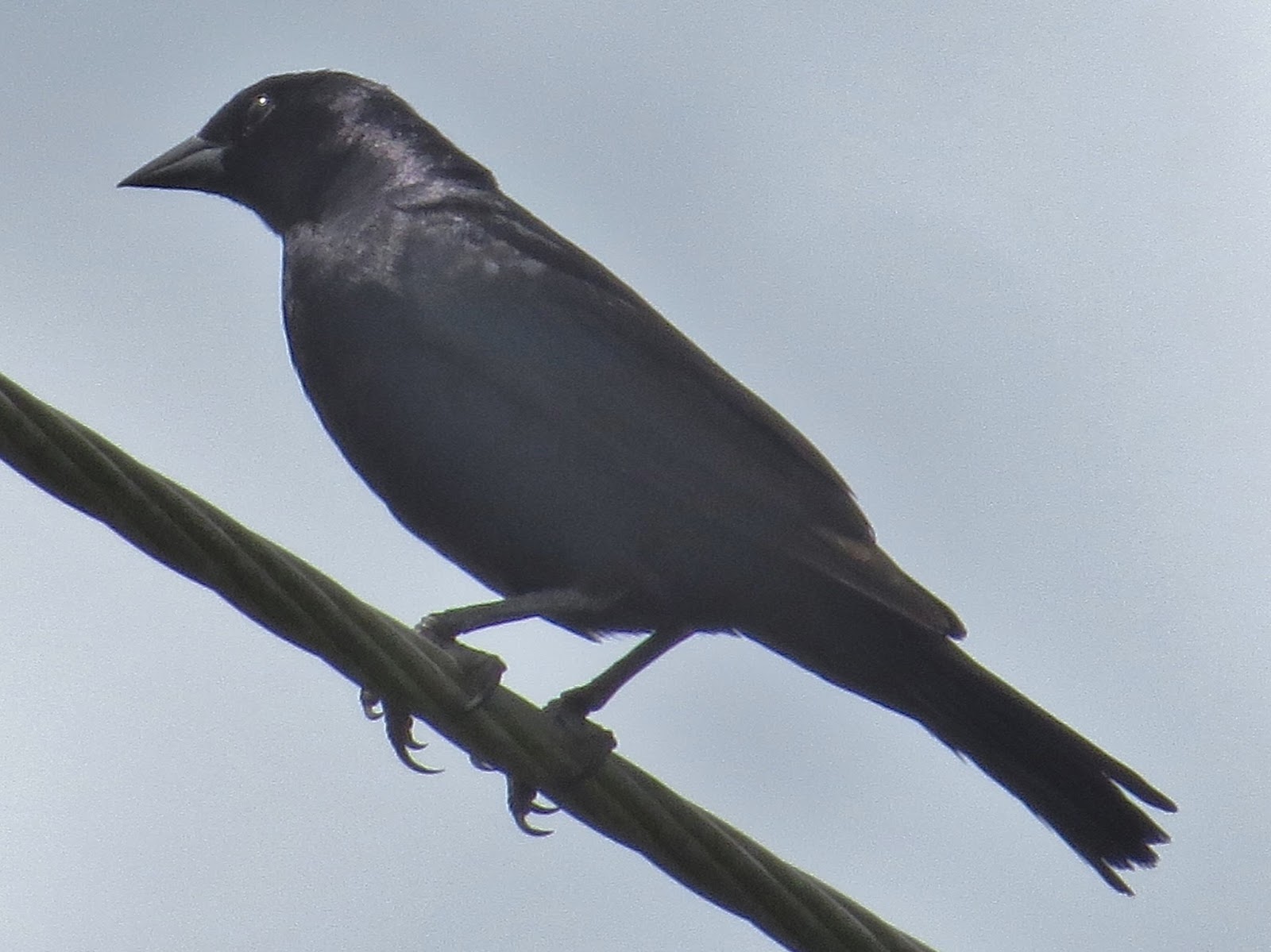
Shiny Cowbird
There was one more stop to make after finishing up at  Brown's Farm Road and that was to visit Belle Glade Marina on Torry Island, just a few north at Lake Okeechobee. Here, we are after a pair of Shiny Cowbirds, but we hit a snag.  Seems that the bridge providing access to Torry Island was under repair and would be closed for most of the day, except between Noon and One PM. We had almost a forty-five minute wait, but it was worth it. The male Shiny Cowbird was easily located within a few short minutes. We dipped in the orchard orioles and eastern kingbirds, but did see a Cooper's Hawk, Pileated Woodpecker, Limpkin  and a Great Egret which after reviewing its photo may possibly be a White Great Heron based on the leg color.

Is this a Great Egret or Great White Heron?

Apple Snail shell at Belle Glade Marina.
 No doubt refuse from a Limpkin's meal

Other sightings on the day included Swallow-tailed Kites, Ospreys, Crested Caracara, Red-tailed Hawk Chimney Swift and Fish Crows.  I'd have to say that a return trip is necessary after migration heats up.


Wednesday, September 16, 2015

Wilson's Phalarope

Tuesday, September 15th

With the idea that the bird magnet at Ft DeSoto Park in Pinellas County could offer some good sightings, Bob Pelkey and I headed out early today.
Wilson's Phalarope at Siesta Key

But first was a stop at Siesta Key in Sarasota County to twitch after phalaropes. Both Wilson's and Red-necked Phalaropes had been spotted here.  Arriving at sun rise we easily found the Wilson's Phalarope, but the red-necked phalarope was a no-show. We had dipped on the Wilson's on recent visits to Palm Beach County, so there was satisfaction in finding one much closer to home.


Arrived at Ft DeSoto Park by 9:30 and headed first to the East Beach turn-around.  Here found a low tide, but the birds were thin due to para-sailing activity. Mostly saw Sanderlings, Least Sandpipers, Ruddy Turnstones, Short-billed Dowitchers and Laughing Gulls.

A lurking Great Blue Heron in wait at the water feature
 for a small bird to snag.
Next onto the water feature behind the ranger's residence. Folks leaving the site report disappointing results, but had seen Prothonotary warbler, yellow-throated warbler, summer tanager and an early cedar waxwing. But we saw even less. Just Blue-Gray Gnatcatchers and a lurking Great Blue Heron.

Next we returned to the East Woods seeking a pair of reported Great Horned Owls. After much searching we could only hear a distance call of the owl. Again only Blue-Gray Gnatcatchers and Ospreys were seen.
A crew seen at North Woods grinding the tree stumps

Then we moved onto the North Woods and beach. Here we found that almost the entire grove of Australian pines had been removed. This was very disappointing as so much needed shade was gone as were the birds that used use these trees, including the Great Horned Owls that had been nesting in them.
Osprey

And the north beach had also suffered as most of the sand was gone. We did have some birds in a back water including many Willets, Marble Godwits, Dowitchers and Foster's Terns. The lagoon was active with hundreds of Black Skimmers and Sandwich Terns. Also present were more Willets, Godwits, Dowitchers, Ruddy Turnstones, Royal Terns and few more Forster's Terns.

After lunch we checked the fishing pier were we sighted Barn, Tree and Banks Swallows, lots of Laughing Gulls, Cormorants and Brown Pelicans. Then lastly a final stop back at the water feature. The birding was now a little better than we experienced this morning. We finally had a warbler when we found a Yellow Warbler. Also seen, before rain clouds pushed us out, were a five count of Eastern Kingbirds, a few Magnificent Frigatebirds soaring over-head, a Cooper's Hawk flying low passed the fountain.  Perhaps the hawk was one of the causes for so few birds seen at this location.  Actually after over three of searching it was truly apparent that the recently seen migrants had moved on without a fresh wave to replenish the transient population.

GALLERY OF TODAY'S BIRDS

A flotilla of Brown Pelicans

Laughing Gull

Rock Pigeons were seen using the beach
A young Sandwich Tern

Royal Tern

Snowy Plover at Siesta Key

Short-billed Dowitcher

Black-bellied Plover with breakfast

Reddish Egret
Ruddy Turnstone
Fish