Showing posts with label Mitred Parakeets. Show all posts

Monday, June 15, 2015

A Visit to the Conch Republic and Vicinities - Part 4

Sunday, May 25th  Memorial Day

White-winged Parakeets

Just spent Monday morning visiting a few spots around south Miami before heading back to Ft Myers. As today is a national holiday, the University of Miami campus in Coral Gables would be a good place to start the day looking for exotics.


No classes today, so the campus was very quite. And we were hopefully to finally experience the blue and yellow macaws that can sometimes be seen here. We  did see or hear the macaws, but we did find a pair of Common Hill Mynas, a couple of White-winged Parakeets, a single Red-masked Parakeet and lifers in seeing two pair of Scaly-headed Parrots (Pionus maximiliani). They scaly-headed parrots are species from South America.  All of the birds mentioned are local populations of escaped caged birds and their off-springs, that have managed to find a home in sub-tropical Miami.
A pair of Scaly-headed parrots 

Scaly-headed Parrots
Red-masked Parakeet


Affectionate Common Hill Mynas

Black-crowned Night-heron hunting small crabs in the rocks

A Green Anole

We moved on to recheck the campus of the Kendall Baptist Hospital and found the Mitred Parakeets busy feeding in the palm trees. A couple of Egyptian Geese were found at the smaller pond away from the Muscovy ducks, Graylag Geese, Swan Geese and other domesticated ducks on the larger pond.  Bob thought that the Egyptian Geese may have been nesting. 

Last stop for the trip was a location along Snapper Creek Canal for the nesting Cave Swallows seen there. Several were seen flying in and out from under the bridge. We also spotted what I think are Spiny-tailed Iguanas sunning themselves along the canal. 

From here it was time to end the birding and head home. We didn't get all of the photographic opportunities we were looking for, but it was a successful weekend. Next year need to go a few weeks earlier.


Egyptian Goose in Kendall

Great Egret at Kendall

Mitred Parakeet feeding in palm tree
 We found close to a hundred bird species including most of the Florida Keys avian specialties, many south Florida exotic birds and lizards and other south Florida native fauna including Bottle-nosed Dolphins, Key Deer and American Crocodile.
Spiny-tailed Iguana at Snapper Creek Canal


Monday's Bird List
Swan Goose (Domestic type)
Graylag Goose (Domestic type)
Egyptian Goose
Muscovy Duck
Mallard (Domestic type)
Great Egret
Snowy Egret
Tricolored Heron
Green Heron
Yellow-crowned Night-Heron
White Ibis
Common Gallinule
Rock Pigeon
Eurasian Collared-Dove
Common Ground-Dove
Mourning Dove
Red-bellied Woodpecker
White-winged Parakeet
Scaly-headed Parrot
Mitred Parakeet
Red-masked Parakeet
Gray Kingbird
Blue Jay
Fish Crow
Cave Swallow
Northern Mockingbird
Common Hill Myna
European Starling
Northern Cardinal
Common Grackle
Boat-tailed Grackle
House Sparrow


Sunday, May 31, 2015

A Visit to the Conch Republic and Vicinities

Friday, May 22nd
Day One


Today is day one of a long weekend to do some birding in the company of wildlife photographer Bob Pelkey. Didn't start out as a Memorial Day holiday. As it was originally scheduled for the first week of May, to take advantage of the ebbing Spring Migration. But logistics forced this unfortunate change. Home base was in Florida City were room rates were far more realistic than in the Keys.
American Crocodile in Everglades National Park

It has become an annual event to head to the Florida Keys in the Spring to find several of the specialties that are usually only seen there. It started by chasing Antillean Nighthawks and Rosette Terns that are usually found in town of Marathon. But it has now expanded to a four day search for specialties from Dry Tortugas National Park west of Key West up to the urban environments of Miami. 


Leaving Ft Myers, we crossed the state along Alligator Alley watching the birds and especially Black-crowned Night-herons and Swallow-tailed Kites. First stop was on Sherman Road just off Krone near Pembroke Pines to look for Purple Swamphens at Chapel Trails park. Upon arrival I found that my memory card was missing for my camera so I missed getting shots of a Brown Basilisk lizard seen at the start of the board walk or of the swamphens.
Black-necked Stilt near Everglades National Park
 After a stop to replace the missing memory card we made the next stop to neighborhood just north of the Kendall Baptist Hospital for a search for Red-whisked Bulbuls. This is one of the best places to search for these exotic birds and in my dozens of attempts I usually dip on seeing any. Today we sighted three.  Looks like it could be a good start for the weekend.
Green Heron at the Kendall baptist Hospital campus

Red-whiskered Bulbuls in Kendall
 At the Baptist Hospital campus the expected flock of Mitred Parakeets were noisily moving around the property. The ponds also had the usual waders and waterfowl. Didn't see any Egyptian geese but the Muscovy ducks had lots of ducklings.

Next was a stop at Mathesson Park in Coral Gables. Looking for exotics or any lingering migrants. Probably arrived too late in the day as the place was very quite. Best birds here were a pair of Yellow-Chevroned Parakeets and hearing a calling Peafowl
We ended the day visiting Everglades National Park. The goal here was to look for white-tailed kite along Research Road.
We only found American Crows and Eastern Meadowlarks, dipping on the kites.

We headed directly to the end of the road to its terminus at Flamingo. Not very birdy but find Prairie Warbler, Spotted Sandpiper, a Willet, Osprey Brown Pelicans and raucous bottle-nosed dolphins thrashing about as they fish for their supper.

At the marina, an American crocodile came out almost on cue for photographs and a Shiny Cowbird briefly showed with a flock of Brown-headed Cowbirds.
Mitred Parakeet are commonly found at Kendall baptist Hospital campus

Ended the day in Florida City were we watched Gray Kingbirds and Common Mynas


Birds for  Day One
Great Egret at Kendall Baptist Hospital

Swan Goose (Domestic type)
Graylag Goose (Domestic type)

Muscovy Duck
Mallard (Domestic type)
Mottled Duck
Northern Bobwhite
Wood Stork
Anhinga
Great Egret
Snowy Egret
Little Blue Heron
Tricolored Heron
Cattle Egret
Green Heron

White Ibis
Black Vulture
Turkey Vulture
Osprey
Swallow-tailed Kite
Red-shouldered Hawk
King Rail
Purple Swamphen
Black-necked Stilt
Spotted Sandpiper
Willet
Laughing Gull
Rock Pigeon
White-crowned Pigeon
Eurasian Collared-Dove
Common Ground-Dove
Mourning Dove
Common Nighthawk
Chimney Swift
Red-bellied Woodpecker
Mitred Parakeet
Great Crested Flycatcher
Eastern Kingbird
Loggerhead Shrike
White-eyed Vireo
Blue Jay
American Crow
Fish Crow
Purple Martin
Red-whiskered Bulbul
Northern Mockingbird
European Starling
Prairie Warbler
Northern Cardinal
Red-winged Blackbird
Eastern Meadowlark
Common Grackle
Boat-tailed Grackle
Shiny Cowbird
Brown-headed Cowbird
House Sparrow
Black-crowned Night-heron

Common Myna

Gray Kingbird

Yellow-chevroned Parakeets

Peafowl


Tuesday, May 26, 2015

A Few Exotics in Miami

Tuesday May 26th

The semi-tropical climate in South Florida lends itself well as a new home for exotic plants and animals. A great many are considered to be pests and the most successful can be quite harmful to our local ecology. The rise of the Burmese Python population in the Everglades is a prime example. Ornamental plants and trees have also overtaken local flora like the expansion of the Melaleuca and Brazilian Pepper. Their is a bounty on the Lionfish, which has rapidly prospered on our Florida reefs, upsetting the ecological balance by becoming an aggressive top predator, prolific breeder with no known predators in the Atlantic Ocean. Iguanas have become established in most of South Florida with some getting  to be over four feet long.
 Not all invasives cause great ecological harm. Just a few minutes ago I spotted the House Gecko that has moved into my apartment. I don't mind its presence at all as he'll consume most any insect pests.  Many of the exotic bird species have not become major issues. The Monk Parakeet though builds huge nests artificial structures and have created damage such as electrical outages. But most of the many parrot species in south Florida aren't as disruptive the ecology as originally feared.


This past week-end Bob Pelkey and spent four days birding the Miami and Florida Keys area for exotics and came up with several.


Red-whiskered Bulbul in Kendall
Red-Whiskered Bulbul -  A native of eastern India,


Purple Swamphens - A common native in Africa, southern Europe, much of Asia including Indonesia, and Australia.
Purple Swamphen at Chapel Trail in Broward Count


Common Hill Myna - The Common Hill Mynas are a species of starlings and a very popular cage bird coming from the hill regions of southern Asia. 
Common Hill Mynas seen on the campus of the University of Miami

Egyptian Goose - These geese were once considered sacred by the ancient Egyptians, but are currently a popular ornamental waterfowl. Escapees and there offspring have become more common in southeast Florida's parks and golf courses.
Egyptian Goose seen at Baptist Hospital campus in Kendall

Muscovy Ducks - The Muscovy Ducks we find all over south Florida are actually feral specimens of domesticated Muscovy ducks. 
Muscovy ducklings seen at Baptist Hospital in Kendall

Mitred Parakeet - Mitred Parakeets come from Peru, Bolivia and northern Argentina. A large number of these birds can usually be found around the Baptist Hospital in Kendall.


Red-masked Parakeet - Red-masked Parakeets come from the western area of Peru.
Red-masked Parakeet seen at the University of Miami campus

Scaly-headed Parrot - Scaly-headed Parrots range from Brazil through Bolivia, Paraguay and Argentina. 
Scaly-headed Parrot seen on the University of Miami campus
White-winged Parakeet - Once a very common species in Miami, but its numbers have been falling as the Yellow-chevroned Parakeets.have been increasing.  Both species were once known as canary-winged Parakeets. White-winged Parakeets came from the northern Amazon River Basin.
White-winged Parakeet at the University of Miami campus.

Iguanas - Both Green and both species of Spiny-tailed Iguanas are found in south Florida. Theses populations have there start when iguana pet owners either loose or release the big lizards.

A spiny-tailed Iguana seen at the Snapper Creek Canal

Green Iguana seen on Key West

Other exotics seen included Common Mynas and a Brown Basilisk lizard

Monday, June 30, 2014

Birding the Florida Keys and Miami - Day Three

Wednesday June 11th
Ibis and Greylag Geese at Kendall Baptist
Wednesday morning we again had an early start, leaving Marathon and heading back toward home. Stops were made to recheck for the neotropic cormorant and golden cuban warblers along Card Sound Road with the same results as on Monday. Before reaching the city environs of Dade County, we made a quick check in the Lucky Hammock area outside of the Everglades National Park with idea of maybe sighting white-tailed kite.  no kite but we a look at a strange lizard that was later identified as a basilisk lizard, which is native to Central and South America. It bolted before we could get photos.
We passed through Florida City where we added Common Myna to our exotics list of birds. There is a long list of exotics living in the Miami area and this was our next leg on the trip. We made the required visit to the Kendall Baptist Hospital campus and the neighborhood to the north.  We actually found only a few species of exotics here to include the large flock of Mitred Parakeets that reside here and several Muscovy ducks and a family of Egyptian Geese. We did add a pair of Coopers Hawks too.
Egyptian Geese
that reside here and several
Next we visited the Coral Gables campus of the University of Miami.  A couple of years ago we had an excellent experience here.  Today we had to work a bit harder to find and succeed in finding a large flock of Red-masked Parakeets was seen. Not much else was seen.
With rain moving-in we elected to cut the day short to one last stop. Caribbean Cave Swallows were reported nesting in over-passes across the Snapper Canal in Kendall. We headed over the intersection of SW 72 St and Snapper Creek Drive.  At first it appeared to be another miss. But then one appeared, then another, then a couple more as they zipped in and out of the under-pass. From here we ended the trip and headed back to Ft Myers. But I'd say I need to revisit Dade County.


A juvenile Cave Swallow


Mitred Parakeet
 Trip List
Mitred Parakeet
 Egyptian Goose, Muscovy Duck, Mallard (Domestic type), Red Junglefowl,  Magnificent Frigatebird, Masked Booby, Brown Booby, Double-crested Cormorant, Anhinga, Brown Pelican,  Great Egret, Snowy Egret, Tricolored Heron, Cattle Egret, Green Heron, Black-crowned Night-Heron, White Ibis, Osprey, Cooper's Hawk, Red-shouldered Hawk, Common Gallinule. Sandhill Crane, Killdeer, Laughing Gull, Brown Noddy, Sooty Tern, Bridled Tern, Least Tern, Roseate Tern, Rock Pigeon, White-crowned Pigeon, Eurasian Collared-Dove, Mourning Dove, Common Ground-Dove, Yellow-billed Cuckoo, Burrowing Owl, Common Nighthawk, Antillean Nighthawk, Chimney Swift, Red-bellied Woodpecker, Monk Parakeet, Mitred Parakeet, Red-masked Parakeet. Great Crested Flycatcher, Gray Kingbird, Loggerhead Shrike, White-eyed Vireo, Black-whiskered Vireo, Blue Jay, American Crow, Fish Crow, Purple Martin, Cave Swallow, Northern Mockingbird, Common Myna, European Starling, Prairie Warbler, Northern Cardinal, Red-winged Blackbird, Common Grackle, Boat-tailed Grackle, Shiny Cowbird and House Sparrow.
Mitred Parakeet


Saturday, February 9, 2013

A Weekend of Twitching.

Saturday February 9th

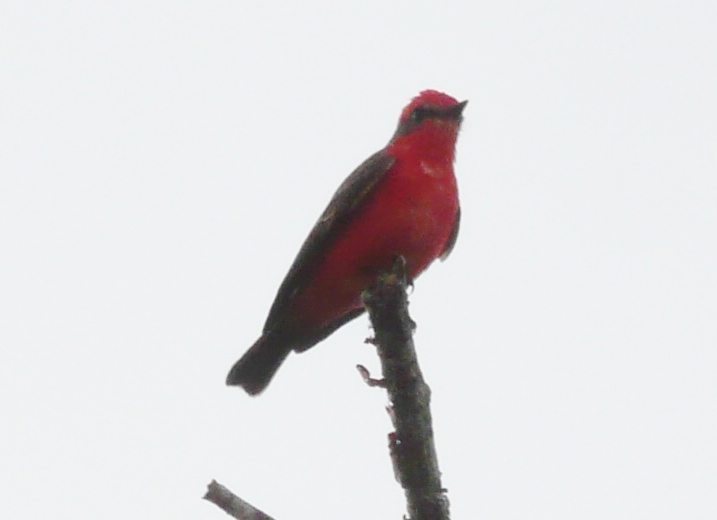
Come each winter we get a handfull of a few interesting birds that stop here instead of their normal wintering grounds. We have a lone Says Phoebe that has wintered in the same pasture in Astutle, in central Florida for the past six seasons. We'll get a scattering of Vermilion Flycatchers, Scissor-tailed Flycatchers and Western Kingbirds around the state. A few Swanson's Hawks too. A pair of Caisson's Kingbirds, a Tropical Kingbird and a lone Gray Kingbird are wintering at STA5, south of Clewiston. And near Homestead we have we have a Lesser Nighthawks, Brown-crested Flycatcher, Ash-throated Flycatcher, a few Least Flycatchers, Tropical Kingbird, Western Kingbirds and Vermilion Kingbirds. On Friday I headed out on to Lucky Hammock to search for them.

But on Thursday my daughter and I did twitch after a pair of Black-legged Kittiwakes in Tampa Bay.  These are very rare in our state and being so close to ft Myers we had to take shot at finding them ourselves. I started the day with birding at Six-Mile Cypress Preserve with the idea of locating a Red-crowned Kinglet or a Black-throated Green Warbler. I did locate the warbler and lots of Palm Warblers and Yellow-rumped Warblers, a couple of nice Pileated Woodpeckers, a Blue-headed Vireo and the other usual suspects.

After my daughter had wrapped up her work at the Humane Society we headed up to The Skyline Bridge at Tampa Bay, were the Kittiwakes have seen found at the north end of the South Fishing Pier. Upon our arrival a couple of photographs put us onto one of the Black-legged Kittiwakes, LIFER!!. Common Loons were numerous as well as Laughing Gulls, Ruddy Turnstones, Brown Pelicans, plus Ring-billed Gulls, Herring Gulls, Cormorants, Snowy Egrets and Rock Pigeons. 

Afterwards we crossed the bridge and checked the ponds at Terra Verdi were we added Redheads (not as many as I had expected), Northern Shovelers, a few Lesser Scaups,  Ring-necked Ducks, American Coots, Common Gallinule and a female Canvasback, a female Ruddy Duck and a lone Red-breasted Merganser.
On our way home we stopped at the Celery Fields just before dark. Here we added an American Bittern, a pair of Black-crowned Nigh-herons, Blue-wing Teal, Common Gallinule, tons of Starlings. Had hoped for a sora or king rail, but we did see the Barn Owl as it left its roost at dusk. 

Vermilion Flycatcher - photo by Bob Pelkey
Friday morning I was on the road by four in the morning with the idea of arriving at the Everglades National Park before sunrise with idea of finding Lesser Nighthawks and Eastern Whip-poor-wills.  Did arrive too late but did have some good birds at Lucky Hammock and The Annex. Here I did find lots of Gray Catbirds and Palm Warblers.  But I also added an Ash-throated Flycatcher, a vocal Brown-crested Flycatcher, a Least Flycatcher, a Brown Thrasher, Great Crested Flycatcher, Savannah Sparrow, Grasshopper Sparrow, Northern harrier, Northern Parula, House  Wrens, Eastern Meadowlarks, Common Yellowthroats,  and a White-eyed Vireo. 
 Before I moved on from The Annex I met a couple of fellas heading into the brush in search of Burmese Pythons as a part of the current Python Roundup sponsored by National Park Service. They were quite colorful and offered interesting stories on their captures including photos. They claim to have already caught several including a huge 12 foot female, which is destined to be used as a Judas snake.

At nearby C-111 canal, I added a beautiful male Vermilion Flycatcher, a pair of Western Kingbirds, a Tropical Kingbird and a Cave Swallow hanging with a flock of Tree Swallows. The Brown-headed Cowbirds were scanned carefully, trying to locate any Shiny Cowbirds roosting with them. No Shiny Cowbirds and other target species missed here included Short-tailed Hawk, White-tailed Kite, Swanson's Hawk 

Egyptian Geese
From here I checked out the Castellow Hammock park in Redlands were I got a pair of Ruby-throated Hummingbirds  a Rufus Hummingbird, White-winged Doves, Eurasian Collared Doves, and a female Painted Buntting

The Kendall Baptist Hospital campus is a popular spot to look for some of the more exotic species. Today I could only find a few Mitre Parakeets. Often find much large numbers and other parrot species as well. Was pretty quite today. I did see a family group of three Egyptian Geese that have taken up residence at the lake. Did spend some time investigating the neighborhood across from the hospital looking for Red-whiskered Bulbuls. After striking out here I decided it was time to head for home.

It was a good trip. Hope to return soon.
Mitre Parakeets

Wednesday, December 14, 2011

Vermilion Flycatcher in South Florida.

Wednesday, December 14th

A male Vermilion Flycatcher
Elected to run solo on a visit to Dade County, particularly to locate the Vermilion Flycatchers at the C-111 canal near the Everglades National Park. I had a number of target species in mind as well, including white-tailed kite, swainson's hawk, red-whiskered bulbul, bronzed cowbirds, purple gallinule and any ducks, sparrows or exotic species.

Left home about 5am for the long drive across the Tamiami Trail (US41) for my first of several spots I had planned on. By 8am I was in the parking lot of LaCarret's Restaurant on SW 40th Ave. It was very busy there with the expected urban birds, Grackles, House Sparrows, Rock Pigeons, Starlings, Ring-billed Gulls, Eurasian Collared Doves, but the bronzed cowbirds were a no-show while I was there.
Egyptian Geese at Kendell Baptist Hospital campus

Mitred Parakeet

Next was the Neighborhood north of Kendell Baptist Hospital. Patrolled the area in search of red-whiskered bulbuls.  Did not find them but did get Loggerhead Shrikes Northern Mockingbirds, Blue jays, Monk Parakeets and Mitred Parakeets.  At the hospital campus it was very quite until the Mitred Parakeets showed up, briefly, till a flock of Fish Crows disturbed them. A pair of Egyptian Geese and Muscovy Ducks were by the ponds and a Red-tailed Hawk flew over head.

Was interested in locating any addition parrot species. So next moved onto Matheson Park in Coral Gables, were it was very quite too. Looked for any birds, besides the parrots and hill mynas I was interested in. Best I found was a herd of cats. At this point it was starting to get very windy which is not good on a birding trip.

Next traveled south down Old Cutler Road toward Black Point Park. Kept an eye out along Old Cutler Road for any interesting sightings like peafowl or other exotics. At Black Point I was interested in any sea birds. Found the usual gulls, pelicans and cormorants. Best bird was a Spotted Sandpiper.  Next stopped at the nearby Dump Marsh and Cutler Wetlands.  The dump marsh had several Mottled Ducks, Blue-winged Teal, a few American Wigeons and a lone Gadwall and Red-breasted Merganser. Lots of Coots and several Common Gallinules. Heard later that lesser nighthawks and barn owls have been seen here recently.
Spotted Sandpiper at Black Point Park

At Cutler Wetlands the lighting was very bad. Missed out on identifying a few species because of the lighting, but did get a Herring Gull, American White Pelicans, Blue-winged Teal, Mottled ducks, more Coots and Common Gallinules. Had three Greater Yellowlegs and a single Lesser Yellowlegs too.

Gassed-up and had lunch in Homestead were I searched for any white-winged doves or common mynas.  But the winds were very gusty and no doubt the birds were sheltered somewhere out of sight.

Now it was time to locate the Vermilion Flycatcathers at C-111 Canal. Easily located one of them. These birds are not seen very often in south Florida. A few can be found wintering in the pan handle, but it was very conveint for a pair to show up here. It was a a LIFER.

Purple Gallinule
Just down the road is The Annex and Lucky Hammock. Again the winds really hampered birding. Did find the reported Western Kingbird and three Scissor-tailed Flycatchers on the fence bordering the main road. But seems that the small birds were hunkered down in the shrubs and grasses.  Did not even see or hear any catbirds or cardinals. Normally this is a good location for wintering raptors and was still so today. Had a couple of Northern Harriers, three American Kestrels, a Swainson's Hawk, a Red-tailed Hawk, a pair of Red-shouldered hawks, another pair of Short-tailed Hawks and a lot of Turkey Vultures with a few Black Vultures mixed in. Did dip on the white-tailed kite.

Purple Gallinule

Highlights in Everglades National Park, included a Purple Gallinule and several Anhingas on the Anhinga Trail, Green-winged Teal at Mrezek Pond, a pair of Pileated Woodpeckers at Eco Pond and at Flamingo had hundreds of Laughing Gulls, several Osprey including one being harassed by a Bald Eagle and a Red-brested Merganser. Out in the bay could be seen several American White Pelican and Black Skimmers. An American Crocodile was seen at the marina.

From here headed for home with brief rechecks at Lucky hammock and C-111 for white-tailed kite.  Still dipped, so headed for home.

Loggerhead Shrike at C-111

Pied-billed Grebe at Mrezak Pond


Black Vulture at Nine-mile Pond.

Day's List (68)
Egyptian Goose, Muscovy Duck, Gadwall, American Wigeon, Mottled Duck, Blue-winged Teal, Green-winged Teal, Red-breasted Merganser, Pied-billed Grebe, Wood Stork, Double-crested Cormorant, Anhinga, American White Pelican, Brown Pelican,
Great Blue Heron, Great Egret, Snowy Egret, Little Blue Heron, Tricolored Heron, Black-crowned Night-heron, White Ibis, Glossy Ibis, Black Vultures, Turkey Vultures,
Osprey, Bald eagle, Northern Harrier, Red-shouldered Hawk, Short-tailed Hawk, Swainson's Hawk, Red-tailed Hawk, American Kestrel, Purple Gallinule, Common Gallinule, American Coot, Killdeer, Spotted sandpiper, Great Yellowlegs, Lesser Yellowlegs, Laughing Gull, Ring-billed Gull, Herring Gull, Black Skimmer, Rock Pigeon, Eurasian Collared Dove, Monk Parakeet, Mitred Parakeet, Belted Kingfisher, Pileated Woodpecker, Eastern Phoebe, VERMILION FLYCATCHER, Western Kingbird, Scissor-tailed Flycatcher, Loggerhead Shrike, Blue Jay, American Crow, Fish Crow, Tree Swallow, House Wren, Blue-gray Gnatcatcher, Northern Mockingbird, European Starling, palm Warbler, Common Grackle, Boat-tailed Grackle, Brown-headed cowbird and House sparrow.
Reptiles (2) American Alligator, American Crocodile