Tuesday, December 15, 2009

The Everglades and Lucky Hammock Again - Dec 14th


Made another trip out to Lucky Hammock and the Everglades seeking those special bird species that should be found there in December. Wanted to find Swainson's Hawks, which by this time last year I had several sightings, but don't seem to have found there way to South Florida in 2009. Also have read of several sightings of Shorteared Owls at Lucky Hammock as well as Whipper-poor-Wills, to be seen at or heard at dawn or dusk.
So I gave it a try but missed on all even with arriving at sunrise. Had left home at 4 AM, arriving just before seven. Did see American Kestrel, a Peregrine, several Northern Harriers, a Broad-Wing Hawk and later in the park, a light-morphed Short-tailed Hawk, a Red-tailed Hawk, several Red-Shouldered Hawks and Ospreys, plus an immature Bald Eagle. Another missed species were White-tailed Kites which I looked for both at Lucky hammock and on Research Road in the park.

At Flamingo, the best sighting had to be a hundred American White Pelicans resting out on the mud flats. A large American Crocodile was also at its usual basking site across the canal from the marina.
At Royal Hammock, many dozens of Black Vultures were congregated in the parking lot and along the Anhinga Trail. The trouble in the parking lot was that the vultures were jumping up onto the hoods and roofs of the vehicles there, were they would relieve themselves as well as trying to pull apart any trim they could pull on. My own car was victimized as well.
The birding was not all that good so I left a bit earlier than usual to drive over Florida City to check on the reported Western Kingbirds and Scissor-Tailed Flycatchers. Did locate one of each at the SW 312th Street which was also a reliable location last year.
Scissor-Tailed Flycatcher - December 2008


Then to Cutler Wetlands were avocets and ruddy ducks are reported. Found it rather birdy, but the light and distance made identifying most of the ducks difficult to manage. So I moved on to Kendell.

The traffic was heavy in Kendell as I was arriving in mid-afternoon to look for exotics. At Kendell Baptist Hospital campus was lucky to find a flock of about 30 Mitred Parakeets wheeling about the campus. They would all land in the canopy of a large tree were they virtually disappeared. They blended right into the foliage, but there vocalizations gave them away. After there brief visit they took off away from the hospital. So it was time to head for home. Had considered checking the neighborhood across the street from the hospital for red-whiskered Bulbuls, but fatigue and the heavy traffic dissuaded me from further ventures. Yet I was rewarded in my way out of town with several sightings of Monk Parakeets along Kendell Drive. Was able to get a few pictures of a flock of Monks competing with grackles and mourning doves feeding below a palm tree in a Home Depot parking lot.

Monk Parakeets in Kendell parking lot


Soft Shell Turtle found along the road in The Everglades Park


Florida Gar found along the Anhinga Trail


Young Pied-Billed Grebes


A scene from Mohogany Hammock


American Alligator

Female Anhinga on her nest along the Anhinga Trail


Black Vultures trying to make a meal out of a car


Double-Crested Cormorants


Thursday, December 10, 2009

Ft DeSoto and Great Horned Owl

December 1, 2009 - Hit the road about mid-day to travel up to Ft DeSoto Park which is located in Tampa Bay. My goals were for the day were tempered by recent BRDBRAINS posting of a great horned owl, scissor-tailed flycatchers and cedar waxwings, plus any possible relocates of the long-billed curlew, snowy plovers, lesser black-backed gulls or caspian terns. I also was interested in locating any common loons or grebes. See this connect to BRDBRAINS message with an attached photo of the Great Horned Owl at north beach http://listserv.admin.usf.edu/listserv/wa.exe?A2=ind0911&L=brdbrain&T=0&F=&S=&P=146537


Arrived after two plus hours and started by checking out the tierra verde pond where I had Pied-Billed Grebes, lots of FOS Redheads, Ring-Necked Ducks and Lesser Scaups. Also lots of cormorants, various waders and a very active osprey looking for lunch.


Went to East Beach first which did not have any great numbers of shore birds but there was a good variety though. Could see a number of diving birds off-shore. Could make out a loon and some cormorants, but other birds were uncertain. A scope is a must.
Next to the dock to see if I could get any better views of diving birds. Sighted the Broad-Winged Hawk on the wire near to were postings had already mentioned past sightings. The dock was loaded with fisherman and the usual birds like Brown Pelicans, Snowy Egrets, and Cormorants found near to fishing piers. But the diving birds were not around. Last January we had a couple off Common Loons right by the dock, but the windy, chilly weather that had keep the dock clear of fisherman that day.
Royal Tern

Spent about an hour looking for the Great Horned Owl at north beach. Had heard a faint hoot but could not locate the bird. Till I met a nice lady at the parking lot as I was giving up and moving on to my next stop. She inquired if I was looking for the owl and I shared how my frustrated search was a bust on the owl, but did yield five warblers. So within five minutes of exiting her car and with the aid of a walker had successfully located the bird. It was all a matter of correctly following the post directions to its roost. Many thanks to her.


Before leaving I double checked the east beach again and found the viewing of the diving birds off-shore Had improved. Several cormorants were obvious, as was a loon, but the duck shaped diving birds needed to be deciphered. They were dark above and a clearly white bottom was definitive. My chooses were between horned grebe and buffleheads. At first I elected for buffleheads, but later concluded that they had to be horne grebes. The use of a scope would have probably solved the dilemma.


My List (62) - Redhead, Ring-necked Duck, Lesser Scaup, Horned Grebe, Common Loon, Pied-billed Grebe, Brown Pelican, Double-crested Cormorant, Anhinga, Magnificent Frigatebird, Great Blue Heron, Great Egret, Snowy Egret, Tricolored Heron, Reddish Egret, Cattle Egret, White Ibis, Wood Stork, Black Vulture, Turkey Vulture, Osprey, Broad-winged Hawk, American Kestrel, Peregrine Falcon, Black-bellied Plover, Wilson's Plover, Semipalmated Plover, Killdeer, American Oystercatcher, Willet, Ruddy Turnstone, Sanderling, Western Sandpiper, Least Sandpiper, Short-billed Dowitcher, Laughing Gull, Ring-billed Gull, Herring Gull, Common Tern, Forster's Tern, Royal Tern, Sandwich Tern, Black Skimmer, Mourning Dove, Great Horned Owl, Eastern Phoebe, Loggerhead Shrike, Fish Crow, House Wren, Blue-gray Gnatcatcher, Gray Catbird, Northern Mockingbird, European Starling, Yellow-rumped Warbler, Pine Warbler, Prairie Warbler, Palm Warbler, Black-and-white Warbler, Northern Cardinal, Common Grackle, Boat-tailed Grackle, Brown-headed Cowbird

Friday, November 27, 2009

November Ramblings - October Too

Having failed to post anything for about the past four weeks, I thought I'd put together a summary of some of my birding activities. For example, I was fortunate to come across a resting Chuck-Will's Widow on three occasions in the same week. Before the time-change, it was still dark in the morning as I was leaving work for home, and I was lucky to discover the chuck-will's-widow resting atop a fence post. I was able to repeat our visit with the same bird on the same post a couple more times on mornings with low road traffic. No doubt it is now resting somewhere in Costa Rica or there abouts tonight. Photography efforts only produced the red glow of its eyes. Sightings noted on October 21 and 24
My October list (160) -

  1. Muscovy Duck

  2. Canada Geese

  3. Wood Duck -

  4. Mallard

  5. Mottled Duck

  6. Blue-winged Teal -

  7. Pied-billed Grebe

  8. American White Pelican

  9. Brown Pelican

  10. Double-crested Cormorant

  11. Anhinga

  12. Magnificent Frigatebird

  13. Great Blue Heron

  14. Great Egret

  15. Snowy Egret

  16. Little Blue Heron

  17. Tricolored Heron

  18. Reddish Egret

  19. Cattle Egret

  20. Green Heron

  21. Black-crowned Night-Heron

  22. White Ibis

  23. Glossy Ibis

  24. Roseate Spoonbil

  25. Wood Stork

  26. Black Vulture

  27. Turkey Vulture

  28. Osprey

  29. White-tailed Kite

  30. Snail Kite

  31. Bald Eagle

  32. Northern Harrier

  33. Sharp-shinned Hawk

  34. Cooper's Hawk

  35. Red-shouldered Hawk

  36. Broad-winged Hawk

  37. Short-tailed Hawk

  38. Red-tailed Hawk

  39. Crested Caracara

  40. American Kestrel

  41. Merlin

  42. Peregrine Falcon

  43. Clapper Rail

  44. Common Moorhen

  45. American Coot

  46. Limpkin

  47. Sandhill Crane

  48. Black-bellied Plover

  49. Snowy Plover

  50. Wilson's Plover

  51. Semipalmated Plover

  52. Piping Plover

  53. Killdeer

  54. American Oystercatcher

  55. Spotted Sandpiper

  56. Greater Yellowlegs

  57. Willet

  58. Lesser Yellowlegs

  59. Marbled Godwit

  60. Ruddy Turnstone

  61. Red Knot

  62. Sanderling

  63. Semipalmated Sandpiper

  64. Western Sandpiper

  65. Least Sandpiper

  66. Pectoral Sandpiper

  67. Dunlin

  68. Short-billed Dowitchers

  69. Long-billed Dowitchers

  70. Wilson's Snipe

  71. Laughing Gull

  72. Ring-billed Gull

  73. Herring Gull

  74. Lesser Black-backed Gull

  75. Great Black-backed Gull

  76. Caspian Tern

  77. Forster's Tern

  78. Royal Tern

  79. Sandwich Tern

  80. Black Skimmer

  81. Rock Pigeon

  82. Eurasian Collared-Dove

  83. Mourning Dove

  84. Common Ground-Dove

  85. Monk Parakeet

  86. Yellow-billed Cuckoo

  87. Burrowing Owl

  88. Chuck-will's-widow

  89. Chimney Swift

  90. Ruby-throated Hummingbird

  91. Belted Kingfisher

  92. Red-headed Woodpecker

  93. Red-bellied Woodpecker

  94. Downy Woodpecker

  95. Hairy Woodpecker

  96. Northern Flicker

  97. Pileated Woodpecker

  98. Eastern Wood-Pewee

  99. Eastern Phoebe

  100. Great Crested Flycatcher

  101. Western Kingbird

  102. Gray Kingbird

  103. Loggerhead Shrike

  104. White-eyed Vireo

  105. Yellow-throated Vireo

  106. Blue-headed Vireo

  107. Red-eyed Vireo

  108. Blue Jay

  109. Florida Scrub-Jay

  110. American Crow

  111. Fish Crow

  112. Purple Martin

  113. Tree Swallow

  114. Northern Rough-winged Swallow

  115. Cliff Swallow

  116. Barn Swallow

  117. Carolina Chickadee

  118. Tufted Titmouse

  119. Carolina Wren

  120. House Wren

  121. Blue-gray Gnatcatcher

  122. Eastern Bluebird

  123. Swainson's Thrush

  124. Hermit Thrush

  125. Gray Catbird

  126. Northern Mockingbird

  127. Brown Thrasher

  128. Tennessee Warbler

  129. Nashville Warbler

  130. Northern Parula

  131. Magnolia Warbler

  132. Yellow-rumped Warbler

  133. Black-throated Green Warbler

  134. Yellow-throated Warbler

  135. Pine Warbler

  136. Prairie Warbler

  137. Palm Warbler

  138. Black-and-white Warbler

  139. American Redstart

  140. Ovenbird

  141. Northern Waterthrush

  142. Common Yellowthroat

  143. Hooded Warbler

  144. Summer Tanager

  145. Scarlet Tanager

  146. Eastern Towhee

  147. Northern Cardinal

  148. Rose-breasted Grosbeak

  149. Indigo Bunting

  150. Painted Bunting

  151. Bobolink

  152. Red-winged Blackbird

  153. Eastern Meadowlark

  154. Common Grackle

  155. Boat-tailed Grackle

  156. Brown-headed Cowbird

  157. Baltimore Oriole

  158. House Sparrow

  159. European Starling

  160. Common Myna
     
    November 2nd Trip to Lake County (42) - My Nemeses Bird was the Say's Phoebe, which is a rare bird in Florida. Seems a single individual Say's Phoebe has been wintering in the same field on Ranch Road outside Astatula in lake County, a four drive from my home. Twice last winter I went up to Lake County seeking - twitching- the Say's as a life count and with making three visits to the site on each trip and struck-out. The sad thing here is that a great number of birders had basically driven up to the location and quickly sited the bird for there tick.


So My daughter Katie and I headed north, birding along the way. We started at Harns Marsh with a FOS Savannah Sparrow, Limplin and Snail Kites, - Mottled Duck, Double-crested Cormorant, Great Blue Heron, Great Egret, Snowy Egret, Little Blue Heron, Tricolored Heron, Osprey, Snail Kite, Common Moorhen, Limpkin, Palm Warbler, Savannah Sparrow, Red-winged Blackbird, Boat-tailed Grackle. Then made a stop in Alva to locate the Red-Headed Woodpeckers - Mourning Dove, Red-headed Woodpecker, Loggerhead Shrike, Blue Jay, Northern Mockingbird, Eastern Meadowlark We located a pair of Creasted Caracaras in Gladys County - Great Egret, Black-crowned Night-Heron, White Ibis, Black Vulture, Turkey Vulture, Red-shouldered Hawk, Crested Caracara, American Kestrel, Sandhill Crane, Pileated Woodpecker, Eastern Phoebe, American Crow. Arrived at Ranch Road and did have a brief, distant view of the Say's Phoebe, which was not too satisfing, but finally took care of my nemesus bird - Cattle Egret, Glossy Ibis, Bald Eagle, American Kestrel, Eastern Phoebe, Say's Phoebe, Blue-gray Gnatcatcher, Eastern Bluebird, Yellow-rumped Warbler, Pine Warbler, Palm Warbler, Eastern Meadowlark. Before heading for home we checked the nearby Lust Road, which has been a good source for locating western kingbirds, various sparrows and an ash-throated Flycatcher, which is another western bird that seems to like this area. But again, not today. Red-shouldered Hawk, Red-tailed Hawk, Sandhill Crane, Mourning Dove, Common Ground-Dove, Eastern Phoebe, Loggerhead Shrike, American Crow, Gray Catbird, Palm Warbler, Northern Cardinal, Red-winged Blackbird

November 5th Bunche Beach - A sundown visit to Bunche Beach was rewarded with a fly over of a Caspian Tern. I had gone down to the beach with the idea of perhaps locating the Caspian tern that had been reported earlier on Ft Myers Beach, as we rarely find them in our locality. My List - Brown Pelican, Double-crested Cormorant, Snowy Egret, Little Blue Heron, Reddish Egret, White Ibis, Wood Stork, Osprey, Black-bellied Plover, Wilson's Plover, Semipalmated Plover, Piping Plover, Willet, Marbled Godwit, Sanderling, Western Sandpiper, Least Sandpiper, Dunlin, Short-billed Dowitcher, Laughing Gull, Ring-billed Gull, Caspian Tern, Forster's Tern, Royal Tern, Sandwich Tern, House Wren, Gray Catbird, Northern Cardinal

November 8th Harns Marsh - Another visit to Hans Marsh in Lehigh Acres found it very busy even with the heavy winds that day. But most of the activity was not on the eastern marsh area because of the winds, rather on the other side off of the Harns Marsh Elementary School site. Found hits on Blue-Winged Teal, FOS Green0Winged Teal, Snail Kites, Limpkins, Northern Harriers and Sandhill Cranes. Lots of vultures. My List - Mottled Duck, Blue-winged Teal, Green-winged Teal, Pied-billed Grebe, Double-crested Cormorant, Anhinga, Great Blue Heron, Great Egret, Snowy Egret, Little Blue Heron, Tricolored Heron, Cattle Egret, White Ibis, Glossy Ibis, Roseate Spoonbill, Wood Stork, Black Vulture, Turkey Vulture, Osprey, Snail Kite, Northern Harrier, American Kestrel, American Coot, Limpkin, Sandhill Crane, Solitary Sandpiper, Mourning Dove, Common Ground-Dove, Belted Kingfisher, Red-bellied Woodpecker, Blue-gray Gnatcatcher, Gray Catbird, Yellow-rumped Warbler, Palm Warbler, Common Grackle, Boat-tailed Grackle
November 9th Collier County (71) - Started the day at Corkscrew Swamp Sanctuary in Collier County, then to Eagle Lakes in east Naples and back into Lee County at Bunche Beach to see if T.S. Ida was blowing in any pelagic species toward shore.
*Corkscrew Swamp offered its usually waders and fall warblers. Did attempt to locate painted Buntings, which I apparently just missed near the Bunting House feeder. Was lucky to spot a Ruby-Throated Hummingbird at the butterfly garden by Blair House. My list - Anhinga, Great Egret, Little Blue Heron, Black-crowned Night-Heron, White Ibis, Wood Stork, Black Vulture, Red-shouldered Hawk, Sandhill Crane, Mourning Dove, Ruby-throated Hummingbird, Red-bellied Woodpecker, Downy Woodpecker, Great Crested Flycatcher, White-eyed Vireo, Tufted Titmouse, Carolina Wren, House Wren, Blue-gray Gnatcatcher, Gray Catbird, Yellow-rumped Warbler, Palm Warbler, Black-and-white Warbler, Common Grackle
*Eagle Lakes is were I had located a pair of Wood Ducks back in July. Did not find them on this day but did find lots of American Coots, FOS pair of Ring-Necked Ducks, several Mottled ducks and few Blue-Winged Teal. My best bird was a Merlin. My list - Mottled Duck, Blue-winged Teal, Ring-necked Duck, Pied-billed Grebe, Double-crested Cormorant, Anhinga, Great Blue Heron, Great Egret, Snowy Egret, Little Blue Heron, Tricolored Heron, Cattle Egret, Green Heron, Black-crowned Night-Heron, White Ibis, Glossy Ibis, Wood Stork, Osprey, Bald Eagle, Red-shouldered Hawk, American Kestrel, Merlin, Common Moorhen, American Coot, Eastern Phoebe, Blue Jay, Fish Crow, Tree Swallow, European Starling, Palm Warbler, Red-winged Blackbird, Common Grackle, Boat-tailed Grackle
*Bunche Beach did not offer any pelagics, but did see most of the usual peeps, waders and shore birds. The most interesting sighting was a lone female Lesser Scaup sitting in the surf near shore, but was uncooperative for any closer view as it paddled out into the bay. My list - Lesser Scaup, Brown Pelican, Double-crested Cormorant, Great Egret, Snowy Egret, White Ibis, Glossy Ibis, Black-bellied Plover, Semipalmated Plover, Willet, Marbled Godwit, Sanderling, Western Sandpiper, Dunlin, Short-billed Dowitcher, Laughing Gull, Ring-billed Gull, Herring Gull, Forster's Tern, Royal Tern, Sandwich Tern, Black Skimmer
November 9th & 10th T.S. Ida - Tropical Storm Ida was churning in the Gulf of Mexico on its way to landfall in Alabama and sometimes these storms especially the hurricanes can push pelagic species toward shore. In September 2008 had some luck on Bunche Beach with three Bridled Terns. This storm, though it did create some winds, did not seem to offer up anything special at the beach. I checked Bunche Beach on the 9th and early on the 10th I was checking Little Estero Lagoon on Ft Myers Beach. Most interesting were the nine or so Magnificent Frigatebirds that were soaring above the shore and a count of 50 (counted them twice) American Oystercatchers huddling out of the winds. My list - Brown Pelican, Double-crested Cormorant, Magnificent Frigatebird, Great Egret, Snowy Egret, Osprey, Black-bellied Plover, Snowy Plover, Wilson's Plover, Semipalmated Plover, American Oystercatcher, Willet, Ruddy Turnstone, Red Knot, Sanderling, Western Sandpiper, Short-billed Dowitcher, Laughing Gull, Herring Gull, Forster's Tern, Royal Tern, Sandwich Tern, Black Skimmer

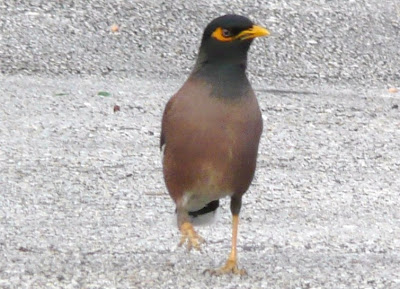
November 16 Dade County Visit (72) - Left home in San Carlos park at 3:30 am with a goal of arriving at Lucky Hammock at sun rise, the rest of the day included stops in The Everglades, Culter Wetlands and Cutler Marsh, plus any sighting in Florida City and Homestead. For me. I enjoy spotting any of Florida's established exotic species, and anytime I am in South Florida I am looking for parrots and other species. While gassing up the car for my drive home for the day I was able watch a flock of Common Mynas wire sitting and bathing in puddles along a busy intersection. earlier at another nearby intersection I had a flock of six or seven long-tailed green parrots fly by. Sadly I was able to get any better notes on the parrots, but I do not think that they were monk parakeets. Made a point of checking a site in Florida City that often yielded western kingbirds and scissor-tailed flycatchers last year, but were not evident on this day. Understand that they have finally moved back in December.
*Lucky Hammock & The Annex - Arrived just at sun rise and checked the road for whipper-poor-wills or any nighthawks. But it started out a bit quite. Was hoping to find western kingbirds as I had last month, plus white-tailed kites and to see if any swainsen's hawks were on hand. Well none of any of these were found today. Did find a young Peregrine Falcon resting on a low bush in the field as well as several American Kestrel and a couple of hunting Northern Harriers. Sandhill Cranes and dozens of Wood Storks flew over head. The Hammock and adjacent bushy area yielded a female Ruby-Throated Hummingbird, a Least Flycatcher, several Eastern Phoebes, a Northern Waterthrush, a solo Tree Swallow, Great Crested Flycatcher and White-eyed Vireo. The fields yielded several sparrows. I had figured that most were Song Sparrows and the rest were Savannah Sparrows. But I was put straight immediately when I had posted finding Song Sparrows on the TAS message board. As the following comment was a sent to me. "It's a common mistake anywhere in South Florida. SOSPs are exceedingly rare below Lake Okeechobee. . . ." Others also commented on the TAS site. Seems that some savannah sparrows sport similar breast markings as song sparrows. But who is to say that I had not actually located six song sparrows well south of there normal range. Misplace birds are located all of the time. But I do not have any cred with the birding world, at this point. So, without evidence may claim is rejected. My list - Double-crested Cormorant, Anhinga, Great Blue Heron, Great Egret, Cattle Egret, White Ibis, Wood Stork, Turkey Vulture, Osprey, Northern Harrier, Red-shouldered Hawk, American Kestrel, Peregrine Falcon, Sandhill Crane, Mourning Dove, Common Ground-Dove, Ruby-throated Hummingbird, Belted Kingfisher, Red-bellied Woodpecker, Least Flycatcher, Eastern Phoebe, Great Crested Flycatcher, White-eyed Vireo, Blue Jay, American Crow, Tree Swallow, Blue-gray Gnatcatcher, Gray Catbird, Northern Mockingbird, European Starling, Yellow-throated Warbler, Prairie Warbler, Palm Warbler, Northern Waterthrush, Savannah Sparrow, Eastern Meadowlark, Common Grackle, Boat-tailed Grackle
*Everglades National Park was not too special on my visit. Checked out the Anhinga Trail but it was mostly a few waders and anhingas. American Crows and Black Vultures dominate the parking lot. Hiked the Snake Bight Trail which was not too troubled with mosquitoes or birds. The best viewing was a flock of American White Pelicans flying over-head and Broad-Winged Hawk soaring above the boardwalk at the Florida Bay terminus.. At Mrazak Pond we had Blue-Wing Teal, a female Northern Shoveler, a couple of Pied-Billed Grebes, and all the waders. At Flamingo we had the usual Ospreys, Bald Eagle and a lone Red-Breasted Merganser.
My list - Blue-winged Teal, Northern Shoveler, Red-breasted Merganser, Pied-billed Grebe, American White Pelican, Brown Pelican, Double-crested Cormorant, Anhinga, Great Blue Heron, Great Egret, Snowy Egret, Tricolored Heron, Reddish Egret, Cattle Egret, Green Heron, White Ibis, Roseate Spoonbill, Wood Stork, Black Vulture, Turkey Vulture, Osprey, Bald Eagle, Red-shouldered Hawk, Broad-winged Hawk, Common Moorhen, American Coot, Willet, Laughing Gull, Mourning Dove, Common Ground-Dove, Belted Kingfisher, Eastern Phoebe, American Crow, Fish Crow, Tree Swallow, Barn Swallow, Ruby-crowned Kinglet, Blue-gray Gnatcatcher, Northern Mockingbird, Yellow-rumped Warbler, Palm Warbler, Eastern Meadowlark, Common Grackle
*Cutler Wetlands had a lot of ducks, mostly American Coots, Mottled Ducks and Blue-winged Teal. Might have ID'd more, but needed a scope. Hoping for american avocets, but settled for Long-Billed Dowitchers My list - Mottled Duck, Blue-winged Teal, Pied-billed Grebe, Great Egret, Tricolored Heron, Cattle Egret, White Ibis, Northern Harrier, Common Moorhen, American Coot, Long-billed Dowitcher, Eurasian Collared-Dove, Red-winged Blackbird, Common Grackle
Cutler Dump Marsh is a location that featured a tropical kingbird in residence last year and had read that it had returned. But not today. Best sighting was a FOS Yellow-Bellied Sapsucker.
My list - Blue-winged Teal, Lesser Scaup, Great Blue Heron, Great Egret, Little Blue Heron, Tricolored Heron, Black Vulture, Turkey Vulture, Red-shouldered Hawk, Red-tailed Hawk, American Coot, Belted Kingfisher, Yellow-bellied Sapsucker, Loggerhead Shrike, Palm Warbler

Wednesday, October 28, 2009

Back to Babcock-Webb

Hit the birding trail for the fourth day in a row, Tuesday, October 20th, by checking out Babcock-Webb WMA in Charlotte County. The location is famous for the big three rareities for south Florida of the Red-Cockaded Woodpecker, Bachman's Sparrow and Brownheaded Nuthatch and on the this trip I miss on all three.
Arrived about 8:45am and had quick hits on a Red-Tailed Hawk, sandhill Crane, Pine Warblers, Eastern Meadowlark and a Yellow-shafted Flicker. The birding slowed down from here on. Found lots of noisy Gray Catbirds and FOS House Wrens. Usually raptors aren't very plentifull here, but seems that migration was contining with sightenings of Red-Shouldered Hawk, American Kestrel, Broad-Winged Hawk and a couple of Sharp-Shinned Hawks. By 11;30 I was on my way home. Needed to get a much needed nap in before going into work
My list - Great Blue Heron, Great Egret, Little Blue Heron, Cattle Egret, Green Heron, White Ibis, Sharp-shinned Hawk, Red-shouldered Hawk, Broad-winged Hawk, Red-tailed Hawk, Sandhill Crane, Mourning Dove, Common Ground-Dove, Chimney Swift, Belted Kingfisher, Red-bellied Woodpecker, Downy Woodpecker, Northern Flicker, Eastern Phoebe, Loggerhead Shrike, Blue Jay, House Wren, Blue-gray Gnatcatcher, Eastern Bluebird, Gray Catbird, Northern Mockingbird, Pine Warbler, Palm Warbler, Eastern Towhee, Northern Cardinal, Red-winged Blackbird, Common Grackle

Friday, October 23, 2009

Back to Lucky Hammock, The Everglades & Cutler Wetlands - October 19th

LUCKY HAMMOCK

On Monday October 19th I still had the bug to cash-in on the big cold front fall-out in the Miami area that stung us on Sunday's hawk watch on Sanibel Island. I had the day off and arrangements had been made to free-up my time, so I ventured over to the east coast.
To reach my first stop by sunrise, I had to leave home at 4am. This stop was at what some birders call Lucky Hammock and The Annex on Aerojet Road. This just outside of the eastern entrance to Everglades National Park. The attached posting on the TAS message board, noted an exciting list of birding opportunities like White-Tail Kites, Short-Tail Hawks and Western, Eastern and Gray Kingbirds plus a Philadelphia Vireo. Arrived just before sun-up and drove the length of the road looking for any nighthawks or chucks-poor-widows. None found. But a Norther Harrier quickly arrived on sight and a roosting White-tailed Kite was noticed sitting atop a bush in the field. The kite soon took off in the early morning. Short-tailed Hawks began to show up and several, both light and dark were active in the area. It was still windy like Sunday which tends to keep many birds buried in the shrubbery, but the hammock area yielded some good birds. They included a female Ruby-Throated Hummingbird, Prairie Warbler, Palm Warbler, Northern Parula, Magnolia Warbler, several American Redstarts, a female Painted Bunting. A couple of pairs of Sandhill Cranes came in to the nearby fields.

The Annex area was not nearly as birdy because of the winds. Lots of Gray Catbirds were vocalizing but skulking in the brush. A a very late Gray Kingbird fought the winds in its effort to sit on the power lines. Never did find any eastern Kingbirds, but I did run into Larry Manfredi, who showed me were a Western Kingbird was sitting. The Gray and Western would be keeping each other company. Larry Manfredi is a noted local birder and guide. His web site is very valuable in the search for south Florida and Caribbean specialties. Larry spend a half hour with me, sharing information on the background to this location and how best to look for certain specialities. I would love to book a trip with him some day.


My list - Anhinga, Great Blue Heron, Cattle Egret, White Ibis, Wood Stork, Black Vulture, Turkey Vulture, White-tailed Kite, Northern Harrier, Cooper's Hawk, Red-shouldered Hawk, Short-tailed Hawk, Red-tailed Hawk, American Kestrel, Sandhill Crane, Killdeer, Mourning Dove, Common Ground-Dove, Ruby-throated Hummingbird, Belted Kingfisher, Red-bellied Woodpecker, Eastern Phoebe, Great Crested Flycatcher, Western Kingbird, Gray Kingbird, Loggerhead Shrike, White-eyed Vireo, Blue Jay, American Crow, Tree Swallow, Northern Rough-winged Swallow, Barn Swallow, Blue-gray Gnatcatcher, Gray Catbird, Northern Mockingbird, European Starling, Northern Parula, Magnolia Warbler, Prairie Warbler, Palm Warbler, American Redstart, Northern Cardinal, Painted Bunting, Red-winged Blackbird, Common Grackle


THE EVERGLADES
Probably are Short-billed Dowitchers
Enter Everglades national Park about 11:00am and spent the next four and half hours looking for birding hot-spots. They were not to be found here today. Took a stab at the Western Spindalis in Long Pine campgrounds, but not much of anything was found there. Not much was found anywhere. Ventured all the way to Flamingo were a few shorebirds and several Ospreys were present. Had a bald eagle soaring above Eco Pond. Noted several flocks of Wood Storks moving back into south Florida. Today there was a large American Crocodile basking on the shore across from the marina at Flamingo.
My list - Double-crested Cormorant, Anhinga, Great Blue Heron, Great Egret, Snowy Egret, Little Blue Heron, Tricolored Heron, Cattle Egret, Green Heron, White Ibis, Wood Stork, Black Vulture, Turkey Vulture, Osprey, Bald Eagle, Northern Harrier, Red-shouldered Hawk, American Kestrel, Ruddy Turnstone, Semipalmated Sandpiper, Short-billed Dowitcher, Laughing Gull, Mourning Dove, Belted Kingfisher, Eastern Phoebe, Loggerhead Shrike, Blue Jay, Northern Rough-winged Swallow, Blue-gray Gnatcatcher, Gray Catbird, Northern Mockingbird, Palm Warbler, Black-and-white Warbler, Common Yellowthroat, Eastern Towhee
CUTLER WETLANDS
Left the park for my final stop before heading the three hour drive home. Headed over to the Homestead-Cutler Ridge area to a site known as Cutler Wetlands, which is a surface water management sight. While sitting at a red light at US 1 in Homestead I was able to locate a pair of Common Mynas among the hundreds or so crows, grackles and starlings hanging out at the intersection, by the white spots under there wings as they flew from one resting spot to another.
The extreme variety of birdlife found at Cutler Wetlands makes it a must stop location. Past sightings have included sacred ibis, flamingo and yellow-headed blackbirds. Today we had Long-Billed Dowitchers, Lesser Yellowlegs, Spoonbills and Blue-Winged Teal.
My list - Mottled Duck, Blue-winged Teal, Great Blue Heron, White Ibis, Roseate Spoonbill, Common Moorhen, American Coot, Lesser Yellowlegs, Long-billed Dowitcher, Rock Pigeon

Sanibel Lighthouse Hawk Watch


Had been looking forward to the Audubon of Southwest Florida's Sanibel Lighthouse Hawk Watch for some time. Because of work I missed last year's event, but showed up the very next day to take a try on my own. Luckily I ran into Vince McGrath who had lead the prior day's hawk watch. This one-on-one was a great learning experience for me. We had well over 100 American Kestrels, a few Merlins, Peregrins and Ospreys. had a number of Sharp-Shinned Hawks and many Swallows. I think we even had a Bald Eagle.

My list for October 13, 2008 -Brown Pelican, Double-crested Cormorant, Snowy Egret, Black Vulture, Osprey, Bald Eagle, Sharp-shinned Hawk, American Kestrel, Merlin, Peregrine Falcon, Black-bellied Plover, Willet, Ruddy Turnstone, Laughing Gull, Royal Tern, Sandwich Tern, Tree Swallow, Northern Rough-winged Swallow, Barn Swallow, Palm Warbler, Brown-headed Cowbird


So this year, we had a very nice cold front arriving right on time for this years scheduled hawk watch on Sunday October 18th, 8am - 10am. My debate was to show-up for the scheduled event or come on my own the following like last year due to the fact that I was getting off of work at 7:00am Sunday morning. Because of the potential bird fallout from the cold front was such a great opportunity I elected to struggle with my constant bane of sleep derivation and headed over to Sanibel Island on Sunday straight from work. The weather was very windy and chilly by Florida standards. But those strong winds had actually blown the birds away from southwestern Florida. Turns out Miami and Key West had outstanding birding that Sunday. So our birding was very slow. Very few song birds were on hand. Our first hwak arrived at 9:45am - a Sharp-Shined Hawk. By the time I left at 11am we had about 16 American Kestels, a dozen Sharp-Shinned Hawks, a couple of Broad-Winged Hawks and a few Ospreys were present. Also had about 6 Merlins with one individual we found very entertaining as it was aggressivelly interacting with another Merlin and the other hawks present. Prehaps those birders still on hand managed an outstanding sighting like a mississippi kite or something like that. You just never now when something exciting might show up. But not for me. It was time for some sleep for me.

My list - Brown Pelican, Osprey, Sharp-shinned Hawk, Red-shouldered Hawk, Broad-winged Hawk, American Kestrel, Merlin, Short-billed Dowitcher, Laughing Gull, Royal Tern, Sandwich Tern, Rock Pigeon, Chimney Swift, Northern Rough-winged Swallow, Barn Swallow, Prairie Warbler, Palm Warbler, Northern Cardinal, Boat-tailed Grackle

Monday, October 5, 2009

Birding Trip to Fort George Island - Jacksonville, Florida


Joined up with a Duval Audubon Society bird tour Saturday, October 3rd on Fort George Island, lead by National Park Service Ranger, Roger Clark. Excellent event. Started at dawn riverside at Kingley Plantation Preserve, over to Ribault Club, then to Huguenot Memorial Park ending at various roadside sites near to New Berlin Road. Had four lifers including Carolina Chickadee, Yellow-Billed Cuckoo, Great Black-Backed Gull and Clapper Rail (only heard several over the course of the day actually). I recorded 84 hits, but the group recorded 105 hits for the day. Ironically our final, but unrecordable birds were three mute swans found on an isolated lake in a half-built out subdivision.


My List for the Day--- Wood Duck, Blue-winged Teal, Pied-billed Grebe, Brown Pelican, Double-crested Cormorant, Anhinga, Great Blue Heron, Great Egret, Snowy Egret, Little Blue Heron, Tricolored Heron, Reddish Egret, Cattle Egret, White Ibis, Glossy Ibis, Wood Stork, Black Vulture, Turkey Vulture, Osprey, Bald Eagle, American Kestrel, Peregrine Falcon, Clapper Rail, Common Moorhen, Black-bellied Plover, Semipalmated Plover, Spotted Sandpiper, Greater Yellowlegs, Willet, Sanderling, Pectoral Sandpiper, Short-billed Dowitcher, Laughing Gull, Herring Gull, Lesser Black-backed Gull, Great Black-backed Gull, Caspian Tern, Forster's Tern, Royal Tern, Sandwich Tern, Black Skimmer, Rock Pigeon, Mourning Dove, Yellow-billed Cuckoo, Chimney Swift, Belted Kingfisher, Red-bellied Woodpecker, Downy Woodpecker, Pileated Woodpecker, Eastern Phoebe, Loggerhead Shrike, White-eyed Vireo, Yellow-throated Vireo, Red-eyed Vireo, Blue Jay, American Crow, Fish Crow, Purple Martin, Tree Swallow, Barn Swallow, Carolina Chickadee, Tufted Titmouse, Carolina Wren, Blue-gray Gnatcatcher, Swainson's Thrush, Gray Catbird, Northern Mockingbird, Brown Thrasher, European Starling, Tennessee Warbler, Yellow-throated Warbler, Pine Warbler, Prairie Warbler, Palm Warbler, Black-and-white Warbler, American Redstart, Common Yellowthroat, Summer Tanager, Northern Cardinal, Indigo Bunting, Painted Bunting, Common Grackle, Boat-tailed Grackle, Baltimore Oriole


Kingsley Plantation and Ribault Club are a part of Timucuan Ecological and Historic Preserve which is operated by the National Park Service. On the day we visited the local PBS station ran a documentary they created about this local National Park Service facility to compliment the the rollout of the Ken Burns "National Parks" documentary that PBS is now featuring. Our tour leader for the day was one of the national Park personal interviewed for the program.
A QUICK RUN UP TO GEORGIA
The day following the Fort George Island event, my daughter and I ran up into Georgia to Crooked Lake State Park before heading heading back south to Ft Myers. Crooked Lake State park features salt marshes and upland forests. http://gastateparks.org/info/crookriv/
We stayed for a couple of hours and the best sighting was a Hermit Thrush.
My list - Double-crested Cormorant, Great Egret, White Ibis, Osprey, Cooper's Hawk, Laughing Gull, Red-bellied Woodpecker, Eastern Phoebe, Blue Jay, American Crow, Fish Crow, Tree Swallow, Carolina Chickadee, Carolina Wren, Blue-gray Gnatcatcher, Hermit Thrush, Northern Mockingbird, Eastern Towhee, Northern Cardinal, Boat-tailed Grackle