Sunday, February 7, 2010

Prairie Warbler

Six-Mile Cypress Slough

Lately I have been trying to bird Six-Mile Cypress Slough very early on Sunday mornings. Its very quite and the parking area can be very birdy with warblers, vireos and woodpeckers. Last week I had good looks at Prairie Warblers and a Hairy Woodpecker, which gave me a total January count of 171 birds. I am also keen to locate the resident wintering Ruby-Crowned Kinglet, which can be usually be found around the parking area, but what I'd really like to relocate is the male Black-Throated Green Warbler that was also wintering here. It has often been observed in mixed flocks and often near to the Green House in the early morning. I had briefly seen it back along the boardwalk back in December and later heard it as well. But so far I have not been able to find it. I'd be interested in hearing from anyone who has recently sited the bird.
Today I arrived about 8:00am to an empty parking area and found it not to be very birdy at all. Did find a couple of Yellow-Rumped Warblers and a Prairie Warble, but not much else. So I took a short walk out along the boardwalk. Still pretty quite. Did find a Black-Crowned and a Yellow-Crowned Nightheron though.
The most interesting sighting was a pair of waterfowl I observed from the balcony of the Green House. They were torpedo-shaped and very rapid in their flight. They circled the area once and took off. My immediate thought was that they were a pair of Common Loon as one was a plain brown and the other, also, had a plain brown body and a dark head and neck. But that would mean that the male had already mottled into his breeding colors. Not totally sure, but my guess is that it is too early. So what I have decided on was we had a pair of Red-breasted Mergansers flyby.
Later in the day I was surprised to find a squawking Monk Parakeet wiring-sitting in my backyard. He did not stay long, maybe because my feeder needs filled. This has been his second visit that I am aware of.

Saturday, February 6, 2010

Scaups

Lesser Scaups are fairly common wintering in Southwest Florida, but we almost never find Greater Scaups here. Identification can be very difficult between the two species. However if you have an opportunity to bird in north Florida, you may have to try. The '10,000Bird' blog has an excellent page on comparing these birds. Try this hyperlink to their site - http://10000birds.com/lesser-scaups.htm/ - to learn more.

Tuesday, February 2, 2010

Masked Duck

Masked DuckMerritt Island and Viera Wetlands
January 23rd - Day #5 and final stops


Merritt Island
Spent the night in Titusville, which is on the doorstep to Merritt Island national Wildlife Refuge as well as cape Canaveral. So was able to enter the refuge at 8:00am. My first good hit for the day was on the causeway with a couple of second winter Lesser Black-Backed Gulls. What had originally caught my eye with this group of gulls was a pair of adult black-backed gulls. Could be sure if they were greater or lesser black-backed gulls as they immediately flew off.
Took the Black Point Wildlife Drive were many good hits were made including American Avocets, Roseate Spoonbills (only sighting all month of spoonbills), more American White Pelicans, Caspian Terns, Northern Pintails, American Widgeons, Blue-Winged Teal, Northern Shovelers, Bald Eagle and a Sora. Missed on the Eurasian Widgeon, but I did not hear about its presence till later and besides there were hundreds of ducks with many in bad light.
At stop #8 was able to call up a sora.. On last years visit to the refuge a sora was called up by another birder’s recording at this spot. This is also an excellent habitat for other rails species, as well, which would have been nice to locate. As for calling up the sora, I remembered someone telling me once that a rail could be called up by a clap of your hands. So with nothing to lose I tried it and the sora began to chatter and made its appearance. Not sure if the clapping really worked, but I was finally able to get a picture of a sora.
After completing Black Point I drove over to the Bio Lab Road, which parallels Mosquito Lagoon. Last year I was able to locate Florida Scrub Jays near to the Bio Lab Road, on cr406, but not today. They can often be found along the roadways in the scrub areas.
The Bio Lab Road had Blue-Winged, American Coots, Mottled Ducks, most of the waders and several shore birds like Dunlins and Sanderlings. Found Forster’s Terns and another lifer in a Bonaparte’s Gull.
Sadly a dead loggerhead turtle was seen close to the shore. I later reported the turtle at the visitors center. I was informed that the turtle probably died from cold stress from the resent two weeks of freezing weather we just experienced. Something like 2,500 cold-stressed sea turtles had been collected by wildlife management from around the state in an effort to try to save as many as possible, yet hundreds still did not make.
The visit to the refuge was a success with fifty-three species.
http://www.nbbd.com/godo/minwr/BlackPoint/index.html


My list - American Wigeon, Mottled Duck, Blue-winged Teal, Northern Shoveler, Northern Pintail, Pied-billed Grebe, American White Pelican, Anhinga, Great Blue Heron, Great Egret, Snowy Egret, Little Blue Heron, Tricolored Heron, Cattle Egret, Glossy Ibis, Roseate Spoonbill, Black Vulture, Turkey Vulture, Osprey, Bald Eagle, Northern Harrier, Red-tailed Hawk, Sora, American Coot, Black-bellied Plover, Killdeer, American Avocet, Greater Yellowlegs, Lesser Yellowlegs, Ruddy Turnstone, Sanderling, Dunlin, Laughing Gull, Bonaparte's Gull, Ring-billed Gull, Lesser Black-backed Gull, Caspian Tern, Forster's Tern, Royal Tern, Rock Pigeon, Belted Kingfisher, Red-bellied Woodpecker, Eastern Phoebe, Loggerhead Shrike, Fish Crow, Tree Swallow, American Robin, Gray Catbird, European Starling, Yellow-rumped Warbler, Savannah Sparrow, Red-winged Blackbird, Boat-tailed Grackle


Great Blue Heron - Bio Lab Road on Merritt Island

Bonaparte's Gull - a poor photo but a lifer. Was preening on shore along Bio Lab Road, Merritt Island.


Sora on Merritt Island


Savannah Sparrow on Merritt Island

Next and the last stop of the vacation was Viera Wetlands near Melbourne. The wetlands are a discharge ponds for a Brevard County wastewater plant and has become quit well known as a good birding location. Most utility plants are off-limits to the general public these days, especially since 9/11. But the Viera facility continues to welcome public access to the wetlands on a controlled basis.
The big draw these days at Viera Wetlands is a wintering male Masked Duck. Very rare to Florida. This is a tropical species usually found in the Caribbean or Mexico on south. I was able to get a tick last year on a female that wintered on Alligator Lake near Lake City.

Spent about an hour and a half here and was able to locate the duck by watching were the serious birders were gathering. Other good hits here were a Crested Caracara, a pair of Limpkins and two pair of Sandhill Cranes. Also present was Caspian Tern and several species of ducks including Hooded Mergansers.

This stop concluded the birding vacation and was now time to head for home. Originally my plans included the panhandle to seek more rare and regional birds like a green-tailed towhee, lark sparrow and pacific loon at Ft Pickens, Florida Caverns State park for more northern birds like brown creeper, golden-crowned kinglets and winter wrens and St Marks NF for all the waterfowl and diving birds. Maybe next winter.

My list - Muscovy Duck, Mottled Duck, Blue-winged Teal, Northern Shoveler, Ring-necked Duck, Hooded Merganser, Masked Duck, Pied-billed Grebe, Double-crested Cormorant, Anhinga, Great Blue Heron, Great Egret, Tricolored Heron, Green Heron, White Ibis, Glossy Ibis, Wood Stork, Crested Caracara, Common Moorhen, American Coot, Limpkin, Sandhill Crane, Caspian Tern, Palm Warbler, Common Grackle, Boat-tailed Grackle

Viera Wetlands


Monday, February 1, 2010

Tundra Swans
Payne’s Prairie to New Smyrna Dunes

January 22nd - Day #4

Payne’s Prairie -
 On day four of my birding vacation I arrived about 8:00am at the LaChua Trail in Payne’s Prairie Preserve, south of Gainesville, Florida. Had earlier started my day with a Carolina Wren and a flock of American White Pelicans flying over the hotel parking in town, which I took as a good omen for the trip.

We had lived in Gainesville back in the 80s when I was the cafeteria manager at the nearby Nationwide Insurance regional offices. At that time I was too busy with work and tending to my growing family for birding. In fact I was just starting up my interest in family history research which did eat up my spare time. So now I am back to check out a great birding site.

Back in January 2009 was, in fact, my first visit to the LaChua Trail, which is very impressive. Had been attracted here by Florida Rare Bird Alerts to a Harris’s Sparrow, very rare in Florida, and of the presence of a pair of Whooping Cranes. On that visit I did score on the Harris’s Sparrow and on the Whooping Cranes. Both lifers.

The whoopers were among several thousand Sandhill Cranes wintering on the prairie. They were adorned with tags and telemetry, as they were a part of the flock of birds that wildlife management are trying to reestablish to Florida. This status negates their qualifying as ABA countable at this time, but I had to see them in the wild and they are now on my lists. Technically, I need to look for them in Texas on their wintering grounds or at the Platte River during migration. But I don’t live over there, I live here.

A surprise last year was the arrival of a flock of Snow Geese. Very unusual in Florida. I witnessed their arrival and was able to get a photograph as they grazed among the cranes. Several days later I noticed remarks on the Birdbrains message board about these same geese and that in fact one of them was a rarer Ross’s Goose. A review of my photos showed that I had a photo of the bird. Cool! Two new lifers. Plus I was able to see one of the resident bison, that lives on the prairie along with a herd of wild horses.

My 2009 list - Snow Goose, Ross's Goose

This year was different. The thousands of cranes, including the whoopers were not on-hand this day. Did find about thirty Sandhill Cranes. Also counted well over a hundred large, some very large, alligators warming themselves in the sun along the trail on this chilly morning. Got five sparrows including Field, Chipping, Vesper, Savannah and White-Crowned Sparrows. Found four ducks including Mottled Ducks, Wood Ducks, Northern Shovelers and Blue-winged Teal. Other interesting sightings included Stilted Sandpipers, Merlin (supposed to be very unusual here), Northern Harrier, Eastern Towhee and an American Bittern. Plus a fly-over of Long-Billed Dowitchers.

My 2010 list - Wood Duck, Mottled Duck, Blue-winged Teal, Northern Shoveler, Wild Turkey, American White Pelican, Double-crested Cormorant, American Bittern, Great Blue Heron, Snowy Egret, Little Blue Heron, Cattle Egret, White Ibis, Glossy Ibis, Wood Stork, Black Vulture, Turkey Vulture, Northern Harrier, Red-shouldered Hawk, Merlin, Common Moorhen, American Coot, Sandhill Crane, Killdeer, Greater Yellowlegs, Stilt Sandpiper, Long-billed Dowitcher, Eastern Phoebe, Blue Jay, American Crow, Tufted Titmouse, Carolina Wren, House Wren, Northern Mockingbird, Palm Warbler, Common Yellowthroat, Eastern Towhee, Chipping Sparrow, Field Sparrow, Vesper Sparrow, Savannah Sparrow, White-crowned Sparrow, Northern Cardinal, Red-winged Blackbird , Northern Shoveler, Pied-billed Grebe, American Bittern, Great Blue Heron, Great Egret, Little Blue Heron, Cattle Egret, White Ibis, Glossy Ibis, Bald Eagle, Northern Harrier, Red-shouldered Hawk, Merlin, Common Moorhen, American Coot, Sandhill Crane, Whooping Crane, Killdeer, Stilt Sandpiper, Eastern Phoebe, Loggerhead Shrike, Blue Jay, House Wren, Northern Mockingbird, Palm Warbler, Chipping Sparrow, Vesper Sparrow, Savannah Sparrow, Song Sparrow, Harris's Sparrow, White-crowned Sparrow, Red-winged Blackbird, Common Grackle, Boat-tailed Grackle


My list - Tundra Swan, Pied-billed Grebe, Merlin, Loggerhead Shrike, Eastern Meadowlark
Bartram Farm, St John’s CountyNext was about an hours drive east toward St Augustine for a pair of juvenile Tundra Swans wintering on the Bartram Farm development along CR13A in St John’s County. This is an extremely southern location for this species and the initial observation reported that original flock was of twenty birds. For some reason these two elected to stay put, which is fine with me as I had been considering a trip to South Carolina to look for wintering swans. Should make the trip someday. Following the Florida Rare Bird Alert directions I drove right up the swans. They were standing on the shore of the lake right next to the roadway. Pretty cool!! Another lifer.


My list - Northern Gannet, Brown Pelican, Double-crested Cormorant, Willet, Ruddy Turnstone, Sanderling, Laughing Gull, Ring-billed Gull, Black Skimmer, Parasitic Jaeger
Gamble Rodgers recreation Area
Next, onto the Atlantic Ocean. Arrived at Flagler Beach about 2:00pm and was amazed by the hundreds of Northern Gannets feeding off the beach. Checked in at the Gamble Rodgers park to look for the reported common eider that had been enjoying this stretch of beach. It was a no-show during my visit, but there was still a good show to watch. The Northern Gannets continued feeding and I had a lifer appear when a dark-morphed Parasitic Jaeger flew in, harassing a gull. With it getting late, I passed on the Florida scrub jays and marsh wrens to be found in the habitat on the western side of A1A at Gamble Rodgers park 
New Smyrna Beach
My last stop for the day was at New Smyrna Beach at the Ponce Inlet in Volusia County. Arrived about 4:00pm, so I hurried along the boardwalk toward the rock jetty for my target. Ponce Inlet is about the most southerly location to reliably locate wintering Purple Sandpipers. I did find a pair of these birds here last year and in a recent email request about them with local Ponce Inlet birding expert, Michael Brothers, a reported recent survey found a pair on the Smyrna Jetty. They prefer rocky shorelines, or rocky jetties and are often in the company of ruddy turnstones.

I attempted to walk along the boulders making up the jetty, but my shoes were too slick for the slippery rock. About had a serious spill, much for the entertainment for the locals. I did get my tick on the Purple Sandpiper, but it was too far out for my camera. So I’ve include a shot from last year. As I was heading out the Northern Gannets arrived at the inlet and were actively feeding. Cool!!.

My list - Northern Gannet, Brown Pelican, Snowy Egret, Willet, Ruddy Turnstone, Purple Sandpiper, Laughing Gull, Ring-billed Gull, Black Skimmer, Eastern Phoebe, Yellow-rumped Warbler


Whooping Crane with crowd of Sandhill Cranes from January 23, 2009


A Ross's and Snow Geese grazing with the cranes at Paynes Prairie January 23, 2009


Alligator sunning along side LaChua Trail - 2010


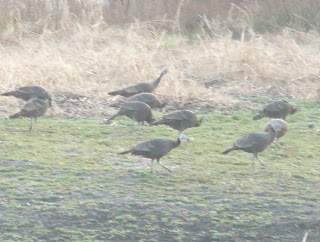
Flock of Turkeys along LaChua Trail in the early morning - 2010


Purple Sandpiper on the jetty at New Smyrna Beach in 2009

Pair of juvenile Tundra Swans at bartram farm in St John's County - 2010


A trio of Ruddy Turnstones on the Jetty at New Smyrna Beach - 2010


Count for the day was 59

Tuesday, January 26, 2010

Hermit Thrush

Ft DeSoto to Lake County
January 21st- Day #3
Double-Crested Cormorant

Laughing Gull at Egmont Key pier
Ft DeSoto Park
Left home at 10am for day three of my birding vacation. The late start was unavoidable and the day's weather was awful. Arrived at Ft DeSoto Park about noon and found conditions very windy, but no storms yet. The winds attracted a couple of dozen wind-surfing enthusiasts, who took over the east beach. I had counted on east beach as a possible site for diving birds, shore birds and perhaps a caspian tern or a black-backed gull. Only got Sanderlings, Dunlins and a lone Ring-billed Gull. Moved onto the Egmont Key pier which was not very birdy and people as well, due to the weather. Only about four Double-Crested Cormorants, a few Laughing Gulls and a lone Common Loon.

But was fortunate to watch a flyby juvenile Northern Gannet. This was surprise as this species is not found here, but with the heavy winds and that juvenile birds are known to wonder beyond their normally established range it was possible. I am very confident on this sighting and this would also be a life bird.
Checked out North Beach, which was wind swept and devoid of birds as well. But I was able to find a a few American Oystercatchers and a juvenile Herring Gulls clustered with Royal Terns and Ring-billed Gulls in a secluded spot out of the wind. Had a pair of Red-Brested Mergansers fly in just as I was heading out.
My list - Red-breasted Merganser, Common Loon, Northern Gannet, Brown Pelican, Double-crested Cormorant, Anhinga, Great Egret, White Ibis, Wood Stork, Black Vulture, Osprey, Bald Eagle, Red-tailed Hawk, American Kestrel, Black-bellied Plover, Killdeer, American Oystercatcher, Sanderling, Dunlin, Laughing Gull, Ring-billed Gull, Herring Gull, Royal Tern, Rock Pigeon, Eurasian Collared-Dove, Loggerhead Shrike, Fish Crow, Blue-gray Gnatcatcher, American Robin, Pine Warbler, Palm Warbler, Red-winged Blackbird, Common Grackle, Boat-tailed Grackle, Brown-headed Cowbird
Ft DeSoto Brochure-Map


Prior to arriving at Ft DeSoto, Checked out the Tierra Verde pond for waterfowl and the pond was loaded. Mostly found Redheads and Ring-necked Ducks, plus Pied-billed Grebes, Ruddy Ducks, American Wigeons, Lesser Scaups and Northern Shovelers.
My list - American Wigeon, Northern Shoveler, Redhead, Ring-necked Duck, Ruddy Duck, Pied-billed Grebe, Great Egret, Osprey, American Coot, Ring-billed Gull


Lake County
My late start got me to Ranch Road east of Astulta in Lake County a bit late to find the resident say's phoebe, because of the pending nightfall and a prior local rainstorm the bird was probably at roost. So took a stab at the western kingbirds, sparrows and a possible ash-throated flycatcher on Lust Road in Apopka. But it too was bird-free. But did find a pair of Western Kingbirds and hundreds of American Robins at the nearby Hopper Farm roost site.
With it getting dark I lastly took a shot at owls at the North Shore - Lake Apopka restoration parking lot. Did get a pair of Hermit Thrushs and as I was checking them out, noticed not ten feet away but separated by a fence was a bobcat. We both did a quick retreat. Observed the cat a couple more times and it seems that it was not intimidated by my presence. Did get a brief look at a low flying Great Horned Owl.
Lake Apopka Restoration Area map


Bobcat

My list - Great Blue Heron, Wood Stork, Sandhill Crane, Great Horned Owl, Least Flycatcher, Eastern Bluebird, Hermit Thrush, Western Kingbird, American Robin

Monday, January 25, 2010

Swamp Sparrow


White Ibis

Babcock-Webb and The Celery Fields
January 19th - Day #2 of Birding Vacation

Babcock-Webb WMA - I try to time my arrival at Babcock-Webb just at dawn so as to have the best opportunity to locate the Red-Cockaded Woodpeckers as they exit their holes. Today my timing was perfect as I arrived at the colony site on Oilwell Grade and found that the pair of RCW were already poking their heads out of their holes and calling to each other. Then in a burst each exits their home to begin a new day. At the next side trail I was lucky to get a Bachman's Sparrow and several Grasshopper Sparrows. Even
had a sole Brown-headed Nuthatch working the pine trees here, were a fox squirrel was also busy constructing a nest. So within a half hour I had hits on all three of Babcock's big three - RCW, bachman's sparrow and the brown-headed nuthatch


Later I came onto a nice mixed flock of Yellow-Rumped and Pine Warblers, with Downy Woodpeckers. A bit further on had a repeat hit on an RCW and and another brown-headed nuthatch.
Lastly, I came across a few sparrows, which I at first took for chipping sparrows, which I had not seen before at Babcock-Webb, but are listed on the printed bird list. However, after reviewing my photos I believe I actually found Swamp Sparrows, which are not on the bird listing.

My list - Great Blue Heron, Great Egret, Little Blue Heron, Green Heron, White Ibis, Wood Stork, Northern Harrier, Sandhill Crane, Mourning Dove, Common Ground-Dove, Belted Kingfisher, Red-bellied Woodpecker, Red-cockaded Woodpecker, Loggerhead Shrike, Blue Jay, Tree Swallow, Brown-headed Nuthatch, Eastern Bluebird, American Robin, Gray Catbird, Northern Mockingbird, Yellow-rumped Warbler, Pine Warbler, Palm Warbler, Common Yellowthroat, Eastern Towhee, Bachman's Sparrow, Savannah Sparrow, Grasshopper Sparrow, Swamp Sparrow, Northern Cardinal, Eastern Meadowlark, Common Grackle, Boat-tailed Grackle

Swamp Sparrow

Fruitville Road
Next headed up to Sarasota were I rechecked the pond on Fruitville Road were a female common goldeneye and a female bufflehead were located last month. They were not to be found. But there was a male scaup that was much larger than any of the other Lesser Scaups on hand and bases on the size I have concluded it was a Greater Scaup.
My list - Ring-necked Duck, Greater Scaup, Lesser Scaup, Hooded Merganser

The Celery Fields
Stopped at the nearby Celery Fields with the idea of locating Black-Bellied Whistling Ducks. The nearby ponds were loaded with American Coots, Moorhens, Blue-winged Teal and some Mottled Ducks. A Northern Harrier was working over the area and Palm Warblers were at home at the gazebo. The Black-Bellied Whistling Ducks were located far back on the shoreline of a larger lake and were confirmed as a pair rose up and flew closer to my location.
My list - Black-bellied Whistling-Duck, Mottled Duck, Blue-winged Teal, Anhinga, Black Vulture, Turkey Vulture, Northern Harrier, American Kestrel, Common Moorhen, American Coot, Laughing Gull, Loggerhead Shrike, Palm Warbler, Red-winged Blackbird

My count for the day - 49 species

Sunday, January 24, 2010

Owl to Owl - Birding in Dade County


Owl to Owl
Birding in Dade County
Monday January 18th - Day #1 of my birding vacation


Along Tamiami Trail
This is to be day #1 on my birding vacation week. Starting out with a very long day trip to Dade County to seek out seasonal South Florida specialties, plus any exotics I can locate. Left home about 5:30am and traveled the Tamiami Trail heading first to the campus of Florida International University. As dawn brightened the new day hundreds of wading birds could be seen lining the parallel canal, but my first bird sighting of the day was a Barred Owl who’s silhouette was easily seen in a bare tree along side the highway. Did stop to confirm the sighting and knew it would be a good day.


Florida International University
FIU is located along the Tamiami Trail outside of Miami and is were the Florida Rare Bird Alert had noting the unusual sighting of a male Western Tanager. One reason I chose Monday for this trip is that it was a holiday and the school would be closed for the day allowing easier access to parking, which is a big deal here. Ran into Trey Mitchell here, who along with a couple of other local birders, put me onto the tanager.
 The Western Tanager was a life count for me. This is link to Trey Mitchell's tanager photos.
Scissor-tailed Flycatcher


Also observed a pair of White-Crowned Pigeons leaving the campus preserve as I arrived. The noisy monk parakeets were easily notice and did find a couple of Blue-Headed Vireos. The other birders were mostly heading up to the Miami Beach area to looking for the red-footed booby and common eider reported there. Another choice was Bill Baggs to look for the La Sagra Flycatcher . But my plans were to head over to Lucky Hammock for hawks.

 My FIU list - Cooper's Hawk, Rock Pigeon, White-crowned Pigeon, Monk Parakeet, Loggerhead Shrike, Blue-headed Vireo, Northern Mockingbird, European Starling, Western Tanager, Boat-tailed Grackle.


Florida City
Checked out the Scissor-tailed Flycatcher site on 314th SW in Florida City and was able to get a single flycatcher and no western kingbirds on this stop.
Lucky Hammock
 Contractors were busy at the Lucky Hammock location as they were prepping the area for the C-111 canal Everglades Restoration project, to divert the canal drainage effect by spreading the water flow across more land. This project should not effect the birding at this location. This morning not much was happening at the hammock, but a couple of Swainson’s Hawks and a couple of Short Tailed Hawks were easily located. A Northern Harrier was very active in the fields as well. Moved on to the Cutler Wetlands from here, but I plan to return at dusk to look for Lesser Nighthawks and Short-eared Owls.

Homestead
In as stop in Homestead for gas had a pair of Common Mynas foraging about the gas station. I have found this location to be pretty reliable for mynas. The corner of West palm Drive and Krome Ave.
Cutler Wetlands and Cutler Marsh
The lighting was awful at Cutler Wetlands and it was difficult to id a lot of the ducks and the water was high so there were almost no shorebirds or waders. About a dozen American White Pelicans were present.

American White Pelicans at Cutler Marsh
 Thought that I would give the nearby Cutler Marsh area a try. Found more than a hundred white pelicans and a few ducks like Blue-winged Teal, Green-Winged Teal and Mottled ducks, plus a few Glossy Ibis. Hundreds of vultures can be seen soaring over the near ‘Mt Trashmore’ garbage dump.

My list for Cutler Wetlands - Mottled Duck, Blue-winged Teal, American White Pelican, Common Moorhen, American Coot, Greater Yellowlegs, Lesser Yellowlegs, Ring-billed Gull, Eurasian Collared-Dove


My list for Cutler Marsh- Mottled Duck, Blue-winged Teal, Green-winged Teal, American White Pelican, Great Egret, White Ibis, Glossy Ibis, Black Vulture, Turkey Vulture, Red-shouldered Hawk, Common Moorhen, American Coot, Belted Kingfisher, Eastern Phoebe

Kendell
Headed from here to Kendall Baptist Hospital campus. This is a good area to look for exotics like red-Whiskered Bulbuls, Spotted Orioles and various parrots. Walked the ponds and had hits on Red-Masked and Mitred Parrots. The ponds are also home the a great many White Ibis, Muscovy Ducks and a couple of domesticated geese. Also drove around the neighborhood across Kendall Avenue from the hospital for the Bulbuls, but got a dip on them. I understand that it is best to patrol that area in the early morning, like about 8:30am.


My list - Muscovy Duck, Double-crested Cormorant, White Ibis, Monk Parakeet, Red-Masked Parrot, Mitred Parrot, Fish Crow, European Starling, House Sparrow.
Back to Lucky Hammock

Got back to Lucky Hammock about 5:00 and met a veteran birder named Dave who was in from Naples. He had pretty much followed the same itinerary as I had. He put me onto the pair of White-tailed Kites commonly seen here as they came in to hunt the fields. These birds would soar over the area and then hover in place as they scoped out any likely meal options. They hunted just up till dusk. I was able to sight a Western Kingbird inside the hammock. Usually we’d see them wire sitting, but I guess it had gone to roost. One interesting sighting was for Dave, when he walked across the field to the tree-line, as we waited for the short-eared owls, he nearly stepped on a Whip-poor-will which flushed at his feet. Lots of raptures were still about including a Broad-winged hawk, Red-Shouldered Hawk, a Merlin, several Kestrels, the Northern Harrier and a Swainson’s Hawk. Finally at dusk a pair of Lesser Nighthawks rose above the trees to the west. They were a life count for me. As the mosquitoes came out and it was getting a bit dark we chose to leave, I thought that I had heard the short-ear’s call but nothing was seen. But finally an owl made its appearance. Its silhouette could be seen landing atop a power pole and a second owl flew up to it and then flew down low and out of sight. So we had an owl, but it was not the sought after short-eared, but a Great Horned Owl.

So at the conclusion of this long day my last bird was also an owl. Started with an owl and ended the same.

My list for Lucky Hammock - Cattle Egret, Black Vulture, Turkey Vulture, White-tailed Kite, Northern Harrier, Red-shouldered Hawk, Broad-winged Hawk, Short-tailed Hawk, Swainson's Hawk, Merlin, Sandhill Crane, Mourning Dove, Common Ground-Dove, Great Horned Owl, Lesser Nighthawk, Eastern Phoebe, Western Kingbird, Tree Swallow, Blue-gray Gnatcatcher, Gray Catbird, Northern Mockingbird, Yellow-rumped Warbler, Palm Warbler, Savannah Sparrow, Eastern Meadowlark.

A total of 69 species were counted for the day
Muscovy Duck, Mottled Duck, Blue-winged Teal, Green-winged Teal, Common Mynah, American White Pelican, Double-crested Cormorant, Anhinga, Great Blue Heron, Great Egret, Snowy Egret, Little Blue Egret, Tricolored Heron, Cattle Egret, White Ibis, Glossy Ibis, Wood Stork, Black Vulture, Turkey Vulture, Osprey, White-tailed Kite, Northern Harrier, Cooper’s hawk, Red-shouldered Hawk, Broad-winged Hawk, Short-tailed Hawk, Swainson’s Hawk, American Kestrel, Merlin, Common Moorhen, American Coot, Sandhill crane, Killdeer,  Greater Yellowlegs, Lesser Yellowlegs, Ring-billed Gull, Rock Pigeon, White-crowned Pigeon, Eurasian Collared-Dove, Mourning Dove, Common Ground-Dove, Monk Parakeet, Mitred Parakeet, Red-Masked Parakeet, Great Horned Owl, Barred Owl, Lesser Nighthawk, Belted Kingfisher, Eastern Phoebe, Western Kingbird, Scissor-tailed Flycatcher, Loggerhead Shrike, White-eyed Vireo, Blue-headed Vireo, American Crow, Fish Crow, Tree Swallow, Blue-gray Gnatcatcher, Yellow-rumped Warbler, Palm Warbler, Western Tanager, Savannah Sparrow, Eastern Meadowlark, Common Grackle, Boat-tailed Grackle, House Sparrow.