Monday, May 18, 2015

A Visit to Carlos Pointe

Monday, May 18th

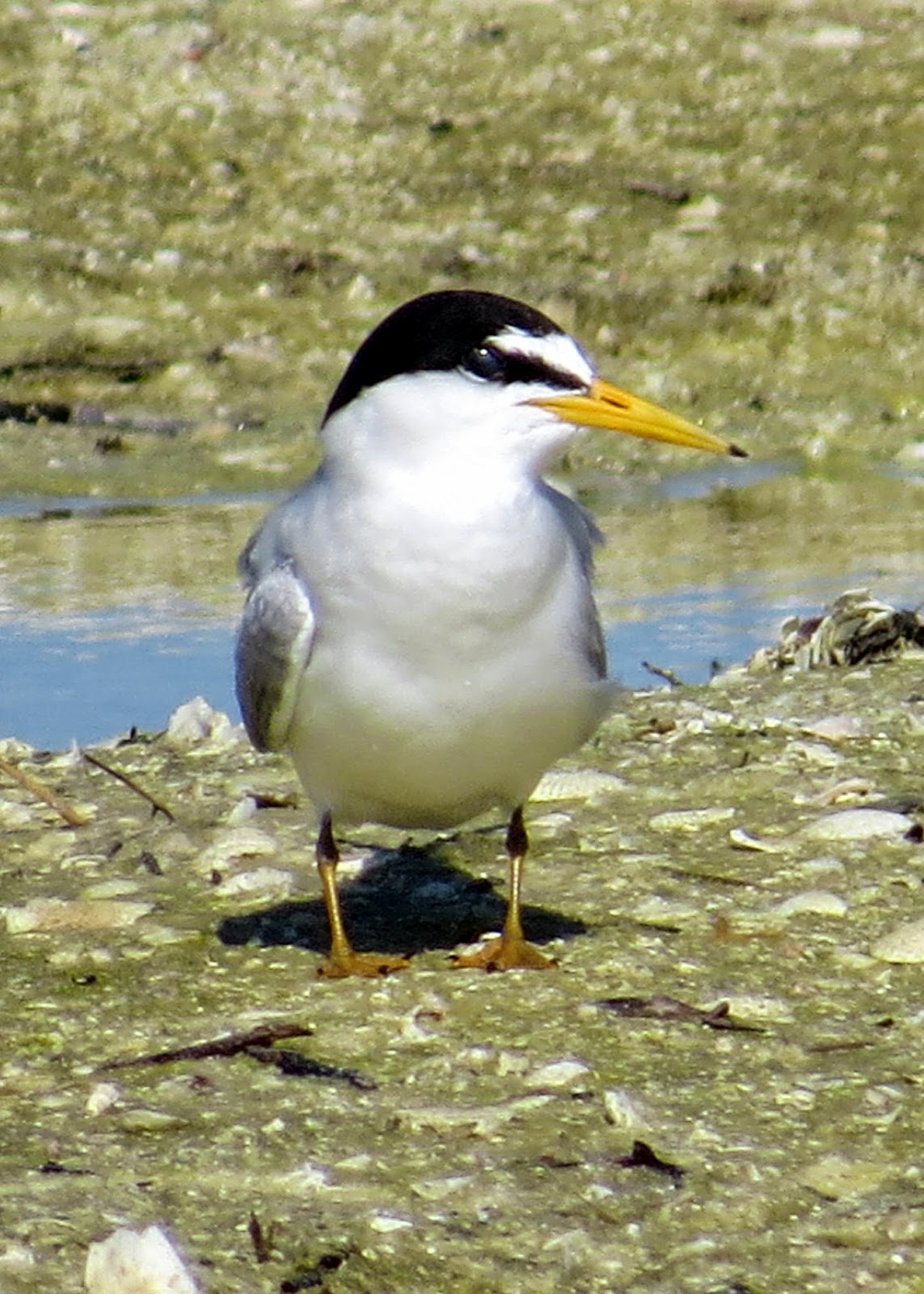
Least Tern
Black Skimmer
Mid-morning, I visited Carlos Pointe to see the Least Tern nesting colony and find any Snowy Plovers. Parked at the Lovers Key State Park entrance at the north end of the park and is at the south end the pass bridge. This is the closed legal parking to access Carlos Pointe which is located at the other side of the pass, which is the most southern point on Estero Island.  

Black Skimmer
The nesting colony was very active with hundreds of Least Terns, Black Skimmers and a few Snowy Plovers. The Sanderlings (many in breeding plumage), Ruddy Turnstones, Laughing Gulls, Brown Pelicans, Royal Terns and Sandwich Terns were also seen here today.


Snowy Plover
Snowy Plover
Dozens of snowies call Lee County beaches as their home

Fledgling Snowy Plover

Least Terns are very defensive in the nesting colony 
and will dive at any intruders. 
They are the smallest tern species and 
will nest in scrapes on sandy beaches and flat roof tops


Least Tern

Sandwich Terns

Royal Tern
Sanderling

Sanderling
Osprey perched atop neighboring condo building

Gray Kingbirds are seen perched on the wires along Estero Boulevard

Looking for Owls

Saturday May 16th


Today as I was heading home from work, I elected to make a stop on Lee Road that sometimes yields Burrowing Owls. The site is a property along Alico Road in San Carlos Park in Lee County being developed as the Alico Road Business Park. 

Just before the financial crisis several years ago, this property was was prepped by felling trees, clearing brush and removing a railroad spur. However as the the economy continued to crashed, the land just sat as is awaiting better times. But the cleared property attracted grassland birds including Meadowlarks, Sandhill Cranes, Northern Harriers, Bobwhite, Grasshopper and Savannah Sparrows.


It also attracted a small population of Burrowing Owls.

The owls were best located along the Lee and Domestic Street parcels, Especially as they were brooding their young.

Today I was able to see three of the owls along Lee Street, but they will become more difficult to find after the babies have fledged.

Tuesday, May 5, 2015

A Visit to Bunche Beach Preserve

Tuesday May 5th


A Short-billed Dowitcher with several Red Knots


Early this morning I found time to spend enjoying the bird life feeding in the shallows and mud at Bunche Beach Preserve. 

American Oystercatcher


Found hundreds of shorebirds beginning to sport there breeding colors including Red Knots, Short-billed Dowitchers, Marbled Godwits, Willets, Dunlins, Black-bellied Plovers, Sanderlings, Semipalmated Sandpipers, Least Sandpipers, Ruddy Turnstones, and a pair of American Oystercatchers

Marbled Godwit


A White-morphed Reddish Egrets.
The white-morphed are not as common here as we find further south in the Keys
One species I was interested in locating were White-rumped Sandpipers and I was lucky to see one as it flew off. Another migrant spotted were a couple of noisy Bobolinks passing over head. 


A Short-billed Dowitcher in his breeding colors
Breed in sub-arctic regions of Alaska and central Canada

A Male Black-bellied Plover.
A very common species that breeds in the high arctic
from Siberia east to Baffin Island in Canada

Wilson's Plover
A local breeder on the salt flats in this preserve

A female Black-bellied Plover

Dunlin.
This species is very abundant and breeds in sub-arctic
and arctic regions of  Alaska, Canada, Greenland, Iceland, Norway, Russia

Least Sandpiper.
Will be heading off to their breeding grounds in sub-arctic tundra
 and northern boreal forests in Alaska and Canada

Male Red Knot and Short-billed Dowitcher

Male Red Knot

Male Red Knot


Red-shouldered Hawk

Willet


Ruddy Turnstone

Semipalmated Sandpiper
A very abundant species that breeds in sub-arctic regions
 from Siberia to Newfoundland

Red Knots
Are very long distance travelers. They fly to the high Arctic
 for breeding from  their wintering locations spread across the planet.
Some from as far away as
New Zealand, Argentina, Africa and even Florida


Sunday, May 3, 2015

Migration Continues to be Slow

Monday May 4th

Our little corner of Florida continues to be quite slow for local birders as the migrants take advantage of favorable winds and fly past us. Even the migrant hot spot at Ft DeSoto Park in Tampa Bay has been very slow. Its good for the birds and not so much for us.


Rose-breasted seen at Sanibel Lighthouse


But a recent bout of weather has contributed a few interesting spring migrants. In the past few days I was able to add samplings of neotropicals to include Yellow-billed Cuckoo, Rose-breasted Grosbeak, Scarlet Tanager, Blackpoll Warbler, Cape May Warbler,  Magnolia Warbler, Red-eyed Vireo, Eastern Kingbird, Northern Waterthrush, American Redstart and Orchard Oriole.

Other folks have found Blue-winged Warblers, Yellow-throated Vireo, Summer Tanagers, Bobolinks, Wilson's Phalarope, and White-rumped Sandpiper.

Black-and-White Warbler at Six-Mile Cypress Slough Preserve
Other species are arriving in the area to take up summer residence, such as the much appreciated and popular Swallow-tailed Kites. They arrive just as February gives way to March and will be gone about the end of July. The Common Nighthawks are just arriving now and will be around till about the end of August. Purple Martins are already fledgling there broods and will soon be free-ranging. A few Chimney Swifts have pasted through and some will spend the summer with us. Gray Kingbirds have also arrived and the Least Terns that nest on our beaches should be increasing their local population soon.  A good place to see many of these species during the summer is down at the River District in Ft Myers.
Orchard Oriole at Sanibel Lighthouse

Cape May Warbler at Ding Darling NWR

Monday, April 13, 2015

Spring Migration Has Stalled


Cuban Anole seen at Six-Mile Cypress Preserve
Monday, April 13th

Spring migration has come to a screeching halt. We had a very nice land-fall a couple of weeks ago, but weather patterns have largely pushed the migrates to the west of Florida.  Even a visit today by the Calusa Bird Club to the migrate hot spot at Fort DeSoto, in Pinellas County, as reported by Vince McGrath, only yielded a couple of  passerine migrants.

Gray Catbird at Six-Mile Cypress Preserve

At Six-Mile Cypress Slough Preserve today we , Ron Bishop and Walt Wintondid find a Northern Waterthrush and lots of Gray Catbirds. But mostly we found the expected natives like Carolina Wrens and Northern Cardinals.

Northern Cardinal at Six-Mile Cypress Preserve

Carolina Wren at Six-Mile Cypress Preserve


We still have a lot of interesting birds that are seen year round.  Here are a few.

Black-crowned Night-Heron at Six=Mile Cypress Preserve

Green Heron at Six-Mile Cypress Preserve

Male Wood Duck seen near the airport

Florida Scrub Jay found in Leigh Acres. Our only Florida endemic species

Male Snail Kite seen near Harns Marsh

The very common Boat-tailed Grackle

Our State Bird - The Northern Mockingbird

Burrowing Owl dozing in Cape Coral

The Eurasian Collared Dove is also a very common species

This Monk Parakeet was collecting nesting materials in Cape Coral

This strange looking duck appears to be a cross between a feral Muscovy Duck
 and some sort of domesticated duck
This Blue Jay was seen at Six-Mile Cypress Preserve


Wednesday, April 8, 2015

Spring Migration

Wednesday April 8th
Hooded Warbler at Sanibel Lighthouse,
 Photo courtesy of Tammy McQuade

Spring migration has arrived here in Southwest Florida. The waterfowl, sparrows, harriers and yellow-rumped warblers have departed. The dunlins, dowitchers and piping plovers will be gone soon.  And the neo-tropics are now passing through.

Weather conditions dictate what, if any, migrants passing through will stop here for a rest. A week ago we had a very nice land-fall of warblers and swallows. The lighthouse on Sanibel Island is the spring hot spot for birding these resting birds. I visited there this morning and most of our earlier visitors had already moved on. Was able to see my FOS sightings of Magnificent Frigatebird and Barn Swallows, plus a Worm-eating Warbler, a single Palm Warblers and a gorgeous Prairie Warbler.
But that earlier land-fall was very rewarding.  I couldn't participate till the third day when I was able to see a Swainson's Warbler, several Hooded Warblers, a Worm-eating Warbler, many White-eyed, Blue-headed and Red-eyed Vireos. Also saw Prothonotary, Northern Parulas, Black-and-White, Prairie and Palm Warblers. A beautiful Swallow-tailed Kite was hunting the tree tops as well. Dipped on the Kentucky Warbler and Oven Bird observed by others.
A rare to our area cave Swallow at Sanibel Lighthouse.
Photo courtesy of Tammy McQuade
On the first couple of days of this land-fall exhausted Barn, Tree, Cliff and even a rare to our area Cave Swallow were observed. All of the previously mentioned warblers and vireos were reported. Gray and Eastern Kingbirds, Indigo Buntings and a suspected Lazuli Bunted have also been reported. I had a suspected first season female cerulean warbler at Six-mile Cypress Preserve.
Swainson's Warbler at sanibel Lighthouse,
 Photo courtesy of Tammy McQuade

Hopefully we'll be treated to more colorful migrants passing through. Another interesting spring migrant are a hand full of Greater Flamingos that have been returning to an isolated and off-limits sight in western Palm Beach county. Seem that varying numbers of these birds have been visiting in the spring for the last several years. The word got last year about this population and the Miami Herald posted an article about a count of 143 at that time.  So far this year only eight have been reported.  Limited access has been made available by reservation, but quickly filled up. My friends Dr Jose Padilla and Dave and Tammy McQuade managed to participate in the first tour of the sight and were successful.
Greater Flamingos seen at STA 2 in  Palm Beach County
 Photo Courtesy of David McQuade

So many visitors to Florida think that they have seen a flamingo, by misidentified the much more common Rosette Spoonbill. But they can be seen, rarely,  even on occasion in our area.
 The best bet is a winter visit to Snake Bight. This is a shallow section of Florida Bay abutting Everglades National Park. Access here is either walking the Snake Bight Trail to its terminus or kayaking to the location from the marina at Flamingo.