Monday, June 15, 2015

A Visit to the Conch Republic and Vicinities - Part 4

Sunday, May 25th  Memorial Day

White-winged Parakeets

Just spent Monday morning visiting a few spots around south Miami before heading back to Ft Myers. As today is a national holiday, the University of Miami campus in Coral Gables would be a good place to start the day looking for exotics.


No classes today, so the campus was very quite. And we were hopefully to finally experience the blue and yellow macaws that can sometimes be seen here. We  did see or hear the macaws, but we did find a pair of Common Hill Mynas, a couple of White-winged Parakeets, a single Red-masked Parakeet and lifers in seeing two pair of Scaly-headed Parrots (Pionus maximiliani). They scaly-headed parrots are species from South America.  All of the birds mentioned are local populations of escaped caged birds and their off-springs, that have managed to find a home in sub-tropical Miami.
A pair of Scaly-headed parrots 

Scaly-headed Parrots
Red-masked Parakeet


Affectionate Common Hill Mynas

Black-crowned Night-heron hunting small crabs in the rocks

A Green Anole

We moved on to recheck the campus of the Kendall Baptist Hospital and found the Mitred Parakeets busy feeding in the palm trees. A couple of Egyptian Geese were found at the smaller pond away from the Muscovy ducks, Graylag Geese, Swan Geese and other domesticated ducks on the larger pond.  Bob thought that the Egyptian Geese may have been nesting. 

Last stop for the trip was a location along Snapper Creek Canal for the nesting Cave Swallows seen there. Several were seen flying in and out from under the bridge. We also spotted what I think are Spiny-tailed Iguanas sunning themselves along the canal. 

From here it was time to end the birding and head home. We didn't get all of the photographic opportunities we were looking for, but it was a successful weekend. Next year need to go a few weeks earlier.


Egyptian Goose in Kendall

Great Egret at Kendall

Mitred Parakeet feeding in palm tree
 We found close to a hundred bird species including most of the Florida Keys avian specialties, many south Florida exotic birds and lizards and other south Florida native fauna including Bottle-nosed Dolphins, Key Deer and American Crocodile.
Spiny-tailed Iguana at Snapper Creek Canal


Monday's Bird List
Swan Goose (Domestic type)
Graylag Goose (Domestic type)
Egyptian Goose
Muscovy Duck
Mallard (Domestic type)
Great Egret
Snowy Egret
Tricolored Heron
Green Heron
Yellow-crowned Night-Heron
White Ibis
Common Gallinule
Rock Pigeon
Eurasian Collared-Dove
Common Ground-Dove
Mourning Dove
Red-bellied Woodpecker
White-winged Parakeet
Scaly-headed Parrot
Mitred Parakeet
Red-masked Parakeet
Gray Kingbird
Blue Jay
Fish Crow
Cave Swallow
Northern Mockingbird
Common Hill Myna
European Starling
Northern Cardinal
Common Grackle
Boat-tailed Grackle
House Sparrow


Tuesday, June 9, 2015

A Visit to the Conch Republic and Vicinities - Part 3

Sunday May 24th
Ft Jefferson at Dry Tortugas National Park

Now Sunday was the cornerstone for this trip the sailing aboard the Yankee Freedom from Key West out to the Dry Tortugas National Park for a four hour visit.
Magnificent Frigatebird

As Bob Pelkey drove us southward through the Keys in the pre-dawn darkness back toward Key West, several Antillean Nighthawks could be heard. And as day broke, Gray Kingbirds, Eurasian Collard Doves, White-crowned Pigeons  and feral keys chickens were also greeting the day.

Arrived at the Key West terminal just as the crew were preparing to board today's passengers. The ride was a bit choppy and the sky was clear.  The Captain gave us a close pass by Hospital Key, were more than sixty Masked Boobies had a breeding colony.

A few minutes later we landed at Bush Key and historic Ft Jefferson. A flotilla of Magnificent Frigatebird sat hovering in the wind above the fort.  They, along with many hundreds of Brown Noddies and Sooty Terns nest on adjoining Garden Key. The Noddies, Terns and any (very late) spring migrants were the reason we traveled here.

There a few migrants to be seen. A lone Cliff Swallow and a lone Bank Swallow were hawking outside the fort.  While a lone Yellow-billed Cuckoo, several American Redstarts, a lone Common Yellowthroat and Bob had a female Blackpoll.
Interior of the Fort


The vast majority of the passengers took advantage of the wonderful snorkeling in the waters around the fort. Understood the one couple had a close encounter with an American Crocodile.  One of the mates on the boat confirmed that a crocodile named Cletus has been calling the Tortugas home for a for some time now.  He's seen it before himself.  A video found on youtube
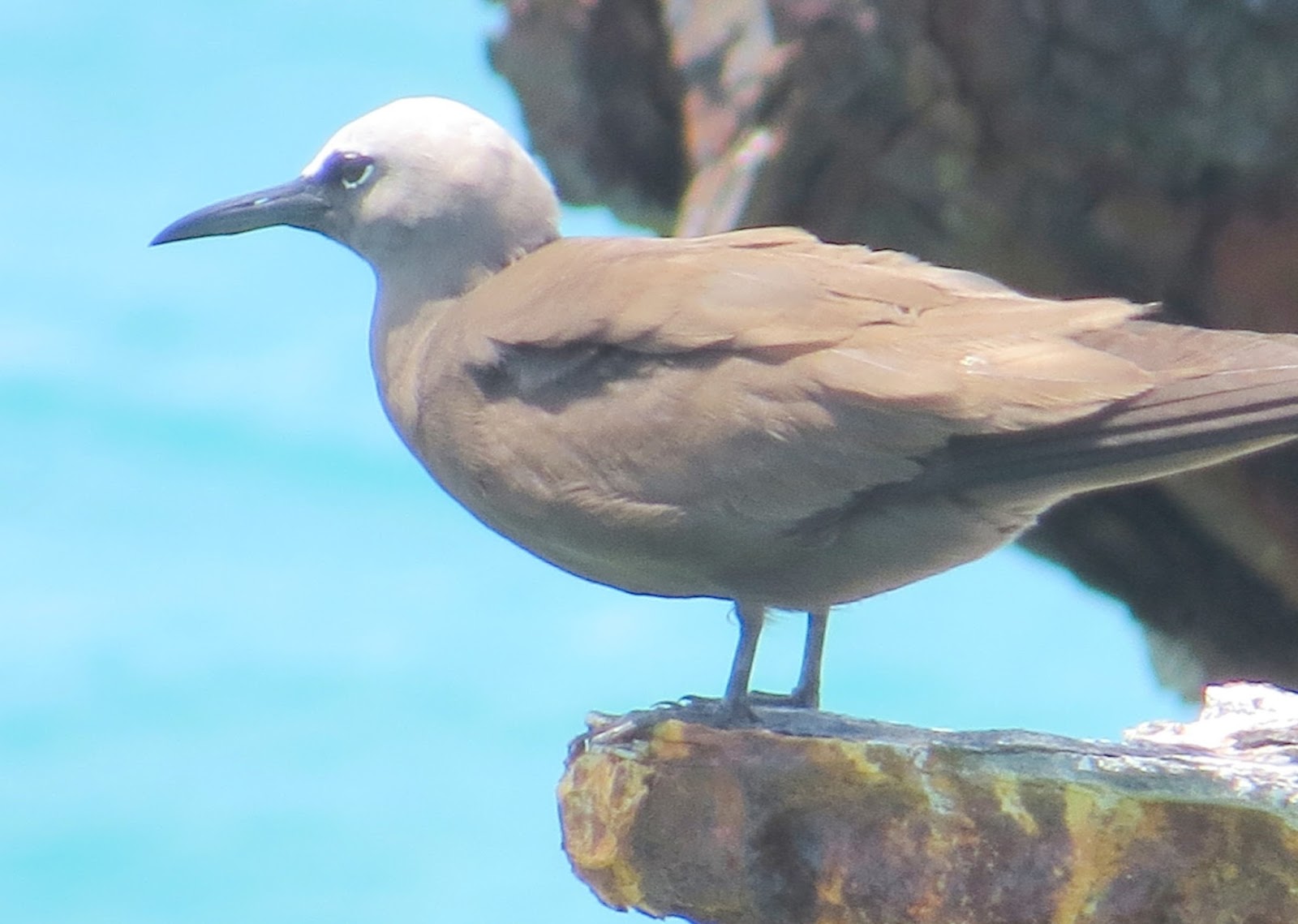
Brown Noddy

Sooty Tern

Yellow-billed Cuckoo
Back at Key West at bit after 5 PM, with that long drive to Florida City. But first we make a couple of stops. First were to find the accommodating and diminutive Keys Deer at the Florida Key Deer NWR on Big Pine Key.
This an endangered sub-species of White-tailed Deer seen only in the Keys.
A young American Redstart


Secondly was a stop at the Marathon Airport set before sundown to look for Antillean Nighthawks. We were joined by a couple of birders from Nashville, Tennessee. They had a lifer when the nighthawk made its appearance and shared with us a sighting of a Bobolink a couple a hundred yards down the airport fence line.  A nice ending for the day's birding.

Sunday's Bird List -- 
Bobolink at Marathon Airport
Magnificent Frigatebird
Masked Booby
Brown Booby
Double-crested Cormorant
Brown Pelican
Cattle Egret
Laughing Gull
Brown Noddy
Sooty Tern
Royal Tern
Eurasian Collared-Dove
Mourning Dove
Yellow-billed Cuckoo
Antillean Nighthawk
Red-bellied Woodpecker
Gray Kingbird
Bank Swallow
Cliff Swallow
Northern Mockingbird
Common Yellowthroat
American Redstart
Bobolink


Key Deer buck in velvet

Bob concentrating on a great shot of the Key Deer. Note the small size of the deer to Bob's right

Tuesday, June 2, 2015

A Visit to the Conch Republic and Vicinities - Part 2

Saturday, May 23rd


Saturday morning we headed out very early to make a run all the to Key West by 8:30. Before starting out Florida City,  Bob Pelkey could hear  a calling Chucks-will-Widow. The first bird for the day.

We did reach Ft Zachary Taylor Historical State Park on Key West by 8:30. Noted that there lots of feral jungle fowl (chickens) in the lower Keys. Another non-native that is found here were large numbers of invasive Green Iguanas. Some quite large.

We spent the remainder of the morning birding the park. White-crowned Pigeons were numerous, here and all through the Keys. Also present today were a few Eastern Kingbirds, Grays Kingbirds, Least Terns, Grackles and Magnificent Frigatebirds. Bob was able to add Bald Eagle, Barn Swallow and American Redstart.  

Green Iguana in Key West
 By noon we were heading back toward the Upper Keys. Made a stop at on Middle Torch Road on Summerland Key. Last year, at this spot we were getting good photos of Black-whiskered Vireos. The vireos continue to be active at this location, but today they would stay deep in the brush.  This would prove to a theme for the rest of the day.


White-crowned Pigeon

Part of the moat surrounding the bastions of Ft Zachary Taylor
Least Terns were active all around the fort

I believe that these blossoms are a species of Indian Blanket. Seen at Ft Taylor


Gray Kingbird

Coast Guard Cutter Thetis is stationed out of Key West
Royal Tern
                                                                                                                At the Marathon government center, Least and Roseate Terns have returned to nest up on the roof . 

This Roseate Tern is sporting a set of legs bands
Unable to read the leg bands code 

Roseate Tern


Roseate Tern


Next, at Key Largo, we stopped at Dagny Johnson State Park. This site contains the largest tract Caribbean Hardwood Hammock left in the Keys. We found the park to be very quite. Only heard Northern Cardinals, White-eyed Vireos and a pair of Mangrove Cuckoos. The cuckoos refused to leave the dense hammock for a photo op.

Lastly was a stop at the toll booth on Sound Card Road to look for Cuban Golden Warblers in the mangroves. We could hear the yellow warblers, but could only coax a Prairie Warbler to pose for the camera.


Red Junglefowl (Domestic type)
Magnificent Frigatebird
Double-crested Cormorant
Brown Pelican
White Ibis
Black Vulture
Turkey Vulture
Osprey
Bald Eagle
Common Gallinule
Laughing Gull
Least Tern
Roseate Tern
Royal Tern
Rock Pigeon
White-crowned Pigeon
Eurasian Collared-Dove
White-winged Dove
Mourning Dove
Mangrove Cuckoo
Red-bellied Woodpecker
Eastern Kingbird
Gray Kingbird
White-eyed Vireo
Black-whiskered Vireo
Fish Crow
Purple Martin
Northern Mockingbird
Common Myna
European Starling
Yellow Warbler
Prairie Warbler
Northern Cardinal
Red-winged Blackbird
Common Grackle
Boat-tailed Grackle


Sunday, May 31, 2015

A Visit to the Conch Republic and Vicinities

Friday, May 22nd
Day One


Today is day one of a long weekend to do some birding in the company of wildlife photographer Bob Pelkey. Didn't start out as a Memorial Day holiday. As it was originally scheduled for the first week of May, to take advantage of the ebbing Spring Migration. But logistics forced this unfortunate change. Home base was in Florida City were room rates were far more realistic than in the Keys.
American Crocodile in Everglades National Park

It has become an annual event to head to the Florida Keys in the Spring to find several of the specialties that are usually only seen there. It started by chasing Antillean Nighthawks and Rosette Terns that are usually found in town of Marathon. But it has now expanded to a four day search for specialties from Dry Tortugas National Park west of Key West up to the urban environments of Miami. 


Leaving Ft Myers, we crossed the state along Alligator Alley watching the birds and especially Black-crowned Night-herons and Swallow-tailed Kites. First stop was on Sherman Road just off Krone near Pembroke Pines to look for Purple Swamphens at Chapel Trails park. Upon arrival I found that my memory card was missing for my camera so I missed getting shots of a Brown Basilisk lizard seen at the start of the board walk or of the swamphens.
Black-necked Stilt near Everglades National Park
 After a stop to replace the missing memory card we made the next stop to neighborhood just north of the Kendall Baptist Hospital for a search for Red-whisked Bulbuls. This is one of the best places to search for these exotic birds and in my dozens of attempts I usually dip on seeing any. Today we sighted three.  Looks like it could be a good start for the weekend.
Green Heron at the Kendall baptist Hospital campus

Red-whiskered Bulbuls in Kendall
 At the Baptist Hospital campus the expected flock of Mitred Parakeets were noisily moving around the property. The ponds also had the usual waders and waterfowl. Didn't see any Egyptian geese but the Muscovy ducks had lots of ducklings.

Next was a stop at Mathesson Park in Coral Gables. Looking for exotics or any lingering migrants. Probably arrived too late in the day as the place was very quite. Best birds here were a pair of Yellow-Chevroned Parakeets and hearing a calling Peafowl
We ended the day visiting Everglades National Park. The goal here was to look for white-tailed kite along Research Road.
We only found American Crows and Eastern Meadowlarks, dipping on the kites.

We headed directly to the end of the road to its terminus at Flamingo. Not very birdy but find Prairie Warbler, Spotted Sandpiper, a Willet, Osprey Brown Pelicans and raucous bottle-nosed dolphins thrashing about as they fish for their supper.

At the marina, an American crocodile came out almost on cue for photographs and a Shiny Cowbird briefly showed with a flock of Brown-headed Cowbirds.
Mitred Parakeet are commonly found at Kendall baptist Hospital campus

Ended the day in Florida City were we watched Gray Kingbirds and Common Mynas


Birds for  Day One
Great Egret at Kendall Baptist Hospital

Swan Goose (Domestic type)
Graylag Goose (Domestic type)

Muscovy Duck
Mallard (Domestic type)
Mottled Duck
Northern Bobwhite
Wood Stork
Anhinga
Great Egret
Snowy Egret
Little Blue Heron
Tricolored Heron
Cattle Egret
Green Heron

White Ibis
Black Vulture
Turkey Vulture
Osprey
Swallow-tailed Kite
Red-shouldered Hawk
King Rail
Purple Swamphen
Black-necked Stilt
Spotted Sandpiper
Willet
Laughing Gull
Rock Pigeon
White-crowned Pigeon
Eurasian Collared-Dove
Common Ground-Dove
Mourning Dove
Common Nighthawk
Chimney Swift
Red-bellied Woodpecker
Mitred Parakeet
Great Crested Flycatcher
Eastern Kingbird
Loggerhead Shrike
White-eyed Vireo
Blue Jay
American Crow
Fish Crow
Purple Martin
Red-whiskered Bulbul
Northern Mockingbird
European Starling
Prairie Warbler
Northern Cardinal
Red-winged Blackbird
Eastern Meadowlark
Common Grackle
Boat-tailed Grackle
Shiny Cowbird
Brown-headed Cowbird
House Sparrow
Black-crowned Night-heron

Common Myna

Gray Kingbird

Yellow-chevroned Parakeets

Peafowl


Tuesday, May 26, 2015

A Few Exotics in Miami

Tuesday May 26th

The semi-tropical climate in South Florida lends itself well as a new home for exotic plants and animals. A great many are considered to be pests and the most successful can be quite harmful to our local ecology. The rise of the Burmese Python population in the Everglades is a prime example. Ornamental plants and trees have also overtaken local flora like the expansion of the Melaleuca and Brazilian Pepper. Their is a bounty on the Lionfish, which has rapidly prospered on our Florida reefs, upsetting the ecological balance by becoming an aggressive top predator, prolific breeder with no known predators in the Atlantic Ocean. Iguanas have become established in most of South Florida with some getting  to be over four feet long.
 Not all invasives cause great ecological harm. Just a few minutes ago I spotted the House Gecko that has moved into my apartment. I don't mind its presence at all as he'll consume most any insect pests.  Many of the exotic bird species have not become major issues. The Monk Parakeet though builds huge nests artificial structures and have created damage such as electrical outages. But most of the many parrot species in south Florida aren't as disruptive the ecology as originally feared.


This past week-end Bob Pelkey and spent four days birding the Miami and Florida Keys area for exotics and came up with several.


Red-whiskered Bulbul in Kendall
Red-Whiskered Bulbul -  A native of eastern India,


Purple Swamphens - A common native in Africa, southern Europe, much of Asia including Indonesia, and Australia.
Purple Swamphen at Chapel Trail in Broward Count


Common Hill Myna - The Common Hill Mynas are a species of starlings and a very popular cage bird coming from the hill regions of southern Asia. 
Common Hill Mynas seen on the campus of the University of Miami

Egyptian Goose - These geese were once considered sacred by the ancient Egyptians, but are currently a popular ornamental waterfowl. Escapees and there offspring have become more common in southeast Florida's parks and golf courses.
Egyptian Goose seen at Baptist Hospital campus in Kendall

Muscovy Ducks - The Muscovy Ducks we find all over south Florida are actually feral specimens of domesticated Muscovy ducks. 
Muscovy ducklings seen at Baptist Hospital in Kendall

Mitred Parakeet - Mitred Parakeets come from Peru, Bolivia and northern Argentina. A large number of these birds can usually be found around the Baptist Hospital in Kendall.


Red-masked Parakeet - Red-masked Parakeets come from the western area of Peru.
Red-masked Parakeet seen at the University of Miami campus

Scaly-headed Parrot - Scaly-headed Parrots range from Brazil through Bolivia, Paraguay and Argentina. 
Scaly-headed Parrot seen on the University of Miami campus
White-winged Parakeet - Once a very common species in Miami, but its numbers have been falling as the Yellow-chevroned Parakeets.have been increasing.  Both species were once known as canary-winged Parakeets. White-winged Parakeets came from the northern Amazon River Basin.
White-winged Parakeet at the University of Miami campus.

Iguanas - Both Green and both species of Spiny-tailed Iguanas are found in south Florida. Theses populations have there start when iguana pet owners either loose or release the big lizards.

A spiny-tailed Iguana seen at the Snapper Creek Canal

Green Iguana seen on Key West

Other exotics seen included Common Mynas and a Brown Basilisk lizard