Wednesday, September 16, 2015

Wilson's Phalarope

Tuesday, September 15th

With the idea that the bird magnet at Ft DeSoto Park in Pinellas County could offer some good sightings, Bob Pelkey and I headed out early today.
Wilson's Phalarope at Siesta Key

But first was a stop at Siesta Key in Sarasota County to twitch after phalaropes. Both Wilson's and Red-necked Phalaropes had been spotted here.  Arriving at sun rise we easily found the Wilson's Phalarope, but the red-necked phalarope was a no-show. We had dipped on the Wilson's on recent visits to Palm Beach County, so there was satisfaction in finding one much closer to home.


Arrived at Ft DeSoto Park by 9:30 and headed first to the East Beach turn-around.  Here found a low tide, but the birds were thin due to para-sailing activity. Mostly saw Sanderlings, Least Sandpipers, Ruddy Turnstones, Short-billed Dowitchers and Laughing Gulls.

A lurking Great Blue Heron in wait at the water feature
 for a small bird to snag.
Next onto the water feature behind the ranger's residence. Folks leaving the site report disappointing results, but had seen Prothonotary warbler, yellow-throated warbler, summer tanager and an early cedar waxwing. But we saw even less. Just Blue-Gray Gnatcatchers and a lurking Great Blue Heron.

Next we returned to the East Woods seeking a pair of reported Great Horned Owls. After much searching we could only hear a distance call of the owl. Again only Blue-Gray Gnatcatchers and Ospreys were seen.
A crew seen at North Woods grinding the tree stumps

Then we moved onto the North Woods and beach. Here we found that almost the entire grove of Australian pines had been removed. This was very disappointing as so much needed shade was gone as were the birds that used use these trees, including the Great Horned Owls that had been nesting in them.
Osprey

And the north beach had also suffered as most of the sand was gone. We did have some birds in a back water including many Willets, Marble Godwits, Dowitchers and Foster's Terns. The lagoon was active with hundreds of Black Skimmers and Sandwich Terns. Also present were more Willets, Godwits, Dowitchers, Ruddy Turnstones, Royal Terns and few more Forster's Terns.

After lunch we checked the fishing pier were we sighted Barn, Tree and Banks Swallows, lots of Laughing Gulls, Cormorants and Brown Pelicans. Then lastly a final stop back at the water feature. The birding was now a little better than we experienced this morning. We finally had a warbler when we found a Yellow Warbler. Also seen, before rain clouds pushed us out, were a five count of Eastern Kingbirds, a few Magnificent Frigatebirds soaring over-head, a Cooper's Hawk flying low passed the fountain.  Perhaps the hawk was one of the causes for so few birds seen at this location.  Actually after over three of searching it was truly apparent that the recently seen migrants had moved on without a fresh wave to replenish the transient population.

GALLERY OF TODAY'S BIRDS

A flotilla of Brown Pelicans

Laughing Gull

Rock Pigeons were seen using the beach
A young Sandwich Tern

Royal Tern

Snowy Plover at Siesta Key

Short-billed Dowitcher

Black-bellied Plover with breakfast

Reddish Egret
Ruddy Turnstone
Fish

Monday, September 14, 2015

Slow Start to Fall Migration

Monday September 14th


Bobolinks seen today at Harns Marsh in Lehigh Acres
Finally, after a very slow start this September with the fall bird migration, action seems to be picking up. We're just now getting nice samplings of migrants passing through Lee County. Blackburnian and Chestnut-sided Warblers are finally here. So are Bobolinks, Summer Tanagers, Eastern Wood-Pewees and Thrushes. More to come!!


White-eyed Vireo seen today at Six-Mile Cypress Preserve
White-eyed Vireo
Eastern Wood-Pewee seen today at Six-Mile Cypress Preserve
Barred Owl seen today at the Grand Father tree at Six-Mile Cypress Preserve

Monday, August 31, 2015

Looking for Terns

Monday, August 31st


Today I visited Bunche Beach Preserve from 9 am till 10 to take advantage of a rising tide and to look for Black and Common Terns. Black terns usually show up in our corner of Florida just before Labor Day and today we found at least six at Bunche.  Was also able to add a first-for-the-year, for me, Common Tern. Plus a few Royal Terns, several Sandwich Terns and a few lingering Least Terns.


Roseate Spoonbill

The exposed mud flats at this low tide had attracted hundreds of shore and wading birds as well. They included Willets, Marbled Godwits, Short-billed Dowitchers, Black-bellied Plovers, Semipalmated Plovers, Piping Plovers, a Snowy Plover, Sanderlings, Ruddy Turnstones, Red Knots, Least Sandpipers, Western Sandpipers, Semipalmated Sandpipers, Spotted Sandpipers and Brown Pelicans. We also had Great Blue Herons, Yellow-crowned Night-heron, Great Egret, Snowy Egrets, Tricolored Herons, Reddish Egrets, White Ibis and Roseate Spoonbills.

Other sightings include Osprey, a Bald Eagle, Barn Swallows, Belted Kingfisher and Northern Cardinals. What a great venue!!


 A Photo Gallery of Today's Birds

 
Black-bellied Plover

Black-bellied Plover
Common Tern


Black Tern


Royal Tern

Least Tern, wearing its winter plumage

Sandwich Tern


Western Sandpiper

Western Sandpiper

Least Sandpiper

Western Sandpiper

Western Sandpiper

Roseate Spoonbill

Roseate Spoonbill
Willet dining on a crab
A tagged Red Knot. Can't read the tag

Short-billed Dowitcher

Marbled Godwit

Great Blue Heron

Sanderling


Spotted Sandpiper

Spotted Sandpiper

Snowy Plover

Semipalmated Plover

Osprey


Sunday, August 30, 2015

A Revisit to the Everglades Ag Fields

Tuesday, August 25th


Today, Bob Pelkey and I returned to the Everglades Ag Area south of Belle Glade in Palm Beach County to look for birds we missed three weeks ago. These targets included upland sandpiper, buff-breasted sandpiper wilson's phalarope and barn owls.


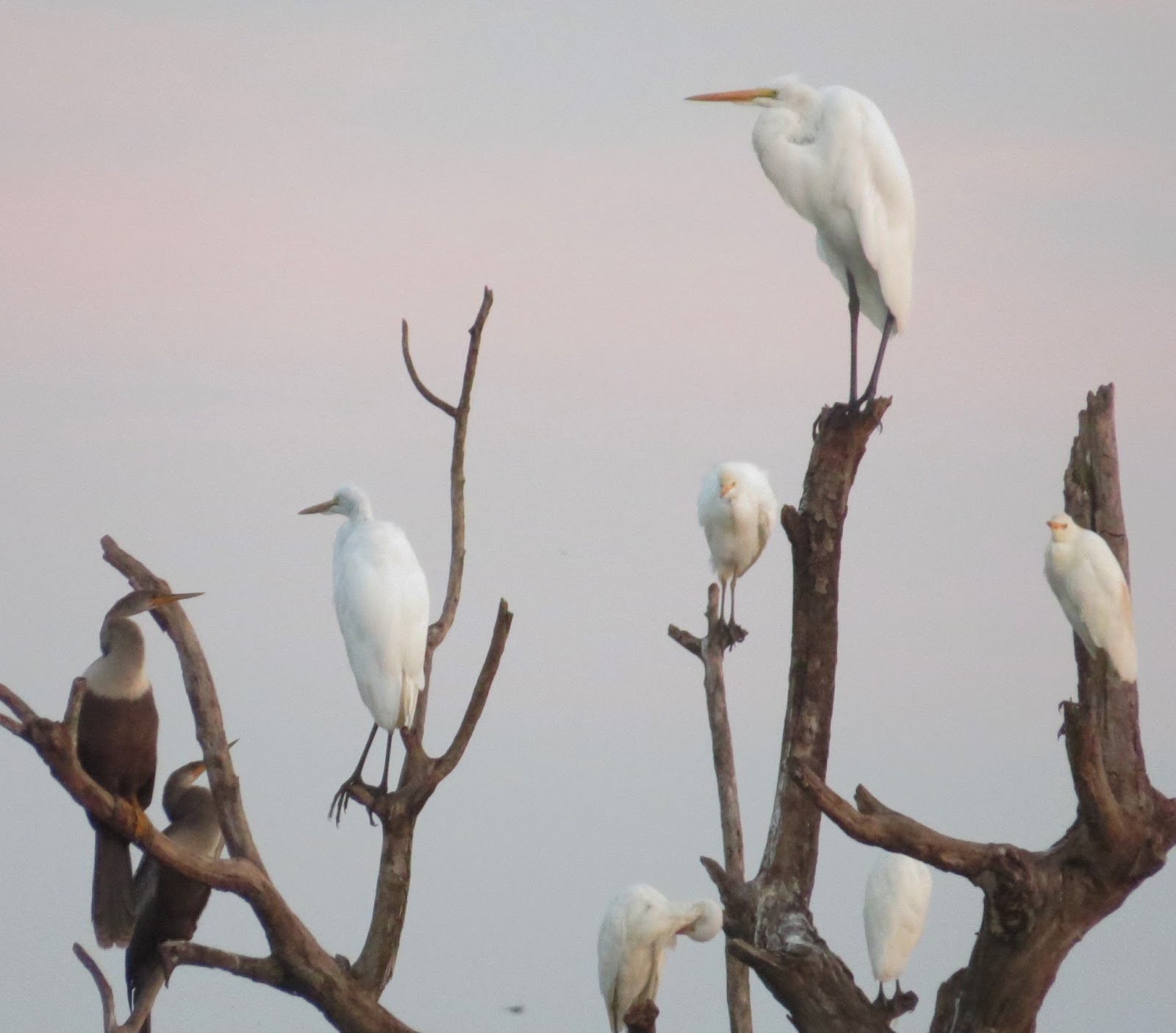
We arrived at sunrise at Brown's farm Road and CR 880 to find the heron roost there loaded with egrets, herons, anhingas, night-herons and ibis.


We then moved on and checked a couple of flooded fields in the area. The wading and shorebird numbers were down, but the number of swallows had swollen, especially Barn Swallows.  We also found Cliff, Bank and FOS Tree Swallows. One of these flooded fields was very active and had been the sight of reported wilson's phalaropes just three days prior.  Bob and scoped the site for an hour and a half without sighting the phalaropes. We did find Black-bellied and Fulvous Whistling Ducks, FOS Blue winged Teal, Mottled Duck, American Avocet, Greater and Lesser Yellowlegs, Least Sandpipers, Pectoral Sandpipers, Stilt Sandpipers, Long-billed Dowitchers, Black-necked Stilts, Common gallinule and American Coots

Juvenile Tricolored Heron. Note the strange bill on this bird


A young Barn Swallow


Bank Swallow


Black-necked Stilt

Lesser Yellowlegs

Lesser Yellowlegs
We then checked the sod fields at 8-mile bend and King Ranch properties for grass peeps and found them virtually devoid of migrant birds.

So we had dipped on three of our four targets of the day, which just left us to check out the barn owl roost on Miami Canal. We initially believed that we had missed out here.  But as Bob was maneuvering his camera to get a good shot of out FOS Eastern Kingbird, a Barn Owl burst out from cover and immediately disappeared deeper into the stand.

A last stop was made in Clewiston, at the Hoover Dike to look for any bronze cowbirds. What we did see were about fourteen Swallow-tailed Kites soaring westerly with a high flying Cooper's Hawk diving at a couple of the kites.  Not sure why the hawk has attaching the kites, but it was an entertaining conclusion for the trip.

Common NightHawk


Cattle Egret


Red-shouldered Hawk


Great Egrets
Compilation Bird Lists from Both Visits this Month - (81)

Great Egret
Black-bellied Whistling-Duck, Fulvous Whistling-Duck, Mottled Duck, Blue-winged Teal, Northern Bobwhite, Pied-billed Grebe, Wood Stork, Double-crested Cormorant, Anhinga, American White Pelican, Great Blue Heron, Great Egret, Snowy Egret, Little Blue Heron, Tricolored Heron, Cattle Egret, Green Heron, Black-crowned Night-Heron, Yellow-crowned Night-Heron, White Ibis, Glossy Ibis, Roseate Spoonbill, Turkey Vulture, Black Vulture, Osprey, Swallow-tailed Kite, Cooper's Hawk, Bald Eagle, Red-shouldered Hawk, King Rail, Purple Gallinule, Gray-headed Swamphen, Common Gallinule, American Coot, Limpkin, Sandhill Crane, Black-necked Stilt, American Avocet, Semipalmated Plover, Killdeer, Spotted Sandpiper, Solitary Sandpiper, Least Sandpiper, Greater Yellowlegs, Lesser Yellowlegs, Stilt Sandpiper, Pectoral Sandpiper, Western Sandpiper, Long-billed Dowitcher, Laughing Gull, Least Tern, Gull-billed Tern, Black Tern, Black Skimmer, Rock Pigeon, Eurasian Collared-Dove,
Common Ground-Dove, White-winged Dove, Mourning Dove, Barn Owl, Common Nighthawk, Belted Kingfisher, Eastern Kingbird, Fish Crow, Purple Martin, Tree Swallow, Bank Swallow, Barn Swallow, Cliff Swallow, Blue-gray Gnatcatcher, Northern Mockingbird, European Starling, Common Yellowthroat, Prairie Warbler, Red-winged Blackbird, Eastern Meadowlark, Common Grackle, Boat-tailed Grackle, Brown-headed Cowbird and House Sparrow

Sunday, August 23, 2015

Six-Mile Cypress Slough Preserve

Friday, August 21st

For the past week the boardwalk at Six-Mile Sough Preserve has been closed for maintenance and will be closed for at least another week. So our efforts to bird spring migrants is limited to the parking area and butterfly garden.

Recently it seemed that we were finding most of the best sightings around the parking area anyway, so spending a few minutes in early morning could still offer some good prospects. So today I felt lucky in spotting my FOS Eastern Wood-Pewee and a roosting Short-tailed Hawk


Short-tailed Hawk perched at Six-mile Cypress Preserve
 The Short-tailed Hawk is one of the rarest birds found in Florida. It is reported that there are only about 500 of these birds living here. We see both the dark and light phases. Currently a pair of dark Short-tailed Hawks have been regulars at Six-mile Cypress Slough.

The species is far more common in tropical Mexico and south into South America. This species needs large tracts of riparian woodlands and cypress swamps and is rarely observed roosting. We do see them soaring above the forests as they search for there primary prey, small birds.

Avian Research and Conservation Institute (ARCI) web site.