Wednesday, May 5, 2010

Terns and Flycatchers

Terns and Flycatchers
  Much of the spring migration has already passed us here in southwest Florida. Hopefully a few interesting or even exciting birds will still continue to come our way.
  I have noticed that we have a pair of Great Crested Flycatchers hanging around our house this week.  They would be a new Yard Bird to add to that list.  This leads to an item from BirdBrains about a Caribbean bird called LaSagre's Flycatcher which is an occasional vagrant to Florida.  Usually in the Keys or in the Miami area. A tantalizing report has appeared from an out-of-state birder about a possible sighting at a local park. So far nobody has reported re-finding the bird at Lakes Park, near Ft Myers. Hopefully I can give it a stab soon.  This same location has been the site for finding our local Scarlet Ibis.  But it would really be nice to get the LaSagre close to home instead of the three hour trip to the other coast. A bird is still being reported at Bill Baggs Park at Key Biscayne in Miami. I tried for it a few months ago without success.


  Another interesting bit of news was a report from the TAS message board, were Carlos, Trey and Toe headed out into the Gulf Stream seeking pelagic birds. They reported slow birding, but had some great photos of an Arctic Tern. Those of us on the Gulf Coast will certainly have to travel to some day add this beautiful bird to our life list. Toe did a great job with these pictures.


x

Saturday, May 1, 2010

Bobolinks - Harns Marsh

Harns Marsh
May 1st

Made a brief visit to Harns Marsh this late today, as I was in the neighborhood, dropping of my daughter at her friends. The water remains high.  This has greatly reduced the numbers of waders and the snail kites have just about totally disappeared. Did manage to find a sole female Snail Kite and a few Limpkins. Only a Tricolored Heron and a couple of Great Egrets were seen. Only ducks left were a few Mottled Ducks.  Boat-tailed Grackles and Red-Winged Blackbirds are nesting in the reeds. A pair of Sandhill Cranes were present and maybe nesting, and I did have a fly-over from a Bald eagle.
The best sighting was the flock of some 30 migrating Boblinks.  Had heard from another birder of boblinks on-hand at Harns Marsh, so I had half-expected that there maybe a few present.  Got some good looks, but they would not let me get close enough for any decent photos. Did manage a couple of cropped ones.


Bobolinks at Harns Marsh


Friday, April 30, 2010

Eastern Screech Owl - April 2010

April 2010 REVIEW

This morning following work I made a quick run over to Sanibel Lighthouse to see if any migrants could be found.  I figured that it would either be hopping or dead and I was right.  It was dead. Seems that the winds are blowing the birds past.  We had a weak storm front overnight, that proved not to be a stopper. Found zero warblers and the only other birder on-hand, John of Ft Myers, did have a male summer tanager. I dipped on the tanager, but John lead me to the Eastern Screech Owl, who posed nicely for us, out of her nest hole in a dead palm. Magnificent Frigetbirds were also on hand.
  Another interesting sighting that John mentioned was a trip to Harns Marsh a couple of days ago were he had a flock of eight Boblinks fly-in to enjoy the grassy berm surrounding the marsh
Eastern Screech Owl at Sanibel Lighthouse - 4/30


Had only paid for an hour's parking, so I was on my way home by 9:00am. But I could not resist a brief stop at Bunche Beach. Found several Black-bellied Plovers, Sanderlings, Semipalmated Plovers and Dunlins. Had a few Brown Pelicans, Laughing Gulls and a lone Ring-billed Gull. Not many Ring-billed Gulls on hand these days. On the flats to the south rose a huge flock of Black Skimmers, perhaps 200 or more. A Bald eagle was sitting in one of the snags nearby the skimmers. This all about ended my birding for April laving me with a count of 141 birds. Had attempted to locate the scarlet ibis at Lakes Park last Tuesday morning were Bob Pelkey had the bird.  Saw lots of Anhingas, White Ibis and other waders, but the scarlet ibis was not to be seen from the trails..
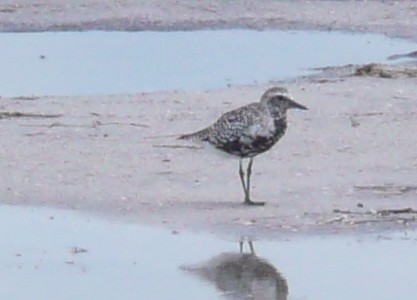
Black-Bellied Plover at Bunche Beach - 4/30
Note the dark feathers of the axillaries (under the wing) This a good way to differenceate the Black-Bellied Plovers, common here and American Golden-Plovers, which are not commonly seen in Southwest Florida. Both of these plovers can be very difficult to diferenceate while in Basic molt.

My April List (139) -
  1. Black-bellied Whistling-Duck
  2. Wood Duck
  3. Mottled Duck
  4. Blue-winged Teal
  5. Lesser Scaup
  6. Ruddy Duck
  7. Wild Turkey
  8. Pied-billed Grebe
  9. American White Pelican
  10. Brown Pelican
  11. Double-crested Cormorant
  12. Anhinga
  13. Magnificent Frigatebird
  14. Great Blue Heron
  15. Great Egret
  16. Snowy Egret
  17. Little Blue Heron
  18. Tricolored Heron
  19. Reddish Egret
  20. Cattle Egret
  21. Green Heron
  22. Yellow-crowned Night-Heron
  23. Black Vulture
  24. Turkey Vulture
  25. Osprey
  26. Swallow-Tailed Kite
  27. Snail Kite
  28. Bald eagle
  29. Red-Shouldered Hawk
  30. Short-Tailed Hawk
  31. Crested Caracara
  32. American Kestrel
  33. Peregrine Falcon
  34. Common Moorhen
  35. American Coot
  36. Limpkin
  37. Sandhill Crane
  38. Black-Bellied Plover
  39. Wilson’s Plover
  40. Semipalmated Plover
  41. Piping Plover
  42. Killdeer
  43. American Oystercatcher
  44. Black-necked Stilt
  45. Spotted Sandpiper
  46. Greater Yellowlegs
  47. Willet
  48. Lesser Yellowlegs
  49. Long-billed Curlew
  50. Ruddy Turnstone
  51. Red Knot
  52. Sanderling
  53. Least Sandpiper
  54. Dunlin
  55. Short-billed Dowitcher
  56. Laughing Gull
  57. Ring-billed Gull
  58. Herring Gull
  59. Least Tern
  60. Common tern
  61. Forster’s tern
  62. Royal tern
  63. Sandwich tern
  64. Black Skimmer
  65. White Ibis
  66. Glossy Ibis
  67. Roseate Spoonbill
  68. Wood Stork
  69. Rock Pigeon
  70. Eurasian Collared-Dove
  71. White-winged Dove
  72. Mourning Dove
  73. Common Ground-Dove
  74. Black-hooded Parakeet
  75. Eastern Screech Owl
  76. Great Horned Owl
  77. Burrowing Owl
  78. Barred Owl
  79. Common Nighthawk
  80. Chimney Swift
  81. Belted Kingfisher
  82. Red-headed Woodpecker
  83. Red-bellied Woodpecker
  84. Red-cockaded Woodpecker
  85. Pileated Woodpecker
  86. Eastern Wood-Pewee
  87. Great Crested Flycatcher
  88. Eastern Kingbird
  89. Loggerhead Shrike
  90. White-eyed Vireo
  91. Blue-headed Vireo
  92. Red-eyed Vireo
  93. Blue Jay
  94. American Crow
  95. Fish Crow
  96. Purple Martin
  97. Barn Swallow
  98. Tufted Titmouse
  99. Brown-headed Nuthatch
  100. Carolina Wren
  101. Ruby-crowned Kinglet
  102. Blue-gray Gnatcatcher
  103. Gray Catbird
  104. Northern Mockingbird
  105. European Starling
  106. Cedar Waxwing
  107. Northern Parula
  108. Yellow Warbler
  109. Chestnut-sided Warbler
  110. Black-throated Blue Warbler
  111. Black-throated Green Warbler
  112. Blackburnian Warbler
  113. Yellow-throated Warbler
  114. Pine Warbler
  115. Prairie Warbler
  116. Palm Warbler
  117. Black-and-white Warbler
  118. American Redstart
  119. Prothonotary Warbler
  120. Worm-eating Warbler
  121. Northern Waterthrush
  122. Common Yellowthroat
  123. Hooded Warbler
  124. Summer Tanager
  125. Scarlet Tanager
  126. Eastern Towhee
  127. Bachman's Sparrow
  128. Savannah Sparrow
  129. Northern Cardinal
  130. Rose-breasted Grosbeak
  131. Blue Grosbeak
  132. Indigo Bunting
  133. Painted Bunting
  134. Red-winged Blackbird
  135. Eastern Meadowlark
  136. Common Grackle
  137. Brown-headed Cowbird
  138. American Goldfinch
  139. House Sparrow

Monday, April 26, 2010

Blackburian Warbler - Ft DeSoto Park

Ft DeSoto Park
Monday April 26th

  Following this morning thundershowers my daughters and I headed to Ft DeSoto Park hoping for some increase in migrant activity. These kind of storm fronts can bring down migrating birds needing to find safe haven and DeSoto may have been impacted. The word was that the park has been slow on migrant activity most of the month, but we did find a good variety with this weather event.  No fall-out but a good day for birding.

Sky Bridge


Did not get on scene till 12:30 pm, with the first stop at the East Beach turn-around.  A good variety of shorebirds were around including Common Terns, Royal Terns, Sandwich Terns, Least Terns, Willets, Short-Billed Dowitchers, Dunlins, Black-Bellied Plovers, Semipalmated Plovers, Sanderlings, Laughing Gulls, Brown Pelicans, Barn Swallows, Ruddy Turnstune and a lone Least sandpiper.

Black-Bellied Plover


Sanderling


Short-Billed Dowitcher
Dunlin
  We headed then to the East Beach Woods which was fairly busy with migrants and birders. We quickly found Black-and-White Warblers, a beautiful male Chestnut-Sided Warbler and a female American Redstart. Several Rose-Brested Grosbeaks were busy at a small mulberry tree and several Summer Tanagers, a Scarlet Tanger and Blue-Headed Vireo present as well. Several birders came in off the Privet Trail telling about ovenbirds, kentucky warbler and a bay-brested warbler that were seen.  Also several people were commenting on a reported warbling vireo and a blue-wing warbler. Dipped on all of these.

  
Summer Tanager
   Katie and I entered the Privet Trail, were Katie immediately spotted a beautiful male Indigo Bunting. we also found more Summer Tanagers and a Northern Waterthrush exploring water puddles. Several small brown birds were a bit difficult to id, but I believe that they are female Indigo Buntings.                 
Female Indigo Buntings
  We moved onto the Mulberry Grove were only a Gray Catbird was seen, however another birder put me onto a beautiful male Black-Throated Green Warbler and a pair of Yellow warblers in a live oak inside the ranger resident's yard. As we were watching, a male Blackburian Warbler joined in with the other warblers in the tree. As I have never seen a blackburian warbler before I had a LIFER.  

Great Horned Owl
Next Katie and I checked out the nesting Great Honed Owl at the North Beach Woods.  The parent owl gave great views and the owlet could be seen but it did not stand up.
  Before heading for home we rechecked the East Beach Woods. Ran into three members of the Caloosa Bird Club, whom I had gone on a birding trip back on March first. They had a great list for the day including the blue-winged wabler and swainsen's warbler. We reentered the Privet Trail with very little to add, but several Eastern Kingbirds and what I believe is an Eastern Wood Pewee. There was some questioning that the bird was a willow flycatcher.  As we were exiting, another birder told us about locating the blue-winged, a bay-brested warbler and a  pale, female cerulean warbler, just around on the adjacent trail. Too tempting. We set out, but I had to get back to car before the search was ended. So I said fairwell and we headed for home.  I am cureous if the bird club folks located the cerulean.
  On trip up to the park we had spotted a Roseate Spoonbill, Magnificent Frigatebird and a couple of Swallow-Tailed Kites. Some hoped for birds we can add to the dip-list included any baltimore orioles, blackpoll warblers, cape may warblers, black-hooded parrots and gray kingbird.

My List (58) - Mottled Duck, Brown Pelican, Double-crested Cormorant, Magnificent Frigatebird, Great Blue Heron, Great Egret, Snowy Egret, Tricolored Heron, Yellow-crowned Night-Heron, White Ibis, Roseate Spoonbill, Osprey, Swallow-tailed Kite, Black-bellied Plover, Semipalmated Plover, Killdeer, Willet, Ruddy Turnstone, Sanderling, Least Sandpiper, Dunlin, Short-billed Dowitcher, Laughing Gull, Least Tern, Common Tern, Royal Tern, Sandwich Tern, Black Skimmer, Rock Pigeon, Mourning Dove, Common Ground-Dove, Great Horned Owl, Eastern Wood-Pewee, Eastern Kingbird, Loggerhead Shrike, Blue-headed Vireo, Blue Jay, Fish Crow, Barn Swallow, Gray Catbird, Northern Mockingbird, European Starling, Yellow Warbler, Chestnut-sided Warbler, Black-throated Green Warbler, Blackburnian Warbler, Palm Warbler, Black-and-white Warbler, American Redstart, Northern Waterthrush, Summer Tanager, Scarlet Tanager, Northern Cardinal, Rose-breasted Grosbeak, Indigo Bunting, Red-winged Blackbird, Boat-tailed Grackle, Brown-headed Cowbird


Sunday, April 25, 2010

Scarlet Kingsnake

Snakes
April 25th


With the weather finally warming up, the reptiles and amphibians are becoming active. The gators are moving around as they are entering breeding season and looking for food as well as mates. They often do not eat at all during the cold months. Snakes, lizards, toads and frogs are now showing up. Found this scarlet kingsnakes on the road to work last night. A beautiful animal.


On a more negative note my daughter Melissa's future in-laws lost a one of their dogs  a week ago to a cottonmouth bite.  It was struck twice on the face and the vet could not save her.  These snakes are very aggressive and dangerous.

We have also seen several Black Racers lately, some with spring-fever.  Like this pair we located at Ding Darling on Sanibel Island a couple of weeks.  The photo is by my daughter Katie


This Eastern Diamondback Rattlesnake was sunning itself at the entrance to Blair House at Corkscrew Swamp Sanctuary back in December. Note how well it camouflages into the landscape. Even in the enlargement it is difficult to see it well.

Another snake photographed at Corkscrew Swamp was this Florida Ribbon Snake.


My nephew John, a post-grad student in Biology at Texas Tech took these next two photos of rattlesnakes while on a research trip to New Mexico last year. Photos borrowed from his facebook page.

A Western Diamondback

A Prairie Rattlesnake.

At a recent visit to Six-Mile Cypress Slough, Katie took these photos of anole lizards.
A Green Anole. A native lizard that is disappearing and being replaced by the invading Brown Cuban Anole.

Brown Cuban Anole.

Friday, April 23, 2010

Wood Ducks

A Visit to Little Grassy Lake
Friday April 23rd

  The family headed over to my folks place on Little Grassy Lake in Highlands County, just south of Sebring. This was a last chance to visit before them before they head back to Illinois for the summer months. Our visits to their place often was rewarded with some great birds.  Like Sandhill Cranes, Great Egreats and White Ibis.  Their neighbor keeps a purple martin house which unfortunately is also home to nesting house sparrows, but Purple Martins are nesting. Also nesting is a pair of wood ducks with 20+ eggs in a wood duck box attached to their boat house. White-winged Doves, House Sparrows, Blue Jays and grackles were present all afternoon.
  I will get to see them again very soon as a family wedding is scheduled in the Chicago area in about three weeks, which is a great excuse for a few vacation days next month. Some birding is scheduled up there with  grassland birds like upland sandpiper, boblinks, dickcissels and henslow's sparrows of interest. Other species of interest include various warblers, swans, yellowheaded blackbirds and black terns.

Noisy House Sparrow

The Purple Martin abode

White-Wing Dove

A family of Sandhill Cranes is usually active in the neighborhood
Wood Duck box
Twenty plus wood duck eggs
"Sir Dudley"

Thursday, April 22, 2010

Red-Eyed Vireo - Corkscrew Swamp Sanctuary

Corkscrew Swamp Sanctuary
Tuesday April 20th

  After taking care of some business I headed over to Corkscrew Swamp Sanctuary in Collier County to see if there was any interesting warbler activity. Could not get there till 10:30 am and found the number of visitors to be way down since my last visit. Reason being that so many snowbirds have already headed back north.
  At the butterfly garden, at the entrance to Blair House, I was informed that I had just missed a hummingbird. After a short wait, I can always try again when later, on the hummer I went inside to pay. Here I was rewarded with a male painted bunting at the feeders behind the building. Grackles and Red-bellied Woodpeckers soon took over and ran it off.  Waited at the feeder for a reappearance of the pair of Shiny Cowbirds, that I had just missed. Pushed on,  as I could try again on my way out, for the cowbirds.
   At the feeders I met up with Jeff, an ex-patriot Brit and snow-birder from New Jersey, whom I had walked with on a prior visit. Later on we were joined by a lady from Michigan, who had just flown-in to search for property in Cape Coral (residential property here are at fire sale values with the collapse of the local housing market). She was a very experienced birder and had plans to attend a birding festival at the migrant trap at McGee Marsh in Ohio in a couple of weeks.

Gray Catbirds were very abundant


 We found the water level to be very high today, so few waders were to be expected.  Had hoped for some nightherons, but only a sole Little Blue Heron and a sole Great Egret were seen. Noisy and soaring Red-Shouldered Hawks were very evident as were calling Gray Catbirds, White-eyed Vireos and Carolina Wrens.  A scope was set up at a Blue Gray Gnatcatchers nest for visitors to use and where we were able watch the gnatcatcher harrass a Red-Bellied Woodpecker that was much to close for the vigilant gnatcatcher. A couple of Great Crested Flycatchers were seen and heard. As for the warblers they were found high up in the canopy of these ancient cypress trees.  Heard several Northern Parulas and actually could only locate a beautiful singing male as the emerging foliage did make the birding more challenging. One warbler we found as Black-throated Green Warbler.  We were able to add a Black-and White Warbler and a calling Pine Warbler. A suspected tennessee warbler, only seen from directly below, I am now convinced was the similarly looking Red-Eyed Vireo. Several FOY Chimney Swifts were seen and heard. It was a good day with a few interesting birds, but not a great variety of warblers. One very interesting observation was a white-tailed fawn and doe grazing right next to the boardwalk.  They were very tolerant of the walkers. Left at 2PM without the shiny cowbirds or hummer, but was satisfied with an enjoyable walk in great weather. Won't be long till the daily 90+ degree temps, high humidity and afternoon showers reappear.
 
The Fawn


The Doe


My List - Great Egret, Little Blue Heron, Black Vulture, Turkey Vulture, Red-shouldered Hawk, Chimney Swift, Red-bellied Woodpecker, Pileated Woodpecker, Great Crested Flycatcher, White-eyed Vireo, Red-eyed Vireo, Carolina Wren, Tufted Titmouse, Blue-gray Gnatcatcher, Gray Catbird, Northern Parula, Black-throated Green Warbler, Pine Warbler, Black-and-white Warbler, Northern Cardinal, Painted Bunting, Boat-tailed Grackle