Thursday, March 21, 2013

Eurasian Wigeon

Thursday March 21st

Eurasian Wigeon found in Cape Coral
Photo by Dr Jose Padilla-Lopez


Photo by Bob Pelkey

Last month I had dipped on getting the Eurasian Wigeon wintering at Merrit Island and did not expect another shot till next Fall. Until I found where Vince McGrath had posted about a sighting of the species in Cape Coral. We only see a very few of the species in Florida and having one appear in our backyard was a very unusual occurrence. Can only speculate where he came from and what is he doing here. Seems Ruth Parks came across the bird yesterday and who knows how long it'll hand around.  So following Vince's directions I easily located the bird. It was sharing a small pond with some mallard hybrids and Mottled Ducks.


Photo by Bob Pelkey

My friends Dr Jose Padilla-Lopez and Bob Pelkey were able to photograph the wigeon a short time after my visit. Hope it sticks around a few days.

Saturday, March 9, 2013

Merritt Island NWR & Tampa Bay

Monday February 25th


North Florida Trip - Day 3


Northern Shoveler seen on Blackpoint Drive
Photo by Bob Pelkey

Bob Pelkey and I arrived at Merritt Island NWR about 8:15 and headed directly to the Blackpoint Drive. Here we were immediately greeted by a busy crowd of waders including Roseate Spoonbills and Wood Storks feeding behind the pay station. (MINWR is no longer a free venue). The first few stops were active with Lesser and Greater Yellowlegs, more waders including Reddish Egrets. Noted a few Hooded Mergansers as well.
 
As Bob concentrated on his birding photography, I took the time to walk the road toward stop #3, which is were a cinnamon teal has been wintering. I dipped on the cinnamon teal but was able to observe a Sora, plus diving Forster's Terns, Northern Shovelers, Lesser Scaups, at least one Greater Scaup, Reddish Egret, a few Blue-winged Teal and American Coots.
Lesser Scaup in Flight along the Blackpoint Drive
Photo by Bob Pelkey
 
The stops were peeps and shore birds were expected only offered  more yellowlegs. Did have a hand full of gulls and terns though. Caspian, Forster's and Royal Terns plus Laughing and Ring-billed Gulls and a lone Black Skimmer
 
Stop #7 is the place for waterfowl. Most of the ducks were in the distance and the lighting was terrible. Mostly had Lesser Scaups and Coots. American Wigeons could be spotted as well. However it was very impossible to try to discern any eurasian wigeons in the poor light.

A refuge employee put us onto the Peacock Pocket Road, so we headed there next. Here we finally a large concentration of American Avocets, plus Long-billed Dowitchers, Black-bellied Plovers, lots of Coots, Blue-winged Teal, Northern Shovelers, Lesser Scaups, a few Green-winged Teal and a lone Northern Pintail. We again dipped on another cinnamon teal often seen here.
Northern Pintail, Lesser Scaup and Blue-winged Teal along the Peacock Pocket Road
Photo by Bob Pelkey
 
I talked Bob into making a run along Bio Lab Road as he was anxious to move on to the Tamps Bay Sunshine Skyline Bridge to search for the Black-legged Kittiwake wintering at the fishing pier. So after a pit stop at the refuge headquarters, were a beautiful male Painted Bunting entertained the visitors at the feeders, we headed over to Bio Lab Road.

Bio Lab was kind of dissapppointing. We did find several shore birds including Spotted Sandpiper, Semipalmated Plover, Short-billed Dowitchers, Dunlins, Willets, soaring American White Pelicans and swimming Red-breasted Mergansers. On another fresh-water pond we added more Hooded Mergansers.

From here we made the drive across the state back to the Gulf of Mexico to seek the Kittewake. Our stop was at the South Fishing Pier of the Sunshine Skyway Bridge. We arrived with about an hour of sun light left for the day and actually thought we had missed our target. So as we were heading back to the car the Black-legged Kittewake was finally spotted. It spent most of the time we were there resting on the closed off section of the old bridge. So Bob got his shots.  When my daughter and I visited here earlier in February, Common Loons were everywhere and I I had a very unsatisfying look at what could have been a razorbill. So no razorbill today, but I managed to spot a group of five loons swimming toward the new bridge. Other birds using the fishing pier included Browm Pelicans, Snowy and Great Egrets, Ruddy Turnstones, lots of Rock Pigeons, Royal, Sandwich and Foster's Terns, Herring, Ring-billed and Laughing Gulls.

As the sun set we headed back to Ft Myers to end our three day road trip. It was a very good trip. Bob landed a lot of Lifers and took a few thousand pics. We did dip in virtually ever speciality I had targeted, but that just makes it necessary to plan a return to the panhandle next year.


Trip List (126) -
Black-bellied Whistling-Duck, Gadwall, American Wigeon, Mottled Duck, Blue-winged Teal, Northern Shoveler, Northern Pintail, Green-winged Teal, Canvasback, Redhead, Ring-necked Duck, Greater Scaup, Lesser Scaup, Black Scoter, Bufflehead,  Hooded Merganser, Red-breasted Merganser, Ruddy Duck, Common Loon, Pied-billed Grebe, Horned Grebe, Wood Stork, Double-crested Cormorant, Anhinga, American White Pelican, Brown Pelican, American Bittern, Great Blue Heron, Great Egret, Snowy Egret, Little Blue Heron, Tricolored Heron, Reddish Egret, Cattle Egret, Green Heron, White Ibis, Glossy Ibis, Roseate Spoonbill, Black Vulture, Turkey Vulture, Osprey, Northern Harrier, Cooper's Hawk, Bald Eagle, Red-shouldered Hawk, Red-tailed Hawk, Clapper Rail, Virginia Rail, Sora, Common Gallinule, American Coot, Sandhill Crane, Black-bellied Plover, Semipalmated Plover, Killdeer, American Avocet, Spotted Sandpiper, Greater Yellowlegs, Willet, Lesser Yellowlegs, Ruddy Turnstone, Sanderling, Western Sandpiper, Least Sandpiper, Dunlin, Short-billed Dowitcher, Long-billed  Dowitcher, Black-legged Kittiwake, Bonaparte's Gull, Laughing Gull, Ring-billed Gull, Herring Gull, Caspian Tern, Forster's Tern, Royal Tern, Sandwich Tern, Black Skimmer, Rock Pigeon, Mourning Dove, Common Ground-Dove, Belted Kingfisher, Red-bellied Woodpecker, Yellow-bellied Sapsucker, Downy Woodpecker, Pileated Woodpecker, American Kestrel, Eastern Phoebe, Loggerhead Shrike, White-eyed Vireo, Blue-headed Vireo, Blue Jay, American Crow, Fish Crow, Purple Martin, Tree Swallow, Carolina Chickadee, Tufted Titmouse, Brown-headed Nuthatch, House Wren, Sedge Wren, Carolina Wren, Blue-gray Gnatcatcher, Ruby-crowned Kinglet, Eastern Bluebird, American Robin, Gray Catbird, Northern Mockingbird, Common Yellowthroat, Palm Warbler, Yellow-rumped Warbler, Yellow-throated Warbler, Prairie Warbler, Eastern Towhee, Chipping Sparrow, Savannah Sparrow, Song Sparrow, Swamp Sparrow, White-throated Sparrow, White-crowned Sparrow, Northern Cardinal, Painted Bunting, Red-winged Blackbird, Common Grackle, Boat-tailed Grackle and American Goldfinch

Friday, March 1, 2013

St Marks NWR


Sunday February 24th

Day 2 - North Florida Bird Trip


St Marks Lighthouse
Photo By Bob Pelkey

It was a bit disappointing to hear from the fella we ran into at the pay station at St Marks NWR. Apparently we arrived a bit too late in the season. Our new friend from Georgia advised that  the birds were already thinning out.  Bob Pelkey and I will  just have to see for ourselves.

Song Sparrow seen at Lighthouse
Photo by Bob Pelkey

We began exploring the forest around the visitor center and had four woodpecker species in five minutes. Along with the Yellow-bellied Sapsucker, Pileated Woodpecker, Downy Woodpecker and Red-bellied Woodpecker we had Tufted Titmouse, Carolina Chickadee, Ruby-crowned Kinglet, Brown-headed Nuthatch, Northern Cardinal, Eastern Towhee, House Wren, Carolina Wren, American Robins, Yellow-throated Warbler, Eastern Phoebe and Tree Swallows.  


Our scheduled visit at Florida Caverns State Park being dropped due to bad weather was disappointing as I had hoped on seeing brown creeper, golden-crowned kinglet, winter wren and rusty blackbird.  These guys can be seen here at St Marks and we did look for them. But will have to return another time.


Eastern Towhees were plentiful
 Photo by Bob Pelkey

As birdy as our first stop was, they were mostly in the canopy making it difficult for Bob's photography so we moved on. We were able to find a few sparrows - Swamp, Song and Savannah Sparrows, Eastern Towhees, Eastern Bluebirds and the usual waders that would pose for us.


The impoundments were virtually waterfowl free.  In deed the ducks were gone. Had a flock of American White Pelicans and a couple of Lesser Scaup. Our friend Vince McGrath recommended looking for white-faced ibis at Stoney Bayou. Stoney Bayou was empty. No ibis of any kind.  The most numerous bird were Yellow-rumped Warbler, which were found everywhere in the refuge. Did have rail pop-up,  think it was a Virginia Rail.


American Bittern at Headquarters Pond
Photo by Bob Pelkey

Finally at Headquarters Pond we had some activity. Pied-billed Grebes, American Coots, Common Gallinule, a Greater Scaup, Lesser Scaup, Redhead, Great Blue Herons, Great Egrets and other waders. Bob was busy photographing a couple of Sora feeding to the right of the observation deck and an American Bittern  on the left. Lots of Yellow-rumped Warblers here plus a Brown-headed Nuthatch, Eastern Towhee and Tufted Titmice.


Finally reached the lighthouse about noon. Lots of Buffleheads in the surf, plus Red-breasted Merganser, Horned Grebe and Common Loon. Tried searching for any scoters or goldeneye in the surf. May of had some present, but needed a spotting scope. The Lighthouse Ponds were productive. Had a lot of Lesser Scaup here. Several Ruddy Ducks were present, a couple of Canvasbacks, at least one Ring-billed Duck and a lone Gadwall. Clapper Rail could be heard in the salt marsh. Searched the salt grass for any sharptail or seaside sparrow, did find Savannah and Song Sparrows instead.
Canvasback at Lighthouse Pond
Photo by Bob Pelkey


From here we retreated from the refuge ahead of the rain and headed to the Atlantic coast and Merritt Island NWR.


Thursday, February 28, 2013

North Florida Birding Trip

Saturday February 23rd
Day One
Bob Pelkey picked me up about three in the morning as we started a three birding trip up to the Florida Panhandle. I've wanted to bird the area for a long time, but logistics had not worked-out till Bob asked if I was interested in visiting St Marks. We expected to visit St Marks, Florida Caverns State Park and Apalachicola National Forest. January and February are the months to visit to search for wintering birds. Winter wrens, golden-crowned kinglets, brown creepers, horned lark, sprague's pipits American black duck snow geese white-faced ibis and rusty blackbirds are some of the wintering species targeted. We also have to leave south Florida to see most of the wintering sparrow species.
White-crowned Sparrow at LaChua Trail
Photo by Bob Pelkey
 
Our first stop was soon after dawn was in Gainesville. We visited the LaChua Trail in Payne's Prairie and a section of the nearby Gainesville-Hawthorne Trail. A flock of American Goldfinches greeted us as we entered the G-H Trail. We had targeted the Fox Sparrow which has been seen here lately. No doubt it was the same bird that wintered here last year. It wasn't present on our visit, but we did add Chipping Sparrow, Tufted Titmouse, Blue-headed Vireo, House Wren, Carolina Chickadee, Ruby-crowned Kinglet and Pileated Woodpecker.
 
We moved onto the LaChua Trail were we targeted sparrows and the reported Grove-billed Ani. In previous visits I had added Harris's Sparrow,Whooping Crane and Snow Geese. This year we a good looks at White-crowned Sparrow, White-throated Sparrow, Sora, American Kestrel, Blue-winged Teal, Green-winged Teal, Mottled Duck, Pied-billed Grebe, Anhinga, Sandhill Cranes, American White Pelicans, Northern Harrier, Red-shouldered Hawk, House Wren, Sedge Wren, Glossy Ibis, White Ibis, American Coots, Common Gallinule, American and Fish Crows, American Bitterns, Bald Eagle, Lesser Yellowlegs, Yellow-rumped and Palm Warblers. Many very large gators were present but we missed the ani. Even though it had been seen earlier.
 
By early afternoon we had to leave as we still had several hours of traveling to reach St Marks tonight. The weather reports for the panhandle showed a lot of rain in our way for this trip. We hoped for the best Sunday.
 
With just a couple of hours left we made a stop at Bald Point State Park at Alligator Point, just west of St Marks. The weather was brisk, the tide was high, the water was choppy and fog obscured our vision out on the bay. Targets included sea ducks, loons and grebes.  Mostly wanted to see if any red-throated loons were present.
 
Sora found along the LaChua Trail
Photo by Bob Pelkey
Our stop at Sunrise Beach access only produced Willets and the parking lot was better. Here we added Eastern Towhee, American Goldfinch, a pair of FOS Purple Martins, Tufted Titmice, Gray Catbirds, Northern Mockingbirds Pine and Yellow-rumped Warblers. But we found the fishing dock area at the end of the road more fruitful. Here we had a lone Common Loon, Horned Grebe, Red-breasted Mergansers, Bufflehead, Black Scoter and Lesser Scaup. A pair of Bonaparte's Gulls made an appearance along the  usual gulls and terns.  A pair of Clapper Rails were heard in the salt grass and a large concentration of Dunlin, Short-billed Dowitchers, Sanderlings, Western Sandpipers and Ruddy Turnstones were gathered out of the wind. No red-throated loon.
 

We ended the day's birding here

Tuesday, February 26, 2013

Burrowing Owls


Pair of Burrowing Owls

Watchful Burrowing Owl at Festival Park in Cape Coral


This past weekend the City of Cape Coral conducted there popular  Burrowing Owl Festival. The Burrowing Owl is city's official bird and the citizens are dedicated to supporting these birds of prey. It is estimated that a thousand pairs of owls nest in Cape Coral and their burrows are closely monitored. Good locations to see the owls are at the ball fields at Pelican Boulevard, which also host a colony of Monk Parakeets and at the Cape Coral Public Library. They can be found throughout the city as well as other locations in within Lee County. I had following a moving colony near Alico Road in San Carlos Park over several years till this season. Seems they have relocated their digs.


To learn more about the Burrowing Owls please visit - http://www.ccfriendsofwildlife.org/


Pair of Owls at Cape Coral Library


Wednesday, February 13, 2013

Surprising Find at Bunche Beach

Wednesday, February 13th

Mangrove Cuckoo at Bunche Beach, Lee County
Photo by Ruth Parks - February 9th
The Mangrove Cuckoo is a coveted species to locate in South Florida and is just now becoming a species of interest by researchers. Much needs to be learned on behavior, breeding, seasonal migrations etc. on this species. There recent presence in the mangroves at Bunche Beach Preserve, in Lee County this winter has been a pleasant surprise. Usually we find the birds locally, that being Ding Darling WMR on Sanibel Island when vocalization begins in May. There has been an assumption that we only see them here through Spring and Summer, before they return to the Caribbean. Hopefully this pair of birds will stick around.

The photo was taken by Ruth Parks, whose party was able to see and hear two cuckoos. I have been there twice this week to look for it, but only heard a brief croaking at the spot where a party of birders, visiting from Minnesota, had just seen one. These birders were having a successful Florida birding trip with finding Nandays in Ft Myers and LaSarge Flycatcher and Western Spinellis in Miami. 

Please note that recordings are discouraged to avoid stressing these birds. It is tempting and I have witnessed their use at Bunche, but the calls could drive them out of the area.

Bunche Beach  is a great location for birding for shorebirds and is an important rest stop for migrants.

Wilson's Plover

Reddish Egret


Piping Plover


Long-billed Curlew

Saturday, February 9, 2013

A Weekend of Twitching.

Saturday February 9th

Come each winter we get a handfull of a few interesting birds that stop here instead of their normal wintering grounds. We have a lone Says Phoebe that has wintered in the same pasture in Astutle, in central Florida for the past six seasons. We'll get a scattering of Vermilion Flycatchers, Scissor-tailed Flycatchers and Western Kingbirds around the state. A few Swanson's Hawks too. A pair of Caisson's Kingbirds, a Tropical Kingbird and a lone Gray Kingbird are wintering at STA5, south of Clewiston. And near Homestead we have we have a Lesser Nighthawks, Brown-crested Flycatcher, Ash-throated Flycatcher, a few Least Flycatchers, Tropical Kingbird, Western Kingbirds and Vermilion Kingbirds. On Friday I headed out on to Lucky Hammock to search for them.

But on Thursday my daughter and I did twitch after a pair of Black-legged Kittiwakes in Tampa Bay.  These are very rare in our state and being so close to ft Myers we had to take shot at finding them ourselves. I started the day with birding at Six-Mile Cypress Preserve with the idea of locating a Red-crowned Kinglet or a Black-throated Green Warbler. I did locate the warbler and lots of Palm Warblers and Yellow-rumped Warblers, a couple of nice Pileated Woodpeckers, a Blue-headed Vireo and the other usual suspects.

After my daughter had wrapped up her work at the Humane Society we headed up to The Skyline Bridge at Tampa Bay, were the Kittiwakes have seen found at the north end of the South Fishing Pier. Upon our arrival a couple of photographs put us onto one of the Black-legged Kittiwakes, LIFER!!. Common Loons were numerous as well as Laughing Gulls, Ruddy Turnstones, Brown Pelicans, plus Ring-billed Gulls, Herring Gulls, Cormorants, Snowy Egrets and Rock Pigeons. 

Afterwards we crossed the bridge and checked the ponds at Terra Verdi were we added Redheads (not as many as I had expected), Northern Shovelers, a few Lesser Scaups,  Ring-necked Ducks, American Coots, Common Gallinule and a female Canvasback, a female Ruddy Duck and a lone Red-breasted Merganser.
On our way home we stopped at the Celery Fields just before dark. Here we added an American Bittern, a pair of Black-crowned Nigh-herons, Blue-wing Teal, Common Gallinule, tons of Starlings. Had hoped for a sora or king rail, but we did see the Barn Owl as it left its roost at dusk. 

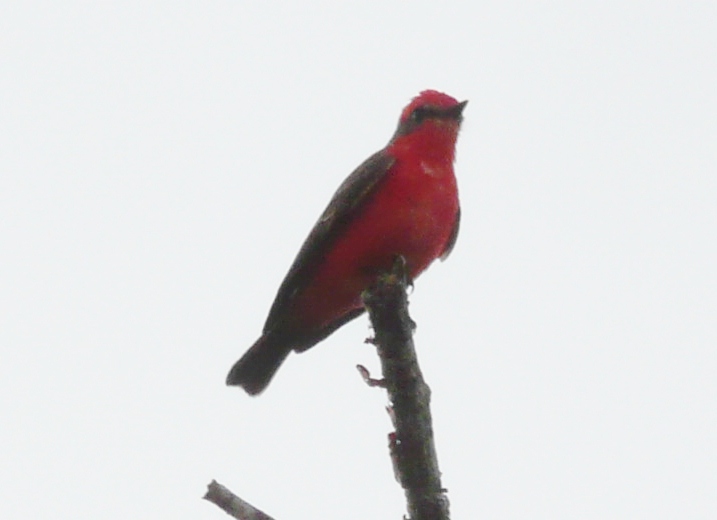
Vermilion Flycatcher - photo by Bob Pelkey
Friday morning I was on the road by four in the morning with the idea of arriving at the Everglades National Park before sunrise with idea of finding Lesser Nighthawks and Eastern Whip-poor-wills.  Did arrive too late but did have some good birds at Lucky Hammock and The Annex. Here I did find lots of Gray Catbirds and Palm Warblers.  But I also added an Ash-throated Flycatcher, a vocal Brown-crested Flycatcher, a Least Flycatcher, a Brown Thrasher, Great Crested Flycatcher, Savannah Sparrow, Grasshopper Sparrow, Northern harrier, Northern Parula, House  Wrens, Eastern Meadowlarks, Common Yellowthroats,  and a White-eyed Vireo. 
 Before I moved on from The Annex I met a couple of fellas heading into the brush in search of Burmese Pythons as a part of the current Python Roundup sponsored by National Park Service. They were quite colorful and offered interesting stories on their captures including photos. They claim to have already caught several including a huge 12 foot female, which is destined to be used as a Judas snake.

At nearby C-111 canal, I added a beautiful male Vermilion Flycatcher, a pair of Western Kingbirds, a Tropical Kingbird and a Cave Swallow hanging with a flock of Tree Swallows. The Brown-headed Cowbirds were scanned carefully, trying to locate any Shiny Cowbirds roosting with them. No Shiny Cowbirds and other target species missed here included Short-tailed Hawk, White-tailed Kite, Swanson's Hawk 

Egyptian Geese
From here I checked out the Castellow Hammock park in Redlands were I got a pair of Ruby-throated Hummingbirds  a Rufus Hummingbird, White-winged Doves, Eurasian Collared Doves, and a female Painted Buntting

The Kendall Baptist Hospital campus is a popular spot to look for some of the more exotic species. Today I could only find a few Mitre Parakeets. Often find much large numbers and other parrot species as well. Was pretty quite today. I did see a family group of three Egyptian Geese that have taken up residence at the lake. Did spend some time investigating the neighborhood across from the hospital looking for Red-whiskered Bulbuls. After striking out here I decided it was time to head for home.

It was a good trip. Hope to return soon.
Mitre Parakeets