Thursday, February 27, 2020

Purple Thistle

Tuesday February 25th

Black Swallowtail Butterfly


Today was a visit to Babcock-Webb Wildlife Management Area in Charlotte County. It wasn't very birdy on this visit, but the flowering Purple Thistle were hosting numbers of butterflies and other insects. Black Swallowtails, Palmetto Skippers and Whirlabouts were very active on these flowers and would pose nicely for the camera. Other butterflies present included Gulf Fritillaries, White Peacocks and Zebra Swallowtails


Twin Spot Skipper

Whirlabout

Palmetto Skipper


Aside from the purple thistles other wildflowers today included Limewater Brookweed, Horned Bladderwort, Spanish Needles, Spanish Daisies, Cowpea, Axilflower, Wild Petunias, Daisy Fleabane, Marsh Fleabane, Southern Cattails, Pitted Stripeseed, Blackroot and Leavenworth's Tickseed
Palmetto Skipper

American Bumble Bee

White Peacock


Carolina Wild Petunia

Daisy Fleabane

Blackroot

White Waterlily

Pitted Stripeseed

Netted Pawpaw

Flooded Gum Trees

Peninsula Axelflower


Friday, February 7, 2020

What Kind of Crow is This?

Friday February 7th


House Crow x Fish Crow hybrid seen at Lovers Key in December 2018


Had posted this photo on iNaturalist.com as an example of a Fish Crow.  The photo was taken December 14, 2018 at the Lovers Key State Park parking area next to New Pass, without taking a real go look at pic.  Fish Crows are the predominate crow species at the beach. I have, as well as other birders, been reporting on hearing an American crow calling in this area on occasions.  I now believe that the calls were coming from this bird.

House Crow seen at Nokomis Beach in May 2018


Reviewers had disagreed that this picture was of a Fish Crow just by the heavy bill.  There was some initial speculation that it was an exotic species, like a Cuban Crow.  But we've now decided that it is fact a hybrid of a House Crow and a Fish Crow. Based on the calls, the bill and faint gray coloration draping the back, neck and breast.

Fish Crow seen at Nokomis Beach May 2018

A very tiny population of House Crows have been living up at Nokomis Beach.  With speculation that they have been nesting with Fish Crows So a hybrid being seen and heard is a real possibility. 


Sunday, January 19, 2020

Hammond's Flycatcher

Sunday January 19th


Hammond's Flycatcher at Corkscrew Swamp Sanctuary 
Why is a Hammond Flycatcher hanging out at Lettuce Lake at Corkscrew Swamp Sanctuary?  It should be wintering in Mexico. It's a western bird. And its a lifer for me.  Lots of birders have twitched after this small bird, which can be cooperative by posing close by occasionally. 

Will staking out the Hammond's a nice variety of birds were seen busily feeding close by.  Tufted Titmice, Blue-headed Vireo, White-eyed Vireo, Black-and-White Warbler, a male Black-throated Green Warbler and Palm Warbles, Downy Woodpeckers, a raccoon, gators and a basking Banded Water Snake. 

Ovenbird
At the Bunting House feeder we had a male Painted Bunting, an Ovenbird, Mourning Doves, Catbirds, a Red-shouldered Hawk and an unexpected female Rose-breasted Grosbeak. Other sightings included a Purple Gallinule, Brown-headed Cowbird, Yellow-bellied Sapsuckers, Carolina Wrens, Black-crowned Night-heron, American Redstarts and Common Yellowthroats.


Northern Cardinal 
Painted Bunting

Banded Water Snake

Tufted Titmouse

A Wild Orchid

A wild Orchid high up in a tree near the Lettuce Lake

Wild Turkeys are often seen feeding on the property adjacent
 to the Sanctuary's parking area

Several White-tail Deer were also feeding in the same yard as the Turkeys


Friday, January 17, 2020

Lake Apopka

Friday January 17th


Heading home today from the Panhandle. Did make a side trip to Lake Apopka to check out the North Shore Wildlife Drive. Had visited last month and had some good sightings like the Ash-throated flycatcher.

Ring-necked duck and American Coot

But today, a great many people have also arrived to enjoy the day, the birds and photography.  Its much more crowded  on the drive than last month. The first the first mile or so was very busy.

At one point I stopped and asked some ladies what they were doing with a Muscovy Duck. Muscovy ducks are not commonly seen here and the ladies were concerned that the bird was a lost pet.  Especially as was kept approaching. No doubt it was used to being feed. They were trying to capture the it because they believed that it wasn't going to survive in the wild. My advise was to leave it alone.  It'll be alright.  Don't know what became of the situation after I left.

Fulvous Whistling Duck

American Coot

Lots of ducks today, but like at St Marks, the counts seemed lower. Fulvous Whistling Ducks, Blue-winged Teal, Ring-necked Ducks, Lesser Scaup and a Northern Shoveler.  Lots of American Coots, Pied-billed Coots, Anhingas, Common Gallinules, Cormorants, White & Glossy Ibis and the expected waders.  Ospreys, Northern Harriers, Red-shouldered Hawks and a Peregrine Falcon too.

Made a short visit. Still had three hours of driving to get home and the crowds were annoying.

Blue-winged Teal

Best Look I had of this Northern Shoveler

Pied-billed Grebe

Ring-necked Duck

Common Gallinule

gator


Thursday, January 16, 2020

Lake Jackson - Tallahassee

Thursday January 16th


Made a couple of visits to the Lake Jackson Mounds Archaeological State Park and the near by Crowder Road Landing at Lake Jackson in Tallahassee.

I came to bird at the state park and was also interested in the history of the mounds.  The Mounds  goes back over thousand years ago and was believed to be a important capital for the indigenous people of the day.

More history is presented on The Butler Miller Trail, which leads to the remnants of a Pre-civil War era grist mill. The mill was once part of Colonel Robert Butler's large plantation.

Red-shouldered Hawk at Lake Jackson
The geography around Tallahassee, called The Red Hills, can be considered the southern terminus of the Appalachian Mountain range. Which also features flora commonly seen in the southern Appalachians of Georgia, such as trilliums and violets. This is also the usual southern range for some wintering birds such as Winter Wrens and White-breasted Nuthatches, that favored this bio-system. I was successful in locating both species. Plus Carolina Chickadees, Barred Owl, and Pileated Woodpecker.


Canada Geese are year round residents in Tallahassee

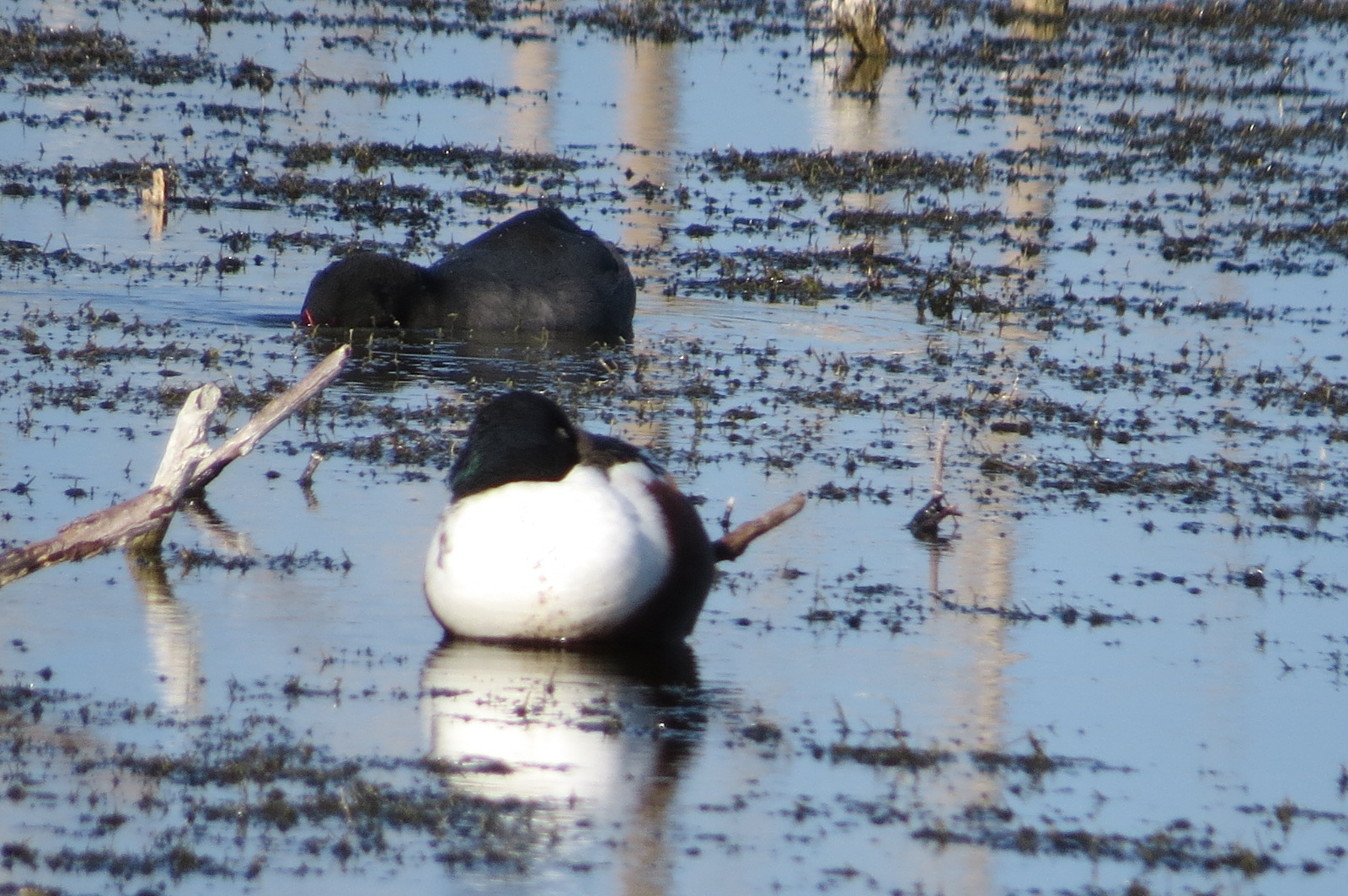
On Lake Jackson, hundreds of American Coots are seen, as well as a large number of Ruddy Ducks, some Buffleheads and a couple of Bonaparte's Gulls.


Possumhaw


Yaupon

Ruddy Ducks and a Coot on Lake Jackson

Underwood's Trillium


Pink Wood-Sorrel

Violet